The health supplement market in 2026: online trends and gray-market risk
Korea's health supplement market, the Coupang and Naver channels, how the gray market is spreading, and an AI-based brand protection strategy.
 Irene Lee4 min read
On this page6
- The supplement market in numbers: growth and buying trends
- Supplement buying trend 3: online channels are now entrenched, led by Coupang and Naver
- Key trends in the health supplement market in 2025
- Real cases: how the gray market spreads and why it’s hard to fight
- Practical strategies to protect supplement brands
- FAQ
The health supplement market is at a turning point. In 2025, Korea’s health functional food market was worth KRW 5.9626 trillion, and 83.6% of people had bought supplements, the highest rate in five years. In 2024, the government began allowing limited secondhand trading of supplements, and offline channels such as Daiso started selling them, bringing big changes to how supplements are sold. As sales channels diversify, so do IP and brand protection risks such as unauthorized sellers, counterfeits and breaches of official distribution, making legal and channel control more important than ever.
Middle-aged and older consumers are now buying online too. As home shopping, Coupang, Naver and other online platforms have become familiar to every generation, online buying is spreading across all age groups. With supplement purchases moving online, competition to win existing and new customers there is getting fiercer. And as platforms increasingly run on a direct-purchase model, brands need to rethink how they operate.
Why did the government relax its policy?
Why, in such a popular, high-growth market, did the government start allowing person-to-person sales in 2024? Under the Health Functional Foods Act, supplements may in principle only be sold by licensed businesses, and person-to-person sales had been banned. But as secondhand platforms grew rapidly and buying online became the norm, the government allowed limited person-to-person sales to widen consumer choice. (Source: Korea Policy Briefing)
Key takeaways
- In 2025, Korea’s health supplement market was worth about KRW 5.9626 trillion, with 83.6% of people having bought supplements, and online buying is spreading fast across all age groups.
- With online platforms such as Coupang and Naver Smart Store now the core channels for supplements, the direct-purchase model and the open-marketplace model each create different gray-market (unauthorized sales) risks.
- As new categories such as mental wellness, blood sugar management and new formats grow fast, opportunities for unauthorized sellers and counterfeits are growing too.
- Real cases are on the rise, from bulk buying on home shopping channels for resale to pharmacy-only products sold on Smart Store and counterfeits, and they lead directly to broken official distribution and lost consumer trust.
- A sophisticated channel monitoring system, with AI-based detection, price monitoring, seller network analysis and automated reporting, is the core of protecting supplement brands.
The supplement market in numbers: growth and buying trends

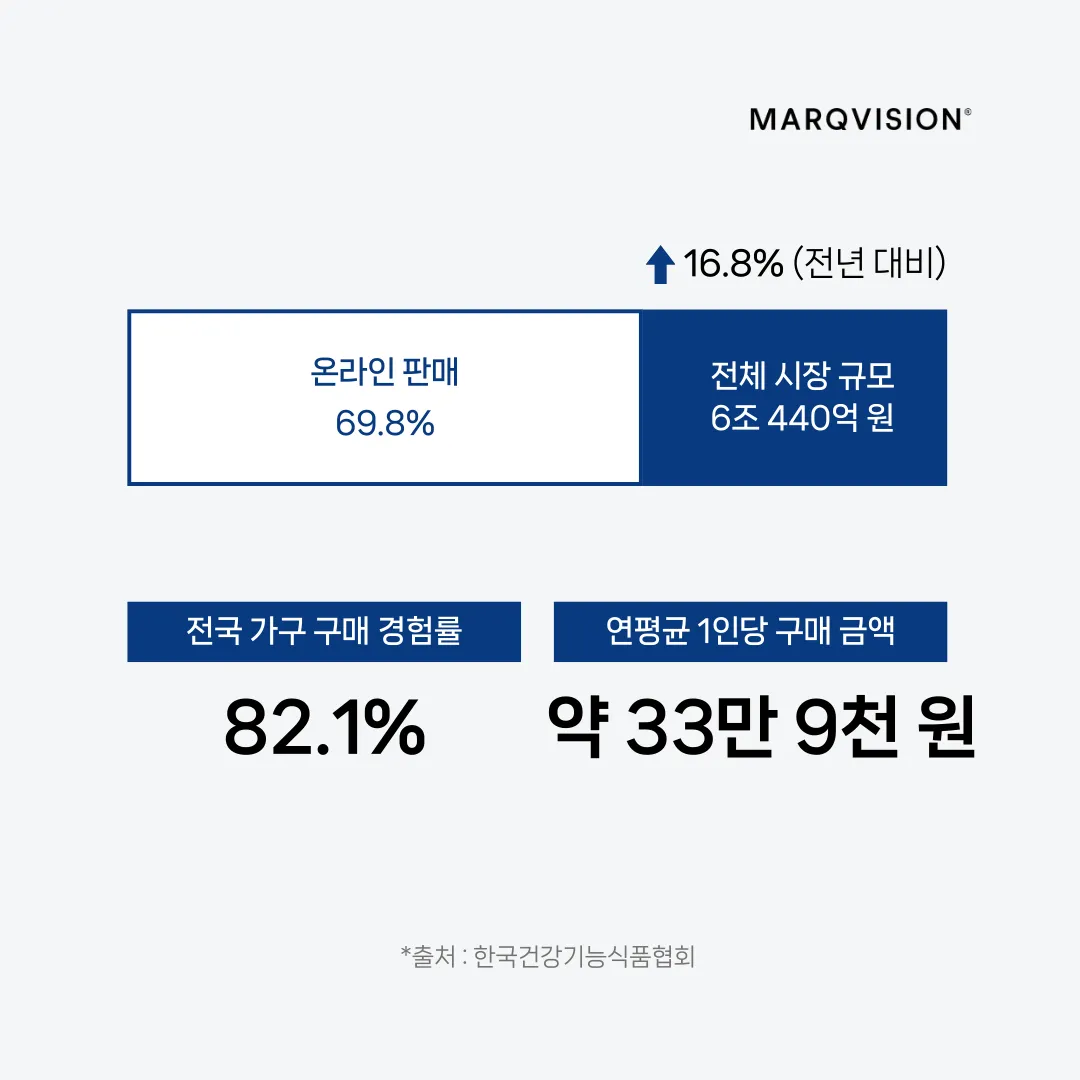
In 2025, Korea’s health supplement market was worth KRW 5.9626 trillion, a slight 0.2% recovery from the year before. That’s a little below the KRW 6.2 trillion of 2023, but the market has kept growing since 2020. The share of people who bought supplements in the past year reached 83.6%, the highest in five years, and the average annual spend per person is about KRW 339,000.
Interest in health keeps rising, and combined with an aging population, the supplement market is expected to keep growing for some time.
82.1% of 6,700 households nationwide have bought health supplements, and the number of buying households grows by an average of 400 a year (2019–2023 average, Korea Health Supplements Association). The average annual spend per person, about KRW 339,000, is slightly below the COVID-19 period, but as Korea becomes an aging society, interest in health keeps rising and long-term growth looks set to continue.
By product group, probiotics sold the most, with about 29.53 million purchases, followed by multivitamins at about 15.01 million. For probiotics in particular, 74.5% of purchases were made online, which underlines that optimizing online channels is central to brand growth.
Supplement buying trend 3: online channels are now entrenched, led by Coupang and Naver
Seven in ten people buy supplements online, and open marketplaces and social commerce account for 32.3% of the total, making them core sales channels.
According to WiseApp Retail data from 2023, the channel shoppers used most was Coupang, followed by Naver Smart Store. Coupang centers on Rocket Delivery products bought directly by Coupang, which brands must factor into their online growth strategy.
Buying trends by generation since 2023 still show a clear tilt toward online. Most age groups, from their 20s to their 50s, buy through Coupang and Naver, and the preference for Coupang stands out by age group. It shows shoppers put a premium on fast delivery, trustworthy sellers and well-known brands when they buy.
Detecting unauthorized sales used to take a full day; with Marq AI, it takes 10 minutes → Book a free consultation
Because supplements are taken regularly, repurchase rates are high, and people often buy several products together in bulk rather than one at a time. Unauthorized sellers exploiting this pattern have surged recently. Gray-market sellers typically buy in bulk from home shopping channels or during big sale seasons, then resell online at a markup. On major platforms such as Coupang and Naver Smart Store, listings from sellers outside official distribution are increasingly visible, threatening brands’ image and pricing policy.
With about 70% of all purchases made online, supplement brands that don’t respond to gray-market sales outside their official channels risk distorted prices and lost consumer trust.
Key trends in the health supplement market in 2025
The rise of mental wellness products
As sleep problems and chronic stress become part of everyday life, the market for mental wellness supplements is growing fast. Launches promising better sleep, stress relief and improved cognitive function have risen noticeably, with sleep products using Lactium and stress-care products containing L-theanine drawing particular attention. Examples include Hanmi Pharmaceutical’s “Lactium Sleep,” GC Wellbeing’s “Theanine Relax” and Chong Kun Dang Health’s “Lactium for Sleep,” and easy-to-take formats are appearing in convenience stores and online stores too. As demand expands from vitamins and red ginseng to mental health care, brands need to differentiate on ingredient credibility and clinical evidence.
Fast growth in blood sugar supplements
With more people in their 20s and 30s at risk of diabetes and growing interest in blood sugar spikes, blood sugar supplements are emerging as a new growth category. Products using ingredients with functional claims approved by the Ministry of Food and Drug Safety, such as banaba leaf extract, indigestible maltodextrin and evening primrose seed oil, are launching one after another. Examples include CJ Wellcare’s “Blood Sugar Care Banaba,” Ildong Pharmaceutical’s “Blood Sugar Out Plus” and Nutrione’s “Glucocare Formula.” These products focus on curbing post-meal blood sugar spikes and actively target people in their 20s and 30s through social media marketing and health content. Surging search volume on Coupang and Naver Smart Store shows this category is a key target for online sales strategy.
New formats
Supplement formats, once centered on capsules, tablets and pills, are diversifying fast for convenience and to make them easier to take. Unusual formats such as yanggaeng-style bars, oral films, jellies and combination formats keep appearing. Examples include Dong-Wha Pharm’s “Whalmyungsu supplement jelly,” Pulmuone Health & Living’s “Easy Film Vitamin C” and “gummy multivitamin” lines for children. These formats improve adherence and, positioned as gifts or premium products, raise average order value. For brands, a distinctive format is a point of difference, but it also makes it easier for unauthorized sellers to produce look-alike packaging or knock-offs, so channel monitoring matters even more.
Real cases: how the gray market spreads and why it’s hard to fight

As buying online becomes routine, sales channels have multiplied, but so have unauthorized sales that brands can’t control. Shoppers are drawn in by phrases like “genuine product discount,” “direct import” and “limited quantity,” but behind them, serious problems are emerging: collapsing pricing policies, damaged brand image and even counterfeits.
This goes beyond more sales channels. It’s time for brands to change how they respond in order to hold their pricing policy and competitiveness and keep consumers’ trust.
1. Direct damage to official channel sales: pharmacy-only supplements on Smart Store?
According to a Dailypharm report, a consumer repeatedly bought a product from pharmacies and resold it on their own Smart Store, even though the pharmaceutical company had attached RFID tags to protect pharmacy distribution.
The buyer had said the purchases were “for gifts,” but tracing the delivery address showed it matched the Smart Store’s business address. The product was being sold at a higher price than in pharmacies, with phrases like “limited quantity,” “joint tonic” and “up to 43% off.” Dozens of buyer reviews had piled up, and the brand’s official distribution and pricing policy were seriously damaged as a result.
2. Fakes that look real: the danger of counterfeits
Another consumer bought supplements labeled “genuine” at half price on a well-known marketplace and suffered health problems after taking them. They looked almost identical to the real thing, but the contents differed in color and size, and tests showed abnormally elevated liver levels.
Counterfeits like these go beyond financial harm to threaten consumers’ health and damage trust in the brand. Above all, lost trust doesn’t stay with a single product. It spreads to the whole brand, which makes it even more damaging.
Practical strategies to protect supplement brands
In a category like health supplements, where trust and safety are everything, enforcement alone can’t solve the gray market. Brands need to build continuous, sophisticated monitoring across their online channels. MarqVision uses AI to provide an efficient gray-market solution.
AI-based detection
It monitors major Korean marketplaces in real time and analyzes products, bundled shipments and keywords to automatically identify gray-market listings and unauthorized sellers. It detects up to 50 times faster and more accurately than manual work.
Price monitoring
It tracks price changes in real time, automatically detects listings sold at excessive discounts, and helps the brand maintain its pricing policy and competitiveness.
Seller network analysis
AI analyzes seller activity patterns to identify high-risk sellers active across multiple platforms. It lets you tackle the unauthorized sellers with the biggest impact on your brand first.
Automated reporting
An automated reporting process optimized for each marketplace enables fast response. Save and streamline your brand’s resources with MarqVision’s AI, built on the know-how of IP experts.
Unauthorized distribution and the gray market aren’t just risks. They bear directly on a brand’s revenue, reputation and sustainability. As supplement buying trends change, use AI-based monitoring and high-risk seller analysis to build an environment where consumers can choose products with confidence.
Sign up for 7 days of free monitoring and see where you stand on the gray market → Book a free consultation
FAQ
For supplement brands, which carries more gray-market risk: Coupang Rocket Delivery or Naver Smart Store?
Both are risky, but the risks differ. Under Coupang’s direct-purchase model, pricing is hard to control and there are few points where the brand can intervene. Naver Smart Store, as an open marketplace with many sellers side by side, carries a higher risk of unauthorized sellers’ gray-market listings appearing right next to the official channel. Each needs its own monitoring strategy, with a response suited to how the channel is structured.
How do we identify unauthorized sellers who buy in bulk on home shopping channels and resell?
The key is combining price monitoring with seller pattern analysis. Bulk buying on home shopping followed by online resale can be identified by a combination of prices above the official channel, phrases like “limited quantity,” and a history of repeated bulk purchases. MarqVision’s seller network analysis uses AI to track high-risk sellers across platforms and identifies first the sellers with the biggest impact on your sales.
Is digital monitoring alone enough to detect counterfeit supplements?
For health supplements, digital detection has limits. Image- and text-based detection can catch listings that copy the packaging, but differences in ingredients, or abnormal color or size, can only be confirmed by inspecting the actual product. As the case of the consumer who suffered health problems shows, counterfeit supplements are hard to spot by eye, so a two-step approach combining digital detection with test purchases is needed.
What should brands with unusual formats (jellies, oral films and so on) watch out for when fighting counterfeit listings?
A distinctive format is a point of difference but also a structural weakness that lowers the barrier for counterfeiters. Unusual formats such as yanggaeng-style bars and oral films are relatively easy to imitate in packaging or knock-offs, so brands pursuing new formats should widen the scope and frequency of their channel monitoring. Look-alike listings from unauthorized sellers tend to cluster right after a new format launches, so it’s effective to run a dedicated period of intensive monitoring around the launch.