The latest IP threats in fashion, from real cases, and tips for protecting your brand
Counterfeits, dupes, resale and impersonation: the IP threats facing fashion brands, how to respond effectively, and a checklist for strong IP protection.
 Irene Lee4 min read

On this page5
- Fashion IP problem 1) Counterfeits: Korea’s counterfeit market tops KRW 2 trillion
- Fashion IP problem 2) Dupes: how cheap alternatives hurt brands
- Fashion IP problem 3) Resale and the gray market: a threat to pricing and the customer experience
- Fashion IP problem 4) Impersonator websites: a surge in consumer harm that exploits brand trust
- An essential strategy for every brand, fashion included: IP protection
In a recent survey of US consumers, 50.8% of respondents said they had bought counterfeit fashion or apparel. That nearly half of shoppers have encountered counterfeits shows fashion is one of the industries most exposed to IP threats.
As online markets and shopping habits change, fashion brands are adopting a range of strategies to protect their distinctive designs and products. They make full use of platform IP protection policies, do more to inform consumers about IP issues, and take legal action against bad actors. But IP threats are diversifying beyond counterfeits to dupes (cheap alternatives), gray-market (unauthorized) sales and impersonator websites, and the damage is spreading fast.
In this post, we analyze the complex, evolving IP problems in fashion through real cases, and look at effective IP protection strategies brands can put in place.
Fashion IP problem 1) Counterfeits: Korea’s counterfeit market tops KRW 2 trillion
Counterfeiting is one of the oldest IP threats in fashion. The global counterfeit market is worth hundreds of billions of dollars a year, and in Korea it has topped KRW 2 trillion over the past five years. (Source: Fashionbiz) In fact, counterfeit imports caught at customs were worth KRW 2.0902 trillion, and 7.56 million counterfeit items were seized. Clothing and cosmetics made up the largest share.
As overseas e-commerce platforms such as AliExpress and Temu push into Korea, the routes by which counterfeits are distributed have multiplied. And as social selling spreads, it’s getting even harder for shoppers to tell genuine products from fakes. Reflecting this, the Korean Intellectual Property Office’s enforcement actions against counterfeits more than doubled over four years, reaching 270,248 last year.
The economic damage to Korean companies from counterfeits has reached KRW 11.43 billion and is expected to keep growing. Counterfeits don’t just cost brands sales. They hurt consumers too. (Source: Maeil Business) Shoppers who buy low-quality fakes thinking they are genuine are disappointed and lose trust in the brand. Bad actors also cut production costs by using unsafe ingredients and raw materials and producing in poor conditions, which can lead to social problems such as labor exploitation and environmental pollution. The harm reaches beyond brands and consumers to society as a whole.
Fashion IP problem 2) Dupes: how cheap alternatives hurt brands
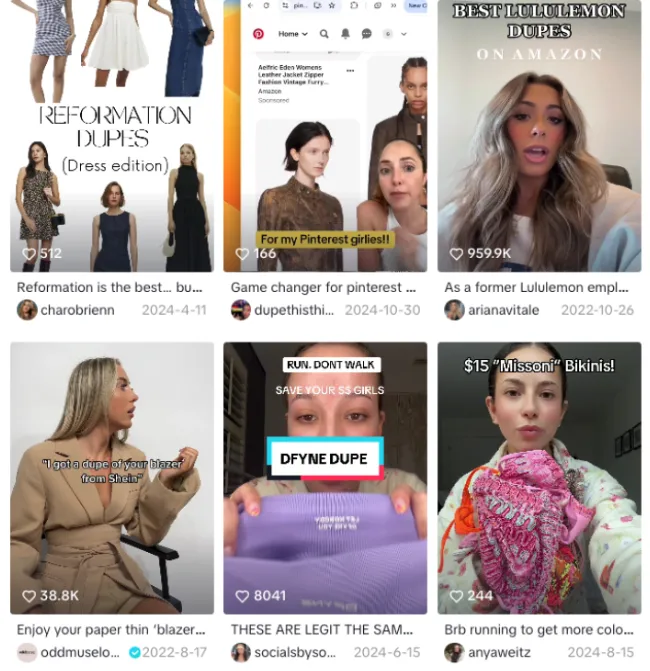
“Dupe” culture, spreading fast on social media, has gone beyond a shopping trend and now threatens brand identity even more than counterfeits do. Search “#dupe” on TikTok and you’ll find videos featuring everything from cosmetics and activewear to furniture with billions of views, a new challenge for brands. In the US and China in particular, more shoppers are seeking “dupes” instead of luxury goods, and for brands this is less about cheap products being popular than about brand value being eroded. According to Mintel, searches for “dupe” on Chinese social media tripled over the past three years.
What are dupes?
Short for “duplicate,” a dupe is different from a counterfeit that copies the genuine product exactly. It keeps the brand’s key design elements but adds slight changes, positioning itself as a cheap alternative.
Reflecting this trend, US retail giant Walmart launched a bag reminiscent of the Hermès Birkin that went viral on social media. Nicknamed the “Wirkin” (Walmart + Birkin), the bag sold out fast at an affordable $78 (about KRW 110,000) and drew an explosive response online. (Source: Maeil Business) But because it didn’t use the brand’s logo or trademark directly, legal action is difficult.
Cheap alternatives like this evoke a brand’s distinctive image and become a “sensible choice” for shoppers. For brands, though, they dilute the originality of the product and can hurt brand value and sales. Responding requires a systematic IP portfolio, including trade dress and design patents.
What is trade dress? The elements that set a product apart from others through its distinctive image, such as size, shape, color and design. It is an especially effective way to keep look-alike products and knock-offs out of the market.
Fashion IP problem 3) Resale and the gray market: a threat to pricing and the customer experience

Resale and gray-market (unauthorized) sales aren’t just secondhand trading. When products circulate through channels the brand can’t control, they can seriously affect pricing and the customer experience.
On the gray market, even genuine products are often sold far below the official price, or traded above retail because they are scarce. When prices are low, shoppers prefer the gray market to the brand’s official stores. When prices are high, bad actors buy products in bulk, deliberately trigger sellouts and then resell at a premium. Either way, the brand struggles to control market prices, and shoppers find it hard to buy at retail.
To tackle this, global fashion brand ZARA last year added new terms restricting customers who buy products for resale. (Source: Economic Review) ITX Korea, which runs ZARA’s Korean online store, revised its website terms of use and introduced measures to restrict misuse.
ZARA introduced the anti-resale clause to stamp out resellers who buy limited-edition products in bulk and resell them at a markup on secondhand platforms. In 2021 and 2022, collections from ZARA’s collaboration with popular brand Ader Error traded on secondhand platforms at prices far above retail, sparking controversy. For the brand, resale culture could lower brand value and degrade the customer’s experience of the product, so it chose a firm response.
The gray market isn’t only trade outside a brand’s official distribution. It’s also directly tied to counterfeits. As the resale market grows, genuine and fake products are mixed together on some platforms. In one recent case, a shopper tried to resell UGG boots bought on KREAM on Soldout a month later, only for the boots to be judged fake, which caused a stir. (Source: Fashion Insight) Similar problems keep occurring with products from many brands, including Nike sneakers and Fear of God shirts.
According to MarqVision’s analysis of US consumers, 7.8% have bought a counterfeit on a secondhand platform. With changing consumer culture and high prices, the resale market is expected to keep growing. Brands need to strengthen distribution management and brand protection to protect the genuine-product experience and brand value, and to build trust with consumers.
Fashion IP problem 4) Impersonator websites: a surge in consumer harm that exploits brand trust
Impersonator websites that copy official sites to deceive consumers are surging. Impersonators steal shoppers’ payment details or sell fakes as genuine products.
As major overseas brands expand into Korea, phishing sites exploiting them are multiplying too. Sophisticated fake stores are thriving, reaching shoppers through ads on social platforms such as Instagram. (Source: Hankooki.com)
These sites advertise expensive clothing or electronics at 50–90% off to push card payments. The card number, expiry date and security code entered at checkout are misused, and shoppers are often charged in dollars or other currencies instead of won. Many target big sale seasons such as Black Friday, Singles’ Day and the year-end holidays, and most run on servers in China, which makes them hard to trace. (Source: Hankooki.com)
To respond, brands need to actively monitor not just their official domains but look-alike domains too. They also need to use official websites, social platforms and other channels for talking to consumers to share guides and warnings that make fakes easy to spot.
An essential strategy for every brand, fashion included: IP protection

A strong brand protection strategy is essential for brands to protect both their value and their products online and to offer consumers a safe place to shop. A strategy aligned with the brand’s business is stronger when it includes the elements below.
We’ve looked at the IP threats facing fashion. These are common challenges any brand can face, not just fashion brands.
As online sales channels multiply and anyone can register as a seller, protecting a brand’s intellectual property (IP) matters more than ever. And with marketplaces and social media now major sales channels, brands are no longer confined to one region. They face direct threats in global markets. As a brand grows, the types and tactics of IP problems such as counterfeits, impersonator accounts and gray-market sales become more varied and complex. But there are limits to how much a brand can monitor and respond to on every channel by hand.
To protect their products and brand value and offer consumers a safe shopping environment, brands need a more systematic IP protection strategy. These are the elements an effective response must include.
1. Build a real-time monitoring system
Counterfeits aren’t sold on just one or two marketplaces. They circulate on global marketplaces, social media and independent online stores, all at once. So brands need multi-channel monitoring based on brand-related keywords, and the ability to detect every IP threat, counterfeits included, quickly.
2. Build an AI-based automated response system
Beyond identifying IP infringement, brands need automated systems that can act on it fast. With AI, counterfeit listings can be detected in real time and evidence collected automatically, making it easy to send warning letters to bad actors or file reports with platforms. That greatly speeds up response and lets brands focus more on product development and marketing strategy.
IP protection goes beyond legal action. It’s a core strategy for protecting a brand’s value and trust. IP problems such as counterfeits, dupes, gray-market sales and impersonator websites are getting more complex, but AI-based monitoring and a response strategy tailored to the brand can address them effectively.
When every brand, not just fashion brands, builds a strong IP protection strategy, it can achieve sustainable growth in global markets.
Sign up for 5 days of free monitoring and get a precise picture of the IP problems threatening your brand’s growth.