[Global trademark filing guide, part 2] IP protection strategy insights for CEOs
For K-brands about to go global: real cases of trademark squatting abroad, strategies to grow safely, and the most effective way to recover squatted marks.
 Irene Lee4 min read

On this page4
- Why rising brands should prepare overseas trademark filings early
- 1. Why brand IP protection matters, seen through real cases of K-brand trademark squatting
- 2. Overseas trademark protection strategies every CEO should know: an essential guide for beauty and fashion brands
- 3. How to fight overseas trademark squatting: the KOIPA government support program and tips to prepare more easily
Why rising brands should prepare overseas trademark filings early
According to the 2024 K-BPI survey, 77.8% of the No. 1 brands in 234 industries, which together account for about 71% of Korea’s GDP, have entered global markets or have significant influence abroad. Expanding overseas is no longer optional.
As the global influence of Korean culture grows, from K-content and K-pop to K-food, brand protection matters more than ever. Trademark (IP) protection in overseas markets isn’t just a legal step. It’s a core strategy for protecting brand value and building consumer trust through a consistent brand experience.
According to the Korea Intellectual Property Protection Agency, a cumulative 17,514 Korean brand trademarks have been squatted in China, especially in cosmetics, electronics, apparel, franchising and food. These IP threats mainly target new brands growing fast on their own online stores and e-commerce platforms, so acting in advance is essential.
In this post, we analyze cases of overseas trademark squatting K-brands have faced and introduce practical strategies to protect your brand safely as you expand globally.
What this post covers
1. Why brand IP protection matters, seen through real cases of K-brand trademark squatting
2. Overseas trademark protection strategies every CEO should know: an essential guide for beauty and fashion brands
3. How to fight overseas trademark squatting: the KOIPA government support program and tips to prepare more easily
1. Why brand IP protection matters, seen through real cases of K-brand trademark squatting
According to a recent analysis by the Korean Intellectual Property Office, cases of Korean brand trademarks being squatted in China and Southeast Asia (Vietnam, Thailand and Indonesia) have surged over the past four years. New and rising brands accounted for 81.8% of all cases, and 69.5% involved the identical mark being squatted in the same industry. By region, 56.3% of the cases were in China, and similar marks used in other industries made up 27.4% of cases, showing how widely the risk is spreading.
China in particular is one of the countries where malicious trademark brokers exploiting this are most active, and Korean brands suffer the most there.
What overseas trademark squatting is, and the main types
In China, trademarks are squatted in many ways, and by the time companies notice, legal action is often difficult or very costly. The three typical forms of overseas trademark squatting are 1) identical marks, 2) similar marks and 3) marks registered for different goods.
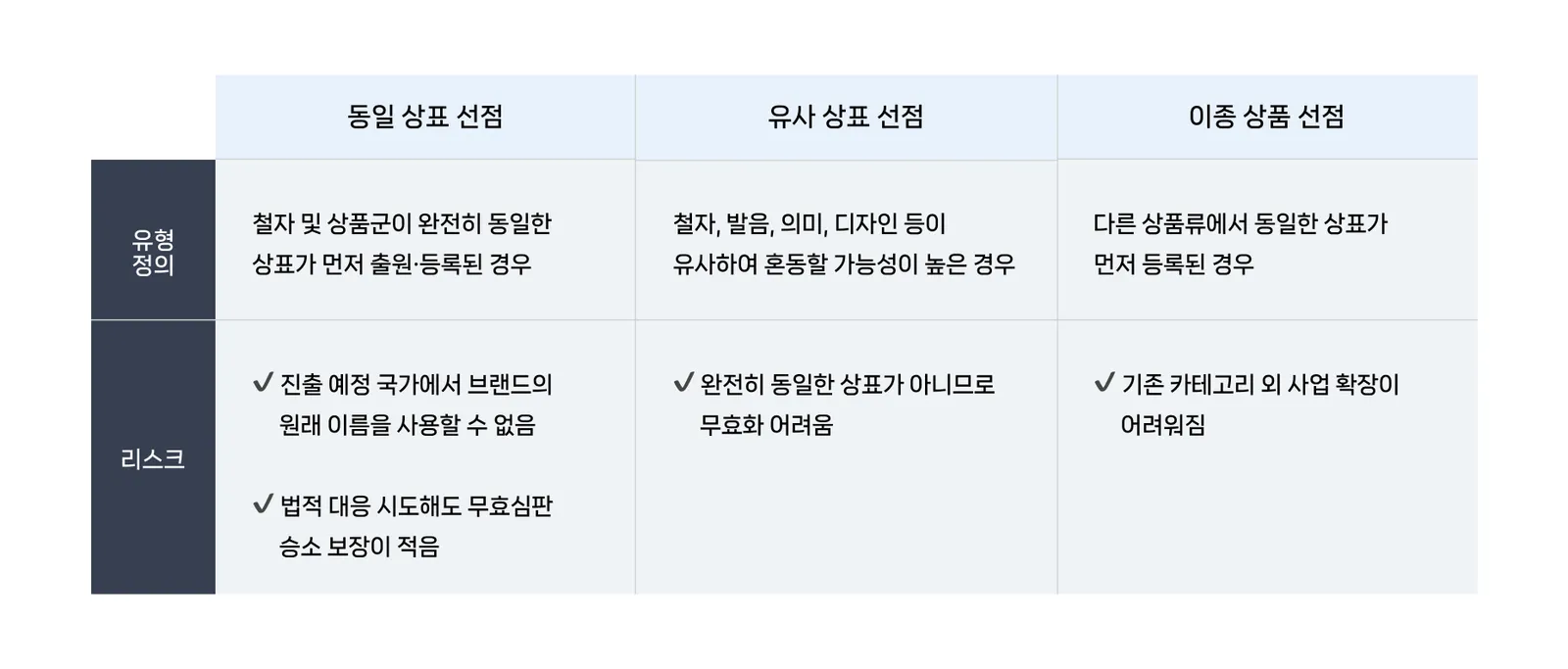
Common tactics of malicious Chinese trademark brokers
Malicious trademark brokers in China mainly target new and rising brands, especially brands that run their own online stores, have gone viral on social media or sell on e-commerce platforms.
Their method is simple but devastating. They register a Korean brand’s trademark in China before the brand does, then approach the brand the moment it tries to expand abroad and negotiate to sell the trademark back.
The problem is that getting the trademark back isn’t easy. Recovering a trademark takes at least a year and legal costs ranging from several million to tens of millions of won. And because there’s no guarantee of winning an invalidation or cancellation action, companies can spend the time and money and still end up having to give up the trademark.
What happens if your trademark is taken? 1) You risk losing the trust and value your brand has built, 2) trademark disputes can disrupt your business, and 3) the squatted trademark can be used to distribute counterfeits.
The biggest cause of these problems is the first-to-file principle. Most countries follow a first-to-file principle, under which the company that registers a trademark first holds exclusive rights to it. Many malicious trademark brokers exploit this, so acting proactively is essential to protect your brand.
Want to see which countries are first-to-file? Learn more here.
See specific cases of how malicious trademark brokers’ tactics are actually used.
Case 1: Identical mark squatted
Cosmetics brand A
Because its identical mark had been squatted, beauty brand A couldn’t use its original trademark and faced either paying extra to buy the trademark or developing a new brand name. Brand A discovered while preparing to enter China that a third party had already registered the identical mark. As this shows, malicious squatters aren’t only brokers. They can also be buyers, overseas distributors and others. For fast-growing brands in particular, considering overseas trademark filings early is essential to avoid this risk.
Case 2: Similar mark squatted
Fashion brand B
Brand B found that counterfeits of its products were circulating in China. The problem was that a mark with a name and design similar to B’s had already been filed. After brand B started selling on Chinese e-commerce platforms, the mark’s owner had been using a nearly identical logo and name to confuse consumers. As a result, it hurt not only the brand’s credibility but also consumer safety and sales. To prevent this kind of harm, continuously monitoring whether similar marks are being registered in the countries you enter is essential.
Case 3: Mark squatted for different goods
Lifestyle brand C
After succeeding in Korea selling interior decor, brand C discovered while considering entering China that the identical mark had already been registered there in the “apparel” category. As a result, brand C couldn’t register products under its existing trademark in China and had to go through additional legal procedures.
Brand risk management tips from MarqVision’s IP experts
The threats brands face as they prepare to expand overseas go beyond trademark squatting. Products copying a brand’s design exactly circulate offline as well as online, and the moment counterfeits spread in the market, brand trust takes a hit. Without trademark rights in particular, legal action becomes difficult and there are limits to stopping bad actors’ unauthorized use.
Registering trademarks proactively, on the other hand, gives you 10 years of protection by default and a strong legal basis if disputes arise. In brand protection, prevention matters more than reaction. To minimize risk and grow steadily in global markets, trademark registration should be your top priority.
In 2023, the Korean Intellectual Property Office and KOTRA (Korea Trade-Investment Promotion Agency) surveyed counterfeits of Korean fashion brands sold in China and, working with Chinese authorities, raided a counterfeit warehouse and seized 6,155 counterfeit items. But without registered trademarks, on-site raids and offline enforcement aren’t possible.
To block counterfeits effectively offline as well as online, trademark registration is no longer optional.
2. Overseas trademark protection strategies every CEO should know: an essential guide for beauty and fashion brands

1. Prepare overseas trademark registrations in advance
The real cases above show the threats and problems brands face. These cases happen often in many countries, but brand misappropriation is especially common in China. It’s important to file key trademarks, including your brand name, proactively to cut off the possibility of misappropriation at the source. Use the checklist below to file overseas trademarks strategically.
Overseas trademark filing checklist:
1. Include IP protection clauses in contracts with overseas partners
- Review in advance to make sure overseas partners don’t file on their own or preemptively, so you don’t end up paying transfer costs.
2. Register not only your company and brand names but also your flagship product lines and package designs
- Design rights are judged by comparing drawings directly with the physical product, so they can block counterfeits effectively. If your brand uses distinctive package exteriors, fabrics or graphic patterns, we recommend filing quickly before they’re released to the market.
2. Monitor for brand misappropriation abroad in advance
Even if you have no plans to expand overseas yet, it’s important to detect squatting risks early and monitor regularly. This lets you invalidate squatted overseas trademarks early or prevent further trademark infringement.
Key monitoring and response methods
1. Protection through priority claims
- If you file with a priority claim within six months of filing your trademark in Korea, your filing date can be backdated to the Korean filing date.
2. Preventing squatting through trademark oppositions
- You can file an opposition within three months of a squatted mark’s publication.
- By submitting evidence of your brand’s renown and of bad-faith filing in an opposition, you can invalidate the squatted mark.
3. How to fight overseas trademark squatting: the KOIPA government support program and tips to prepare more easily

As covered above, in an era when global expansion is essential, growing brands and companies face many challenges. One of the first to solve is trademarks squatted abroad. There are several ways to solve it, from working with a law firm to using government support programs.
Working with a law firm usually happens the traditional way, by phone, email and spreadsheets, and the costs can be high. But using KOIPA’s (Korea Intellectual Property Protection Agency) government support program can cut costs while resolving the issue quickly.
What is KOIPA’s “K-Brand Dispute Response” program?
The K-Brand Dispute Response support program provides legal and administrative support to quickly resolve trademark and design disputes that arise abroad. (Learn more about K-Brand Dispute Response)
Program overview
- Support: Procedures to recover rights to squatted trademarks
- Support for overseas trademark and design disputes: administrative procedures and legal advice
- Support for dispute-related litigation and oppositions: litigation costs before overseas authorities
- IP protection training and consulting: guidance to prevent disputes abroad
- Eligibility: Small and mid-sized companies that export or plan to export, or are in a trademark dispute
MarqVision has been selected as an official provider for the K-Brand Dispute Response program, and to date more than 30 brands have successfully recovered their overseas trademarks. Working with a team of experts in Chinese trademark disputes, it offers a fast track for dealing with prior-filed marks, enabling quick, effective resolution.
In this post, we’ve looked closely at the overseas trademark squatting problems K-brands face and strategies to solve them. In our next post, we’ll share KOIPA’s K-Brand Dispute Response process and real success stories of trademarks recovered through MarqFolio, MarqVision’s trademark management solution. If you need a fast, effective response to an overseas trademark dispute, check out the KOIPA support program.
Need more help?
With MarqFolio, MarqVision’s trademark management service, IP experts offer free consultations on an overseas trademark strategy tailored to your company, including strategies for identical marks. Talk to an IP expert about a trademark strategy built for your company. Request a consultation now and you’ll also get our newsletter full of IP insights.