The crisis facing K-beauty in the US: IP infringement and the limits of marketplace brand protection
The IP infringement K-beauty brands face in the US, how to respond on Amazon, where marketplace IP protection falls short, and the alternatives that close the gap.
 Irene Lee4 min read
On this page3
In an earlier post, we covered K-beauty’s global growth and its successes and challenges in the US. If you haven’t read it yet, you can find it here, and we recommend reading it alongside this one.
In this post, we summarize the key points:
- Amazon’s IP protection programs:
Amazon runs three main IP protection programs, Brand Registry, APEX and strict compliance with the US MoCRA law, to protect brands from IP infringement and bad actors.
>
- The limits of Amazon’s brand protection:
Bad actors multiply faster than manual monitoring can keep up, and English-based monitoring systems struggle to detect infringement that involves language and cultural elements. Shoppers also rely on Prime sellers and reviews, which makes it hard to tell genuine products from counterfeits.
>
- Why brands need IP protection beyond the platform:
Alongside platform IP protection, brands need to build strong legal leverage through keyword-based monitoring, test purchases of suspicious products, monitoring of look-alike trademarks, a patent portfolio and ongoing IP management.
As demand for K-pop and K-content grows, K-beauty exports are rising fast. According to the Korea International Trade Association, cosmetics have become a major export, and exports by indie brands in particular are booming. According to the Ministry of SMEs and Startups, cosmetics exports by small and medium-sized companies reached $3.3 billion in the first half of this year, up 30.8% year over year. Exports to the US and Spain rose 236% and 4,606% respectively, both record highs. (Sources: Ministry of SMEs and Startups, CNC News)
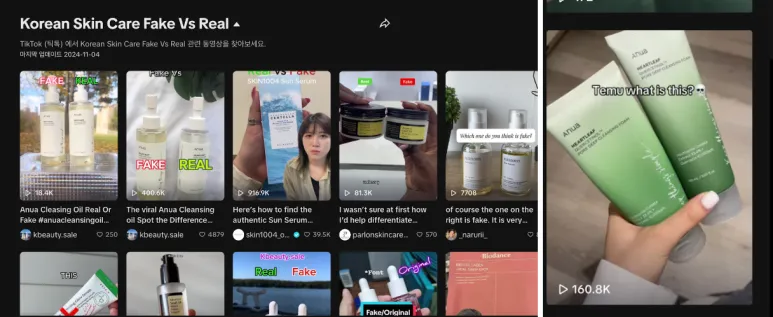
The growth of K-beauty exports is a good sign, but counterfeiting on overseas platforms is growing too. The problem is serious. Soon after a K-beauty brand launches a new product, platforms fill up with look-alike counterfeits. On TikTok, short videos on “Korean Skincare Fake VS Real” keep coming, some reaching 160K views.
K-beauty brands that have entered the US sell through overseas marketplaces such as TikTok Shop and Amazon, so a strategy for responding to IP infringement is essential. K-beauty brands popular with US shoppers often face a range of IP infringement, including counterfeits, gray-market (unauthorized) sales and patent infringement, and sales platforms run strong IP protection programs to protect brands and consumers. In this post, we introduce Amazon’s main IP protection programs and look closely at their limits for brands.
IP protection on Amazon, the world’s largest marketplace: a safety net for K-beauty brands
Global marketplaces like Amazon run several IP protection programs to prevent counterfeiting of K-beauty brands. The main ones are Amazon Brand Registry (ABR), APEX (Amazon Patent Evaluation Express) and MoCRA (Modernization of Cosmetics Regulation Act). Each protects brands and consumers from different kinds of IP infringement.
ABR (Amazon Brand Registry)
A registration program for protecting a brand’s intellectual property (IP) on Amazon. By enrolling in ABR, brands can protect key assets such as logos, product images and text. They can also report counterfeits quickly and work with Amazon to use the tools needed to prevent illegal sales. Amazon’s in-house AI monitoring efficiently detects fakes and unauthorized use of IP so brands can respond quickly.
APEX (Amazon Patent Evaluation Express): Amazon’s utility patent infringement process
APEX is Amazon’s patent protection program, which helps brands resolve patent infringement quickly. The APEX process delivers a result within 30 days and, once infringement is found, removes the listings within 10 days. There’s an upfront fee, but it’s refunded if the brand wins.
MoCRA (Modernization of Cosmetics Regulation Act)
MoCRA is the US Modernization of Cosmetics Regulation Act. With it taking effect in July this year, Amazon has tightened its review of sellers’ products. Products that don’t comply can be removed without notice. This strengthens protection for consumers and brands.
The limits of IP protection: the crisis facing K-beauty brands

As K-beauty products win over shoppers worldwide, they face IP infringement on many platforms. In a MarqVision survey, 71.6% of respondents said they had tried to find a genuine product online but bought a counterfeit, and 60.4% of them bought it on US-based marketplaces such as eBay and Amazon. On large marketplaces like Amazon in particular, the number of sellers is growing so fast that it’s hard to check every product and seller thoroughly. Fakes and unauthorized sales spread quickly, and platform monitoring and policy alone can’t respond to every counterfeit in real time. This happens often, even on a platform with infrastructure as strong as Amazon’s.
The platforms’ own technical limits also mean that brand IP shaped by language and culture, especially trademarks with Korean-language logos or Korean design elements, often isn’t monitored accurately. Most marketplace monitoring systems are designed around English, and where multilingual data handling is weak, K-beauty brands’ IP is at high risk of going unprotected.
For example, some counterfeit sellers use entirely different Korean words styled to look like the genuine logo to evade search algorithms, or confuse shoppers with designs that evoke K-beauty. Platform IP protection policies inevitably have limits, especially for K-beauty brands.
Finally, gaps in consumer awareness are a big problem too. On online shopping platforms, it’s hard to tell genuine products from counterfeits, and when a product is a little cheaper or uses the same images, shoppers easily mistake a fake for the real thing. The resulting bad experience damages the brand’s image. And when many sellers sell the same product on one platform, checking authenticity gets complicated, which can affect K-beauty brands’ credibility.
Alternatives for protecting K-beauty brands
Relying on platform IP protection programs isn’t enough for K-beauty brands. A more thorough strategy now requires your own IP monitoring system.
A brand’s monitoring system should:
-
Monitor based on high-search-volume core keywords
-
Regularly analyze look-alike brands and trademarks
-
Build a patent portfolio covering different types of patents
-
Keep trademarks and other brand IP up to date to strengthen legal protection.
In the US, a key market, brands can also protect what makes them different by securing patents on new material technologies, original manufacturing processes and distinctive container designs. Holding patents goes beyond trademark registration and becomes an important tool against technology infringement, playing a central role in keeping the brand competitive.
To issue warnings and take legal action against bad actors quickly, it’s also important to keep your IP up to date and strengthen your legal leverage as market conditions change. That makes strong legal measures against IP infringement, such as asset freezes and revenue recovery, possible.
Brands can also detect counterfeits through monitoring or make test purchases of suspicious products to check them thoroughly. Building this kind of verification system takes brand protection a step further.
But continuously monitoring and managing marketplaces in many countries on your own takes enormous cost and resources. The most effective approach is to use a brand protection solution to manage IP infringement and your IP portfolio together, efficiently. With AI analyzing big data in real time, you can systematically monitor patterns of IP infringement across marketplaces. The insights advanced AI provides let you respond to infringement efficiently and build a strong brand protection strategy.
Ultimately, K-beauty brands should combine platform IP protection programs with a brand protection solution to build a stronger, more proactive strategy.
Not sure how to build a protection strategy tailored to your brand?
Check your IP infringement exposure and get a free consultation