Online brand protection: an essential strategy for brand growth
Why online brand protection matters as marketplaces multiply, and how an IP portfolio built around your strategy protects your ideas, customers and revenue.
 Irene Lee4 min read

On this page5
As marketplace platforms grow rapidly, it’s becoming more important for brands to protect their intellectual property (IP) and respond strategically to infringement. Real cases show the harm IP infringement online can do to a brand.
In this post, we look at the business benefits of online brand protection (OBP) and why companies should make it a priority.
What is online brand protection (OBP)?
Before getting into brand protection, what kinds of illegal activity exist online? Beyond the familiar problem of counterfeits, there’s piracy, impersonation using deepfakes, gray-market (unauthorized) sales and more. It also includes any use of any part of a brand, such as its trademarks, without permission.
Protecting a brand from these threats is what we call brand protection. It covers the strategies, actions and measures taken to protect a brand’s reputation, image, intellectual property (IP) and customers.
There are two ways to deal with brand threats: online and offline. Offline, problems are mainly solved through raids on factories and distribution sites. Online, they’re solved by requesting removal through IP reporting centers or platform reporting centers, which involves writing a report, submitting evidence and having the product removed. For example, when you find a counterfeit on a marketplace, you write a report and submit it to the IP reporting center; after review, if the product is judged counterfeit, the listing is removed. It sounds simple, but the report must describe the infringement in detail, with evidence, so even an experienced person spends about an hour removing a single listing.
Even so, online brand protection is essential, because it’s vital for maintaining trust with customers, holding market share, and protecting revenue and innovative, creative ideas. Let’s look at each in more detail.
Maintaining trust with customers
Have you heard of the Korean brand “Oh, Lolly Day”? Built on the philosophy of “making warm products that make your life happier,” it creates a range of products and characters loved by Millennials and Gen Z. Consumer trends used to focus on product and price, but today’s consumers make purchase decisions based on whether they relate to a brand’s philosophy and values.
Consumers look at the philosophy behind a brand’s products and services when deciding to buy, and beyond simply liking the brand, they come to share its philosophy and values and may even become fans. Devoted fans actively promote the brand and its products to the people around them and take part in brand activities. They engage closely with brands and are the unsung heroes behind their growth.
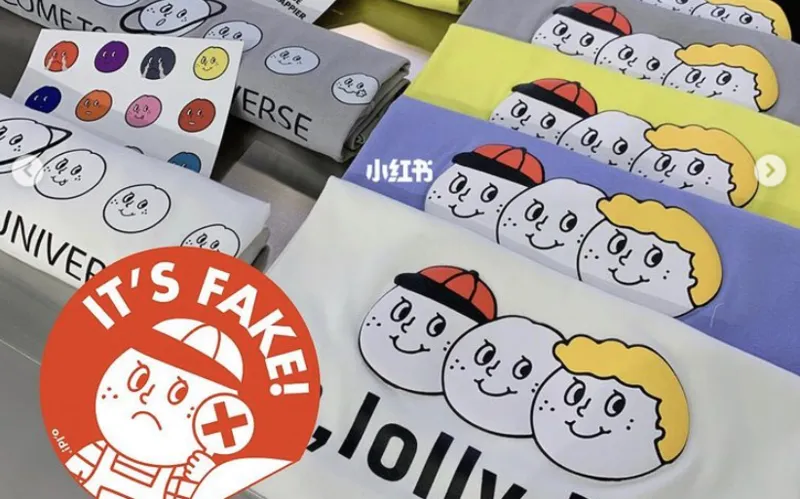 Counterfeit Oh, Lolly Day products in China (Source: Oh, Lolly Day)
One incident made these devoted fans especially angry: a Chinese company registered the brand’s trademark first without permission and openly sold copycat products in physical stores. The brand’s founder said, “I thought fakes were inevitable as we got more popular,” but decided that the physical stores had to be stopped, for the sake of “Happiers” (Oh, Lolly Day fans) in Korea and abroad.
Oh, Lolly Day’s social media post sharing the news drew more than 40,000 likes and supportive comments. After three years of copyright infringement litigation in China, the brand won at first instance, with a ruling ordering the Chinese companies to pay 1 million yuan (about 180 million won) in damages. (Source: HuffPost Korea) Through transparent communication with customers and strong brand protection measures, a brand can make its relationships of trust even more solid and protect its philosophy and values.
Protecting revenue and market share
 K-food’s popularity: Cardi B’s Buldak review on TikTok
Famous rapper Cardi B shared a TikTok video of herself eating Carbo Buldak Bokkeum-myeon, which drew more than 19 million views. K-food and K-brands across many industries are gaining popularity worldwide, but exporters are struggling with counterfeits and gray-market sales.
Beyond K-food, electronics brands have also suffered heavily from online brand infringement such as counterfeit production and sales. For example, mobile phone accessory maker S had to pull out of China because of a flood of counterfeits, losing more than 10% of its total revenue. (Source: Dae Han Economy) In another case, Company A, a Korean SME exporting set-top boxes to Europe, was hurt on online sales channels by Chinese knockoffs, and 200 million won worth of fakes were seized. (Source: Maeil Business)
As Korean companies expand actively around the world, including the US, China and Southeast Asia, IP infringement such as trademark squatting and counterfeits sold online abroad is growing across every industry, from beauty to fashion to electronics. Without an active response to IP infringement, companies can suffer serious economic losses, such as falling market share abroad and lower exports.
Protecting creative ideas
Customer trust, revenue and market share all stem from a brand’s creative, innovative ideas. Creative ideas express a brand’s philosophy and identity and can become a distinctive strength that gets people’s attention.
Products that are popular with consumers, or a brand’s best sellers, are easy targets for bad actors to copy. They can take a product that sells well without investing any time or effort in developing it. Online brand protection goes beyond stopping counterfeit sales. Securing IP rights to protect a brand’s creativity is essential.
In the digital age, building an IP portfolio is a must. Brands should register trademarks, copyrights and patents in Korea and abroad in line with their business strategy. This not only prevents ideas from being stolen but also lets brands protect their IP and take legal action abroad. A brand’s innovative, creative ideas are central to business success, and online brand protection and secured IP rights are essential to protect and strengthen them.
Effective online brand protection strategies
Solving these threats that damage a brand’s revenue and reputation takes thorough monitoring and strong enforcement. With that effort, brands can stop counterfeit sales in the market, reinforce their commitment to quality and rebuild consumer trust.
Why online brand protection strategy matters, from a brand IP protection expert
“Most consumers make purchase decisions online rather than offline because prices are lower online. So they compare several channels, not just one, to find the cheapest platform. Then they look at reviews and seller information before deciding. I think that’s why monitoring online channels matters.”
“You need to see for yourself which channels you officially sell through, whether they show up at the top of search results, and whether other illegal sellers in Korea and abroad offer better reviews and prices. The real reason for brand protection is to go beyond running official sales channels: to measure and improve where your products are bought most and what that costs you. MarqVision is an integrated online brand protection platform built for exactly that. Gain data-driven visibility into your online channels with MarqVision.”
– Boreum Lee, MarqVision Marketing Team
Learn more about MarqVision
MarqVision is an AI-powered online brand protection platform that lets you act on every illegal activity infringing your brand’s intellectual property (IP) in one platform. AI monitors your brand’s IP, such as trademarks and copyrights, in real time to detect infringement automatically, and quickly identifies and blocks the channels where infringement occurs most. Get fast, accurate insights from the data collected and keep your brand’s value safe. To learn more about MarqVision, request a consultation.