Gray-market K-food and household goods directly harm consumer health and brand perception
See real cases of counterfeit and gray-market Choco Pie, soju, ramyeon and health supplements, and how brands are responding with effective protection strategies.
 Irene Lee4 min read
On this page3
Korean products are popular worldwide for their high quality at reasonable prices. Now that e-commerce and social media have erased borders, that popularity keeps growing. But so do cases of gray-market distribution that exploit it. Gray-market sales are products of unclear origin distributed by people without authorization. They may be counterfeits, or genuine products sold without permission. In this post, we take a detailed look at strategies for stopping counterfeit and gray-market sales and protecting consumers and brands.
The K-food craze sweeping Southeast Asia
Products popular in Korea are generating strong demand abroad, and K-food is especially popular in Southeast Asia. But that has also led to a wave of counterfeits and knockoffs.
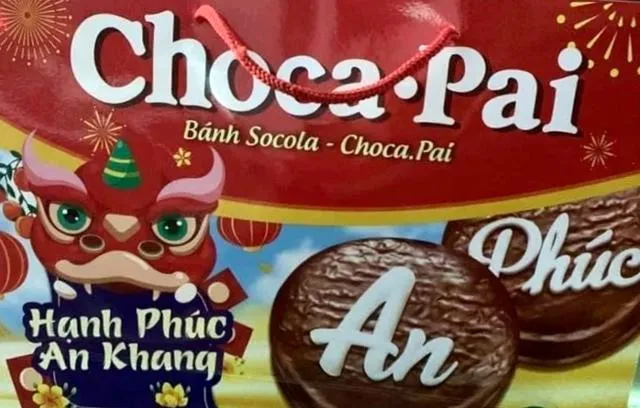 Choca-Pai, a Choco Pie knockoff (Source: Hankook Ilbo)
Choco Pie or Choca-Pai? Counterfeits one letter apart
In Vietnam, Choco Pie is so popular it’s even placed on ancestral rite tables. It has become a snack that represents Korean culture there. But walk into a wholesale district and you’ll easily find counterfeits labeled “Choca-Pai” instead of “Choco-Pie.” These fakes use red boxes and designs similar to the Korean Choco Pie brand, with the English spelling tweaked just enough to confuse shoppers. Other examples include selling Korean company Orion’s products as “Oreon,” and Choco Pie as “Chooco-Pie” or “Chocoo-Pie.” Counterfeiters in Southeast Asia mainly alter brand names slightly like this to avoid intellectual property (IP) problems. It poses health risks to consumers and damages Korean brands’ premium image.
Soju: fakes with near-identical green bottles and labels
Korean soju, including Chamisul, is very popular in Vietnam. Cocktails made with fruit soju are in fashion locally, and even American tourists can often be seen enjoying soju. Korean dramas have raised awareness of soju, and people in their twenties and thirties are its main consumers. That popularity has led to counterfeit soju. Fake soju sells for 30% less than the genuine product and looks almost identical, from the green bottle and colors to the label design. It even copies flavors such as strawberry, grapefruit, peach and grape, and the 13% alcohol content, confusing consumers. These fakes are inferior in taste and quality and hurt the image of Korean soju brands.
Ramyeon: counterfeits disguised as the real thing at a glance
Buldak Bokkeum-myeon is a flagship success story among Korean ramyeon brands and hugely popular worldwide. Its rosé flavor, loved by Cardi B, became a social media sensation, boosting its popularity even further. But many counterfeit ramyeon products are exploiting that popularity.
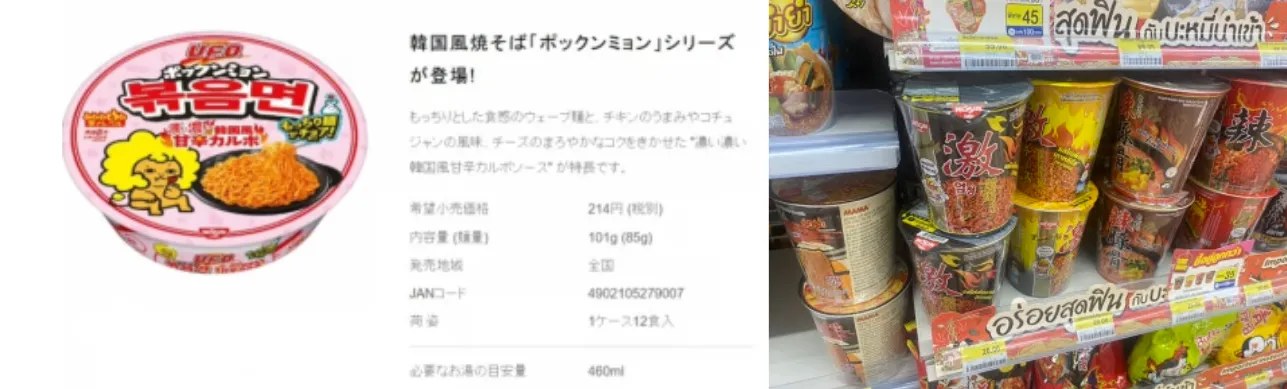 Knockoffs found in Japan and Thailand (Source: Maeil Business left / KPI News right)
A convenience store in Bangkok, Thailand, sells a product printed in Korean with “Korean Buldak flavor,” a knockoff made by a Thai company. It uses illustrations and colors similar to Samyang Foods’ Buldak Bokkeum-myeon, leading shoppers to mistake it for the real thing. Japanese ramyeon maker Nissin also drew controversy for a product that imitated Samyang Foods’ design. These knockoffs sell for less than the genuine product and damage Korean ramyeon brands’ premium image.
Like the Choco Pie and soju examples above, these products sell for far less than officially imported products, damaging Korean brands’ premium image and putting consumers at risk. Many other kinds of fakes are being made too. From snacks to fruit, stopping products falsely labeled as Korean and protecting brands is becoming more urgent.
Counterfeit production and sales alone are a headache for companies, and legal options for protecting brands online are limited. For example, even if Samyang Foods finds a knockoff of Buldak Bokkeum-myeon and wants to take legal action, “buldak” is the name of a dish, so a product labeled “Korean Buldak flavor” is hard to stop on trademark grounds. (Source: KPI News) To protect their brands, companies are adding distinguishing marks to official export products, such as the Korean flag, a “Korea” label and QR codes, so consumers can tell genuine Korean products from counterfeits.
Health supplements and household essentials: products tied to health and hygiene
Health supplements and household goods aren’t immune to gray-market sales and counterfeits either. Here’s how brands in each category are protecting themselves.
Health supplements: counterfeit sales
Health functional foods (health supplements) range from vitamins to red ginseng. This year the government allowed secondhand trading of health supplements for one year, but there are concerns about side effects such as quality issues and limits on market growth. With health supplements, there are many cases of counterfeits that alter the amounts of raw ingredients or use ingredients not permitted in food.
Demand rises around holidays when supplements are given as gifts, and many fakes appear without the “health functional food” label or certification mark on the packaging. To prevent counterfeits, the Ministry of Food and Drug Safety evaluates health supplements in circulation through scientific procedures and investigations. Products that pass carry the label or mark, meaning they’ve passed evaluations of functionality and safety for the human body. Consumers should check for the “health functional food” label or mark and watch out for false or exaggerated advertising. They should be especially careful when buying foreign products directly, since safety often isn’t guaranteed.
Household goods: gray-market sales
Gray-market (unauthorized) sales of household goods are a particularly serious problem. Consumers often compare platforms to buy everyday essentials at lower prices. As a result, open marketplaces frequently carry products of unclear origin from unauthorized sellers. These sellers use the brand’s product images as is, confusing shoppers. Household goods are also sold by unauthorized people in other ways, such as reselling products bought in bulk during sales on online marketplaces. This can deal a heavy blow to brand value, and consumers who buy products of unclear origin, with no idea when they were purchased, may have a worse experience with them. To protect their brands and consumers, brands should monitor bulk purchases intended for resale and keep track of sales channels across platforms.
Brand protection strategies against counterfeits and gray-market sales
Brands are trying many approaches to prevent counterfeits and gray-market sales. Food brands are renewing packaging or adding certification marks, and for health supplements, consumers are encouraged to use the “Naesonan” app to check certification marks and labels. You can find app information and download links here.
Ideally, consumers would tell genuine products from fakes themselves before buying, but that’s hard for them to do. Through consumer reports, brands can find counterfeit distribution channels they didn’t know about and respond quickly. That’s how brands can take back control of online distribution.
Starting in August, MarqVision will launch its “No More Fake” campaign to stamp out counterfeits, running a customer reporting program that makes it easy for brands and consumers to communicate about counterfeits. Use the No More Fake campaign to strengthen trust with consumers and send bad actors a clear warning: fakes will be reported and stopped.
Before the campaign, check your brand’s IP infringement status for free.