Gray-market sellers and counterfeits: how Marvis Korea changed the way it runs its brand
Gray-market sellers and counterfeits need different responses. How Marvis Korea moved past repeat reports, removed 1,200+ listings and cut response time by 70%.
 Jinie Park4 min read

On this page8
- When your official products are hard to find in search
- Tell gray-market sellers and counterfeits apart
- A change in public prices is a signal about your distribution
- Reporting listings one by one has limits
- Why sellers, channels and sales history need to be connected
- How Marvis Korea moved from repeat reporting to continuous management
- FAQ
- Less repeat reporting, more time for your brand
The number of listings you remove shows how much you did. It doesn’t tell you whether your online distribution actually got better.
If removed products come back under other accounts or on new product pages, your team repeats the same searching, evidence-gathering and reporting. What helps then isn’t more manual reports. It’s a system that tells gray-market sellers apart from counterfeiters and connects sellers, channels and sales history.
Marvis Korea is a good example. Here’s how it moved from repeat reporting to continuous management.
Key points
- Reporting listings one at a time can’t keep up with sellers who come back on new accounts and channels.
- Gray-market sellers and counterfeit sellers differ in what they sell and in the grounds for enforcement, so manage them separately from the start.
- A change in public prices isn’t a conclusion. It’s a signal to check for new sellers or channel moves.
- Connecting sellers, products, channels, sales history and past enforcement shows repeat-selling patterns and what to tackle first.
- Marvis Korea removed more than 1,200 infringing and unauthorized listings and cut time spent on repetitive response by more than 70%.
When your official products are hard to find in search
Search for your brand and you may find products from sellers you’ve never heard of ranked above your official store. Each seller uses different images, descriptions and prices, so shoppers can’t easily tell which product is genuine and officially distributed.
The questions then land on the brand: “Is this genuine?”, “Where’s the official store?”, “Why does the product information differ from seller to seller?” Delivery or quality problems with products the brand never sold can also turn into bad experiences with the brand.
Your team has to answer those questions while finding suspicious listings, checking seller details and filing reports with platforms. But even after one listing comes down, the same or a related seller can return on a new account, and the confusion in search results starts again.
So when official products are hard to see, it isn’t only a search visibility problem. It’s an operational one: customers struggle to find a seller they can trust, and the customer experience the brand designed starts to slip.
Tell gray-market sellers and counterfeits apart
Not every unofficial product in search results is the same. Gray-market sellers sell genuine products through channels the brand doesn’t manage. Counterfeit sellers sell fakes that use the brand’s trademarks or designs without permission and pass them off as genuine.
To shoppers, both can look like the official store. But what the brand needs to check, and the grounds for enforcement, are different.
For gray-market sellers, look at sales channels, product mix, repeat-selling history and how they relate to official distribution. For counterfeits, confirm whether the product is genuine and whether trademarks or designs are infringed, then ask the platform to act based on the rights documents you hold.
Treat the two as one and it gets unclear which sellers to review and why. So separate seller types from the detection stage onward, and build up criteria and enforcement history for each.
A change in public prices is a signal about your distribution
When a price moves unexpectedly on a channel, the price alone won’t tell you why.
Check whether a new seller has appeared, whether an existing seller has moved to another account or channel, or whether it’s a temporary change from a promotion or stock levels.
Public prices work best not as a level to hold but as an indicator of change in your online distribution. Connect when the price change began with seller, product and channel data, and your team can see where the change started and what to check first.
The point is not to assume a price change is a problem in itself. Look at which sellers were active at the time and whether other channels moved the same way. That’s how you tell a temporary fluctuation from a repeat-selling pattern.
Reporting listings one by one has limits
Manual response usually looks the same.
Your team searches each platform for the brand and product names and checks suspicious pages and seller details. Then it takes screenshots, prepares the evidence and fills in each platform’s report form. Requests for more information, and the outcomes, have to be tracked one by one.
The problem starts after a listing comes down.
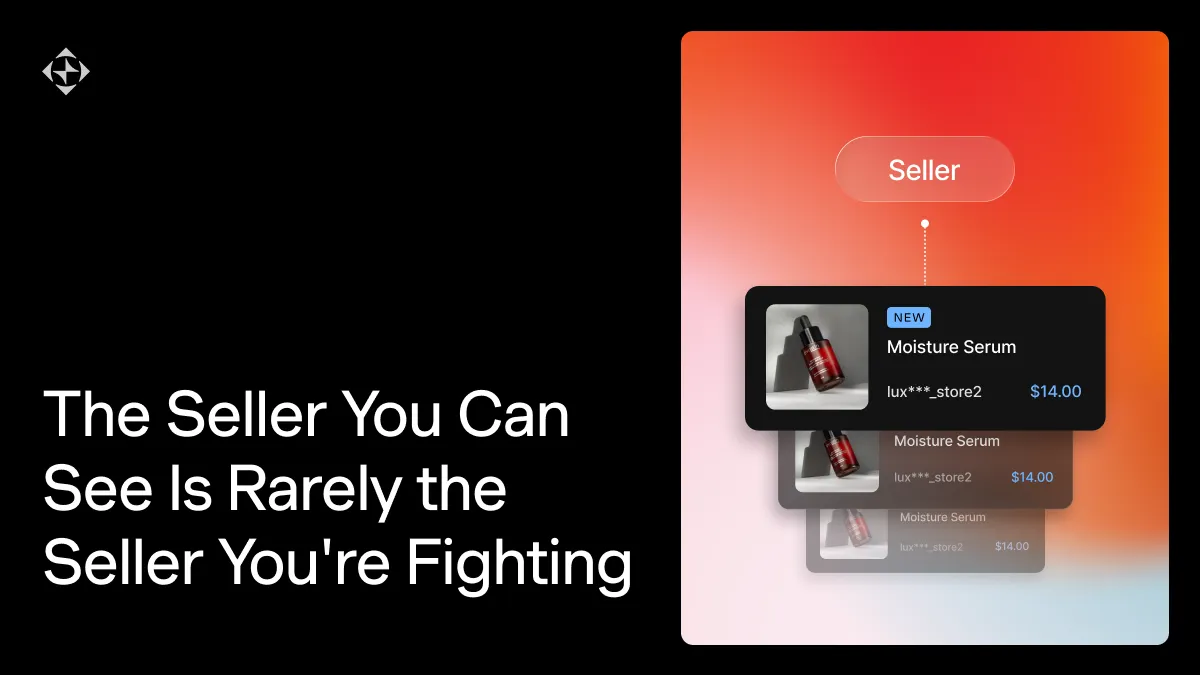
When the same or a related seller changes its account name and product page, it can look like a new problem. Some sellers move to other platforms, or list products and delete them at hours when your team can’t check.
Each time, the searching, evidence-gathering and reporting start over. The count of handled listings goes up, while your team has less time to understand repeat sellers or improve the customer experience and channel operations.
Handling individual listings is necessary. But to reduce repeat selling, you have to look at the sellers behind the listings and their history.
Why sellers, channels and sales history need to be connected
Sellers that look like separate accounts can share an email address, phone number, business name or business address.
Add the products they sell, the channels they’re active on, when they list, how their prices change and how past enforcement went, and you can see more concretely whether a seller has switched accounts or moved channels. Where needed, check against your own official distribution and partner records to narrow it down.
Marq AI detects brand-related listings across channels and helps your team review what needs review and enforcement.
The Brand Intelligence Agent uses the data you’ve built up to let you check repeat sellers, possibly linked accounts, channel moves and past enforcement in plain language.
Questions you could ask the Brand Intelligence Agent
- List the sellers who came back after our last round of enforcement.
- Find accounts that use the same contact details or business information.
- Show me the channels and periods where this seller was active.
- Check the pattern of sellers who list on weekends and then disappear.
- Rank what to review first by number of repeats and past enforcement results.
Collecting a lot of data isn’t the point. What matters is building up the links between products, sellers, channels, prices and enforcement history, so you can decide what to check next.
How Marvis Korea moved from repeat reporting to continuous management
Marvis Korea is the official importer and distributor in Korea for Marvis, the premium toothpaste brand. A core part of its online team’s job is making sure customers can buy officially distributed products with confidence.
Before Marq AI, the team searched for the brand name by hand, checked how sellers and products were linked, and filed every report manually. Each platform and agency had its own reporting process, and evidence such as purchase records, waybills and powers of attorney had to be prepared by hand.
At peak times this took three to four hours or more a day. Even when a listing came down, the work started again as soon as the seller returned with a new account or product page.
Rather than add staff to keep filing manual reports, Marvis Korea chose an operating model on Marq AI that connects detection, review, enforcement and history.
The team now reviews listings from every channel in one place and acts on the ones that need it. It uses email addresses, phone numbers and business names to identify repeat sellers and possibly linked accounts, and brings the related data and reports into conversations with platform contacts.
The result: more than 1,200 infringing and unauthorized listings removed, and more than 70% less time spent on repetitive monitoring and reporting.
Speed wasn’t the biggest change. With less repetitive work, the online team can focus on work that grows the brand: planning promotions, pop-up ideas, sales strategy for each platform and a better customer experience.
FAQ
Q. How should we respond differently to gray-market sellers and counterfeit sellers?
Gray-market sellers sell genuine products outside official distribution, so check their sales routes, seller activity, platform policies and specific violations. For counterfeits, confirm whether the product is genuine and whether trademarks or designs are infringed, then request enforcement based on your rights documents.
Q. How do we know when a seller we acted against comes back on another account?
Account names alone won’t tell you. Connect email addresses, phone numbers, business names, addresses, products and activity times to find what accounts have in common. If you also keep your enforcement history, you can review the accounts most likely to be repeat sellers first.
Q. Can we judge a distribution problem from price changes alone?
A price change is a signal to check, not a conclusion. Look at the related data, such as the mix of sellers, when they were active, channel moves and whether a promotion was running, to understand what’s behind it.
Less repeat reporting, more time for your brand
Enforcement against listings is necessary, but it isn’t the goal. To cut repetitive work, connect the dots: whether the same seller comes back on new accounts and channels, what changed after past enforcement, and what to review first.
Marvis Korea moved from manual, listing-by-listing response to continuous management built on sellers and sales history. It removed more than 1,200 infringing and unauthorized listings, cut time spent on repetitive response by more than 70%, and its online team could focus again on growing the brand: promotions, platform operations and the customer experience.
See how Marvis Korea moved past repeat reporting to manage its online distribution continuously.