.jpeg)
Brand protection teams enforce at the listing level. The operators doing the damage work at the account level. Here's what changes when you can finally see the gap.
Every brand protection team knows the pattern: take down a price-violating storefront, and within a week, two or three more show up undercutting at the exact same price. On the takedown list, that reads as three new sellers. In the underlying registration data, it's often one operator running three storefronts under three different names.
That's the blind spot brand protection and e-commerce teams have been working around for years, and Brand Intelligence Agent is the AI agent that finally lets them see through it.
Enforcement tools show storefronts. The damage comes from operators.
Most enforcement tools show you one storefront at a time. If you wanted to know whether two sellers were actually the same operator running multiple accounts, the only way to find out was to open their registration details side by side and compare them by eye: business registration numbers, representative names, phone numbers, shipping addresses.
At any real scale, nobody does that consistently. So teams worked the list, ranking by violation count, taking down the top offenders, moving to the next batch.
The trouble is that the list measures storefronts. It has no way to measure the businesses behind them. Take down the one storefront you can see, and the price floor often doesn't recover, because the other three storefronts undercutting it belong to the same operator, and nobody knew.
Four storefronts, one operator: identified in minutes
With the Brand Intelligence Agent (BI Agent) as their most valuable tool, brand teams can ask a different question than "which listings are violating?"
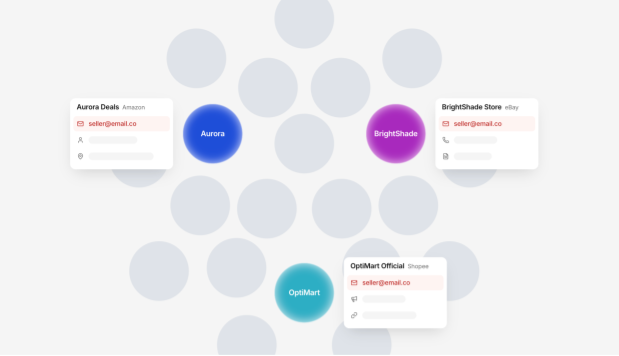
Ask whether a group of sellers have anything in common, and BI Agent joins registration numbers, representative names, phone numbers, and shipping addresses across every storefront to tell the team which ones are actually the same operator. Ask about one seller, and it points them straight to the next one worth investigating.
That's a small shift in the question, but it hands the team a real advantage. One team ran into it twice this year, from two directions:
A premium global oral-care brand spotted that four storefronts on the same marketplace shared an email address and phone number, visible only once they could compare seller details side by side instead of one at a time. They turned to MarqVision's BI Agent to take it further: instead of checking just those four, run the same comparison across the whole seller list and cluster every storefront that shared an operator. In minutes, BI Agent connected dots that a manual cross-check, realistically, never would have managed at that scale.
The same team ran into it again a few weeks later, from a different angle. Detections on one marketplace jumped to two dozen in a single day, and they needed to know fast whether that was one seller mass-listing or several acting at once. They asked BI Agent to cluster the sellers, got their answer, and moved with a very different response than working down a list of two dozen individual takedowns.
Block the operator, and every connected storefront goes with it
Once the team can see that four storefronts are one operator, the job stops being four takedowns and becomes one account to shut down. Instead of chasing four separate storefronts through four separate takedown cycles, they act on the operator, and everything connected to that operator goes with it. Multiple cases collapse into one. And because investigating one seller now surfaces the next connected one, the team's work shifts from clearing a list to mapping a network.
That's the real gap most brand protection and e-commerce teams are working around without naming it: enforcement happens at the listing level, while the sellers causing the damage operate at the account level. As long as that gap stays invisible, more sellers on a report will always look like a bigger threat, even when it's the same handful of operators wearing different storefronts. BI Agent is what makes that gap visible in the first place, and puts the advantage back with the team.
Where this leaves your enforcement program
If your team is measuring progress by takedown volume, it's worth asking a harder question first: how many of those "different" sellers are actually the same one? Usually, the answer is sitting in the connections between the entries on the list you already have. Until BI Agent, there was no practical way for your team to see them.
FAQ
How does MarqVision's Brand Intelligence Agent identify that multiple storefronts belong to the same operator?
The BI Agent joins registration numbers, representative names, phone numbers, and shipping locations across every detected storefront simultaneously, then clusters accounts that share identifiers. This cross-referencing happens at scale in minutes. It is a comparison that manual side-by-side review could never consistently complete across a full seller list.
My team tracks enforcement progress by takedown volume. What's the problem with that as a primary metric?
Takedown volume measures storefronts removed, not operators stopped. If one operator runs four storefronts and your team clears three of them, the price floor still won't recover. The remaining storefront continues undercutting, and the operator relists elsewhere. Measuring by volume makes a coordinated network look like independent incidents, which keeps your response proportionally wrong.
When should I escalate from listing-level enforcement to operator-level enforcement against unauthorized sellers?
Escalate when the same price violation or listing pattern resurfaces within days of a takedown, especially at the same price point. That recurrence pattern is the signal that you are working against clustered storefronts instead of isolated sellers. Once the BI Agent confirms shared registration data across accounts, acting on the operator collapses multiple cases into one enforcement action instead of cycling through individual takedown requests indefinitely.
What's the difference between using MarqVision's BI Agent and running a manual seller cross-check in a spreadsheet?
A manual cross-check requires someone to open seller registration pages one at a time and compare details by eye, which breaks down at any real enforcement scale and gets skipped entirely under volume pressure. The BI Agent queries across the entire seller list at once and returns clustered results with the shared identifiers already surfaced, so the team acts on network structure instead of individual listings.
How do I use a sudden spike in detections on one marketplace to figure out whether I'm facing one operator or many?
Ask the BI Agent to cluster the sellers behind that spike by shared registration attributes before building any enforcement response. If the cluster reveals one or two operators mass-listing under separate storefronts, your response is a targeted account action, not two dozen individual takedowns. If it reveals genuinely separate sellers, you size the response accordingly. Getting that answer first prevents misallocating enforcement resources against a symptom instead of the source.
BI Agent is MarqVision's AI-native intelligence layer, the one that turns data brand teams already have into the connections that used to take a data team days to find. To see what it can surface in your own marketplace data, request a demo today.
Stay up to date on the latest IP Protection content from MarqVision.




4 Enforcements a Week to 400: Scale Brand Safety with Marq AI

Don’t Just Find Counterfeits. Dismantle the Entire Network.

.png)
Discover the latest trends and challenges in IP protection

Take Control of Your Trademarks with MARQ Folio
Renew and Manage Your Trademarks Easily With MARQ Folio

We’re waiting to hear from you

See the best brand protection solution in action

Don’t let piracy steal your growth

Talk to us about your brand protection problems