
.jpeg)
Your product is authentic. Your seller isn't authorized. That gap is the grey market, and it's a completely different fight than chasing fakes. We'll walk through how these transactions work, where the legal line sits, and what your team can do when diverted stock starts flooding channels you never approved.
TLDR:
- Grey market goods are genuine products sold through unauthorized channels, generally legal under first-sale doctrine.
- In 2021, 13% of global consumer sales moved outside intended markets, typically 20-30% below net retail cost, per Oliver Wyman.
- Grey goods differ from counterfeits: real products in the wrong channel versus fakes carrying your marks.
- Warranties vanish for grey buyers, and diverted inventory often becomes a counterfeit pipeline later.
- MarqVision separates grey market channel control from counterfeit takedowns using price monitoring and seller tracing across major marketplaces.
What Is the Grey Market?
The grey market, also spelled gray market, is the trade of genuine branded goods through channels the manufacturer never authorized. These are real products, not counterfeits, but they reach buyers outside the brand's intended supply chain, often through parallel imports that exploit regional price gaps. Those gaps open up when the same product carries different list prices across regions, when currency swings widen the spread, and when distributor overstock gets dumped below net cost. Resellers buy where stock is cheap and move it into markets where it commands more, undercutting authorized dealers along the way.
Is the Grey Market Legal?
In most jurisdictions, grey market trade is legal because the goods are authentic and lawfully produced. The friction is contractual and channel-related, not criminal. Under the first-sale doctrine (also called trademark exhaustion), once a product is lawfully sold, the buyer can resell it freely. That is why parallel imports rarely constitute trademark infringement on their own.
Legal does not mean risk-free, as detailed in this unauthorized sales report. Grey goods cross into illegality when they breach regulatory requirements, differ materially from the authorized version, or violate licensing terms. Warranties often disappear for buyers. For brands, pricing integrity and channel control erode fast.
Grey Market vs Black Market vs Counterfeit
Three terms get conflated. The white market is the authorized channel: genuine goods through approved sellers. The grey market sits beside it, genuine goods moving through unauthorized channels. Black market and counterfeit trade are both illegal but differ in what changes hands.
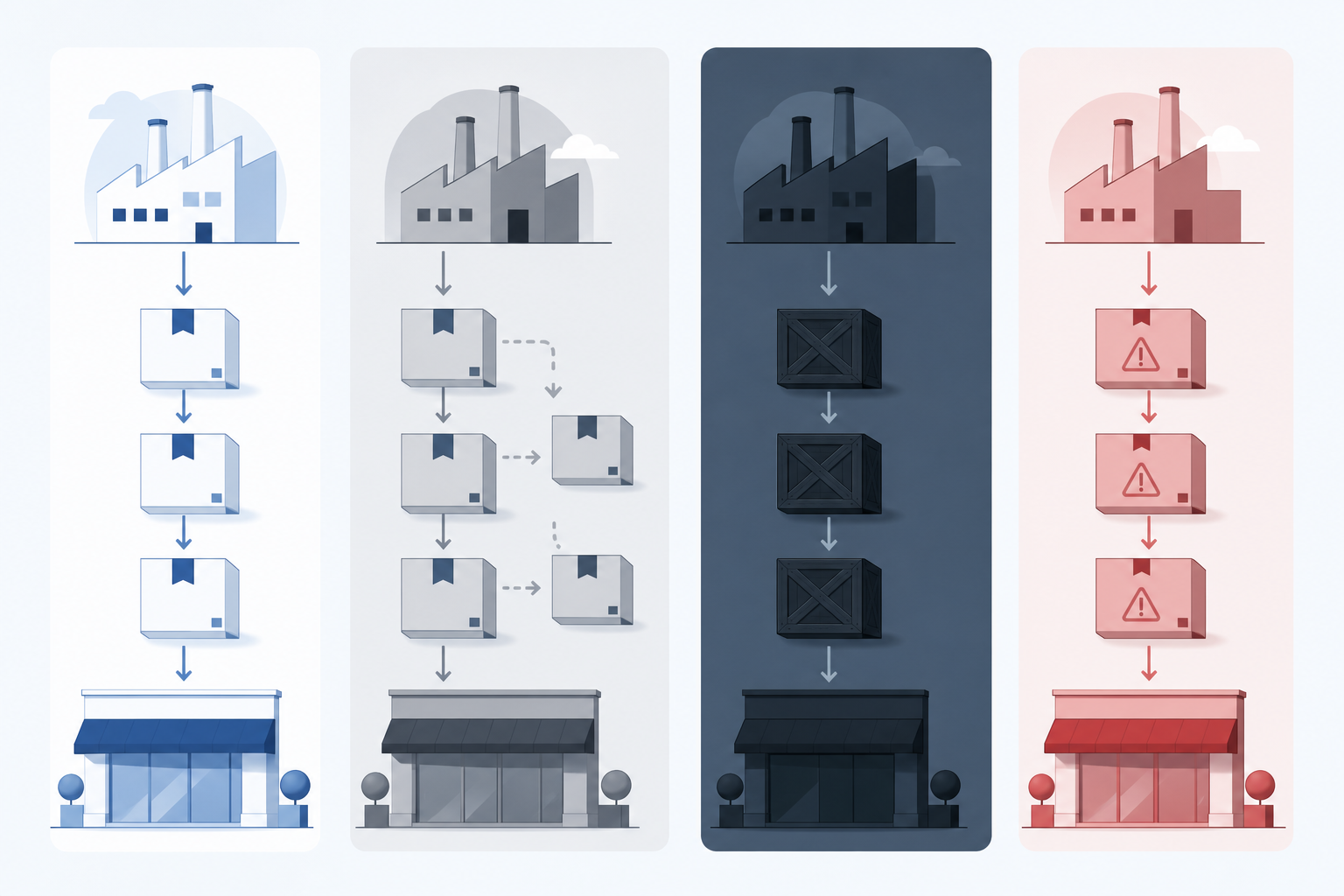
For enforcement: grey goods are real products in the wrong channel; counterfeits are fakes carrying your marks.
Gray Market or Grey Market: Spelling and Terminology
Both spellings are correct and interchangeable. "Gray" dominates American English, while "grey" is standard in British English, so a US brand team and a UK distributor may write the same term differently in one contract. The concept does not change.
You will also see this trade called the parallel market or parallel imports, with the goods themselves called grey goods. In finance, grey markets refer to pre-listing securities trading, a separate meaning covered later.
How Grey Market Transactions Work and Why They Exist
Grey market supply runs on arbitrage. When the same product carries different prices across regions, a reseller buys where it is cheap and sells where it commands more. Currency swings widen those gaps, as does distributor overstock dumped into liquidation and weak channel controls that let authorized partners divert inventory to third parties.

A worked example, the kind a seller monitoring solution is built to catch: a watch retails for $3,000 in one market and $4,200 in another. A reseller buys authentic stock low, ships it, and undercuts authorized dealers at $3,800. Multiply that across pallets, and diverted inventory floods channels you never approved.
Common Grey Market Product Categories
Grey market activity clusters where price gaps, regional exclusivity, and portable high-value goods meet. The most active categories:
- Luxury watches: wide regional price spreads and authorized-dealer scarcity
- Automobiles: spec and price differences across markets drive grey imports
- Electronics and cell phones: over 30% of mobile phones traded pass through the grey market, per Wikipedia, a pattern that also plays out when brands respond to unauthorized sellers on Amazon
- Perfume and cosmetics: distributor overstock diverted to discounters
- Pharmaceuticals: cross-border price gaps and supply shortages
- Software and video games: region-locked keys resold globally
- Securities: pre-listing trading before official issuance
Grey Market Watches: What They Are and Are They Authentic
Grey market watches are authentic timepieces sold by dealers the manufacturer never authorized, usually below boutique prices. Are they authentic? Yes. The watch is genuine. What buyers give up is the manufacturer's warranty, which typically covers only authorized dealers, leaving grey buyers reliant on third-party coverage.
Unauthorized dealers source genuine stock, often through overseas boutiques or dealer diversion or diverted allocations, then resell at a discount. Jomashop and Chrono24 listings are commonly referenced as grey market channels. In 2016, gray market sales accounted for 20% of the global luxury watch market, per Mayer Brown.
Grey Market Vehicles and Grey Import Cars
A grey market vehicle, or grey import car, enters a country outside the manufacturer's official channel, usually to access a model or price not sold locally. A classic example is the Nissan Skyline GT-R, sold in Japan but never officially imported to the United States, which buyers brought in through grey channels for years. Automakers segment markets by territory and price, creating the demand.
The complications are practical. Grey imports must meet local safety and emissions standards or fail registration. VIN records may not match domestic databases, insurers can hesitate to cover non-standard vehicles, and parts or authorized service are often scarce.
Grey Market Perfume and Fragrance
Grey market perfume is genuine fragrance diverted from authorized channels and resold through discounters like FragranceNet and FragranceX. Prices run lower because sellers source distributor overstock, closeouts, and parallel imports.
Forum buyers raise recurring concerns: batch codes tracing production dates, storage affecting freshness, and no brand authenticity guarantee. The harder problem is separating diverted genuine stock from counterfeits, especially given evolving counterfeiter evasion tactics, since packaging alone rarely settles it.
Grey Market Pharmaceuticals, GLP-1s, and Research Peptides
Pharmaceuticals behave differently from watches or perfume because a mislabeled channel here carries clinical risk. Genuine medicine parallel-imported across borders is grey market. GLP-1 drugs like tirzepatide and semaglutide often cross into illegal territory when unapproved or diverted. So do vials marketed as "research peptides" or "research use only" for human use: unapproved, compounded, or diverted stock with no authenticity guarantee.
In markets with strict drug oversight, importing unapproved drugs for human use is a violation, which strips buyers of dosing accuracy, sterility assurance, and legitimate recourse. This is a reminder that the visible seller is rarely the source of the problem.
Grey Market Securities
In capital markets, the grey market refers to trading of securities before they are officially issued, also called the "when-issued" market. Buyers and sellers agree deals on shares that have not yet begun regular trading, typically ahead of an IPO. Those grey market prices act as an early demand signal, helping underwriters price a new issue. The meaning is unrelated to grey market goods, but shares the same unofficial, pre-authorized channel logic.
Grey Market Websites: How to Spot Them and the Risks
Grey market storefronts share recognizable signals. Watch for:
- Prices well below MAP or authorized retail
- No manufacturer warranty, only third-party or in-house coverage
- Vague sourcing language and no authorized-dealer status, the same red flags brands check for when assessing whether Alibaba is safe for brands
- Inconsistent packaging or region-specific variants
The risks fall on you as the buyer: no warranty support, limited technical help, harder repairs and parts access, and the higher chance of counterfeits mixed into genuine stock.
Why the Grey Market Matters for Brand Protection Teams
Grey market activity drains value before it surfaces as a counterfeit. Authorized dealers get undercut, MAP breaks down, and margins compress. Warranty costs land on you for products you never sold into that channel.
The enforcement levers brands pull:
- Distribution agreements with clear resale and territory terms
- Serial and lot tracking to trace diverted stock to its source
- Control buys to confirm sourcing and authenticity
- Warning letters to unauthorized sellers
- Ongoing unauthorized-seller and price monitoring
How MarqVision Helps Brands Detect and Control Grey Market Activity
Each of those levers moves only as fast as you can spot the leak. Our Anti-Unauthorized Sales module gives your team that visibility automatically, in real time. Price monitoring across Amazon, eBay, and Walmart flags MAP violations as they appear. Our Seller Match feature traces inventory leakage to its source. Seller Dialogue verifies authorization and issues warnings, while network analysis maps connected unauthorized sellers. Grey market goods are genuine, so the enforcement problem is channel control, not IP removal. We keep that work separate from counterfeit takedowns and tune our seller intelligence tools to the distribution leak your team is actually chasing.
FAQ
How do I tell whether a discounted listing is grey market or counterfeit before I file enforcement?
Price alone won't settle it, so tie the determination to sourcing evidence. If a control buy confirms genuine stock with mismatched region variants, batch codes, or packaging, treat it as grey market and route it through unauthorized-seller and MAP enforcement; if the goods are fake or carry your marks without authorization, escalate as a counterfeit takedown. The distinction matters because grey goods require channel-control and contract levers, while counterfeits require IP-based removal.
What's the difference between grey market and unauthorized sellers versus counterfeit products?
Grey market and unauthorized sellers move genuine goods through channels you never approved, while counterfeits are fakes carrying your marks. The enforcement basis is what separates them: unauthorized-seller cases hinge on distribution agreements, MAP violations, and seller intelligence, whereas counterfeit cases rely on trademark, copyright, or design rights. Misclassifying the two sends your complaint to the wrong workflow and stalls it.
Should I focus on grey market monitoring or counterfeit enforcement for my brand?
It depends on your documented exposure. If authorized dealers are being undercut on Amazon, eBay, or Walmart and MAP is breaking down, focus on price monitoring and Seller Match to trace the leak; if fakes carrying your marks are the dominant threat, focus on IP-based takedowns. Grey market leakage often becomes a counterfeit pipeline later, so a persistent distribution leak warrants acting on the channel-control problem before it converts.
Can I stop grey market resellers if reselling genuine goods is legal in my market?
Yes, but not through IP takedown claims alone. Because trademark exhaustion and the first-sale doctrine generally protect resale of authentic goods, enforcement leans on distribution agreements, territory and resale terms, serial and lot tracking, and warning letters to unauthorized sellers. In markets like Korea where reselling itself isn't illegal, volume-based warning outreach and compliance-based reporting grounds carry more weight than rights-based claims.
Do grey market warranties transfer, and how does that affect my brand protection stance?
Manufacturer warranties typically cover only authorized dealers, so grey buyers lose that coverage and often turn to you for support on products you never sold into that channel. That warranty cost is a direct signal of diverted inventory and a distribution leak worth tracing to its source. Serial and lot tracking paired with control buys lets you connect the warranty claims back to the authorized partner feeding the grey channel.
Final Thoughts on Grey Market Goods and Channel Control
Grey market trade is usually legal, but it still erodes your pricing, warranties, and dealer relationships. Once you can see diverted inventory and MAP breaks as they happen, you can trace them back and shut the leak down. That kind of visibility turns a messy channel problem into something you can actually manage. Grab a demo with MarqVision if you want to see how the tracing works.
Stay up to date on the latest IP Protection content from MarqVision.




4 Enforcements a Week to 400: Scale Brand Safety with Marq AI

Don’t Just Find Counterfeits. Dismantle the Entire Network.

.png)
Discover the latest trends and challenges in IP protection

Take Control of Your Trademarks with MARQ Folio
Renew and Manage Your Trademarks Easily With MARQ Folio

We’re waiting to hear from you

See the best brand protection solution in action

Don’t let piracy steal your growth

Talk to us about your brand protection problems