Real vs. fake: why K-beauty counterfeits are so hard to spot, and what to do about it
Copied packaging, genuine-level prices and scattered channels make K-beauty fakes hard to spot. How brands protect shoppers and choose a detection solution.
 Irene Lee4 min read
On this page7
- The harm counterfeits do to K-beauty brands
- Why K-beauty counterfeits are hard to identify
- Showing consumers how to spot counterfeits
- What to expect after adopting a counterfeit detection solution
- Key checklist for choosing a counterfeit detection solution
- Global beauty brand Anua on why brand protection matters
- FAQ
The MarqVision blog takes an in-depth look at the counterfeit problems facing legal, IP and brand protection teams at K-beauty brands expanding globally. In previous posts, we covered K-beauty brands’ global growth and challenges and cases of IP infringement against K-beauty brands and how to respond. In this post, from a brand protection manager’s perspective, we focus on the state of the counterfeit problem, why fakes are hard to identify, the harm to consumers and practical ways to respond.
For K-beauty brands fighting counterfeits in global markets, much depends on which counterfeit detection solution they adopt. This post sets out what to watch for when choosing one and walks through the criteria to weigh when comparing options. Consumers put beauty products directly on their skin, so counterfeits threaten consumer safety as well as revenue, and choosing the right solution translates directly into brand trust.
Start with these four factors:
- Technical capability: AI detection accuracy, the range of image and text recognition, and real-time monitoring
- Platform coverage: channel coverage spanning marketplaces, social media and messaging apps
- Cost-effectiveness: pricing structure and real market improvement relative to investment
- Support services: customer support and whether test purchases and legal action are connected
As demand for K-beauty has surged in the US, Europe and elsewhere, K-beauty counterfeits are sold freely on many overseas marketplaces. Fake K-beauty products are easy to find not only on Chinese marketplaces such as Temu and AliExpress but also on US online marketplaces such as Amazon. According to a study of e-commerce counterfeit trends published by US consumer protection group Smart Protection, one in five consumers who bought beauty products online said they had unintentionally bought a counterfeit. It shows how hard it is for consumers to identify genuine products, and if it continues, brand trust suffers directly.
Summary:
- With increasingly sophisticated packaging and genuine-level pricing, K-beauty counterfeits have become nearly impossible for consumers to tell apart
- 30.1% of people who used counterfeit products experienced skin damage, and 68.8% lost trust in the brand
- Brands can build a line of defense for consumers with QR code authentication systems and published lists of authorized sellers
- AI solutions automatically detect counterfeits on more than 200 platforms and remove more than 95% of detected fakes
- Test purchases secure physical evidence that serves as the basis for marketplace reports and legal action
The harm counterfeits do to K-beauty brands
With beauty products, counterfeits can seriously harm consumer health. According to MarqVision’s consumer survey on counterfeit cosmetics, among respondents who had used counterfeit beauty products, 30.1% experienced mild skin damage or discomfort and 9.1% experienced serious health threats or allergic reactions.
Unlike genuine products, fake beauty products made with cheap ingredients can cause rashes, redness and allergic reactions, and harmful chemicals such as arsenic have been found in some counterfeits. The FBI’s warning about harmful ingredients in fake cosmetics confirms that carcinogens such as arsenic, beryllium and cadmium have been detected in counterfeit cosmetics. The FDA’s testing data on heavy metals in cosmetics likewise confirms that heavy metals such as arsenic, cadmium, lead and mercury can be found in cosmetics. Long-term use of counterfeit beauty products containing harmful ingredients also risks serious health problems such as skin, lung and bladder cancer. The American Cancer Society’s information on arsenic and cancer risk confirms that inorganic arsenic is classified as a carcinogen linked to lung, bladder and skin cancer.
Counterfeits don’t only harm consumers’ health. They also do serious damage to brand trust. According to MarqVision’s consumer survey on counterfeit cosmetics, 68.8% of respondents lost trust in a brand after a negative experience, 29.4% said they would avoid the brand in the future, and 15.8% took a critical view of brands that don’t actively act against counterfeits.
For K-beauty brands, these counterfeits damage brand value and can hurt sales of genuine products. On online marketplaces where genuine products and fakes sit side by side, consumers lose trust in the brand, and credibility and revenue take a direct hit.
Download the MarqVision beauty insight report
Why K-beauty counterfeits are hard to identify
1. Sophisticated packaging:
With fashion brands, packaging or product tags make fakes relatively easy to spot, but with beauty products these elements alone are less and less reliable. Makers of counterfeit beauty products use packaging similar to the genuine product so consumers can’t easily tell them apart by appearance. Even fine details such as logo design, box color and product tag numbers are made almost identical, confusing consumers.
Take a popular K-beauty cushion compact, for example. In the past, blurry printing or awkward Korean spelling made fakes easy to spot. But recent fakes increasingly copy the genuine product’s fonts, embossed logo, hologram sticker and even its QR code. Looking at the box alone, it’s practically impossible for consumers to tell genuine from fake.
What makes it even trickier for brand teams is that such sophisticated packaging makes it hard to identify fakes from online product page images alone. Accurate identification means looking past the packaging and analyzing several signals together: seller information, whether official product images were stolen, and real product photos in reviews.
2. Narrowing price gaps:
Low prices used to be one of the main ways to spot counterfeits, but today fakes are often sold at prices similar to genuine products. Some counterfeit sellers deliberately match genuine prices so shoppers won’t suspect a fake on price. This makes it even harder for consumers to tell genuine from fake.
For example, if a popular K-beauty serum sells for about 30,000 won, past fakes were dumped at rock-bottom prices of 5,000–10,000 won, so consumers could filter them out with the rule “if it’s too cheap, be suspicious.” Recently, though, the same fakes increasingly appear at prices nearly identical to genuine, such as 25,000–28,000 won. Sellers also add phrases such as “official store,” “guaranteed genuine” and “shipped direct from headquarters,” along with fake authenticity certificate images, to further dull consumers’ suspicion.
The bigger problem for brand teams is that when fakes appear at prices similar to genuine products, it becomes hard to filter suspicious products automatically by price alone. Accurately identifying fakes requires analyzing multiple signals beyond price, such as seller history, review patterns and whether images were stolen.
3. The spread of online markets:
As global online markets expand, counterfeits circulate easily through many channels, including cross-border export platforms, social media and messaging apps. As seller registration on overseas platforms and social media gets easier, more people buy beauty products at discounted prices on Korean marketplaces and resell them abroad without authorization, adding to the confusion. As overseas platforms get harder for K-beauty brands to control, the risk to consumers grows.
In the past, counterfeit distribution was concentrated on a few large marketplaces, so monitoring targets were relatively clear. Now, sales channels are scattered not only across marketplaces such as Temu, AliExpress and Amazon but also across social media and messaging apps such as Instagram, TikTok, KakaoTalk and Telegram. Even when you block a counterfeit seller in one place, the same seller often reappears on another platform with a new account, so responding channel by channel easily turns into a game of whack-a-mole.
On top of that, channels where posts appear only briefly, such as live commerce and group buys, are growing, and sales are often over by the time a brand notices the problem product. That makes a system that can monitor many channels at once, and quickly, all the more important.
Showing consumers how to spot counterfeits
K-beauty brands can build trust by giving consumers ways to tell genuine products from fakes. For example, they can list authorized sellers on the brand’s official website or explain the design elements unique to genuine products, helping consumers verify authenticity easily. Brands can also consider building systems, such as authentication apps or QR codes, that let consumers check authenticity themselves.
Some K-beauty brands already run systems where scanning the authentication label on the bottom of a product with a smartphone shows the manufacturing date, whether it’s genuine and the list of authorized sellers all at once. Consumers can verify authenticity within seconds of buying, so if they receive a fake, they can recognize it quickly and request a refund or report it.
This kind of guidance goes beyond consumer protection and becomes an effective line of defense for brands too. The more widely people know how to spot genuine products, the harder it is for counterfeit sellers to deceive consumers, and brands build trust with a message of “here’s how to check our products.”
1. A guide to identifying genuine products
Here are specific authentication methods you can share with consumers:
- Check packaging details: Compare font weight and letter spacing, box color saturation and print finish quality with photos of the genuine product. Genuine logos often differ subtly in embossing depth or matte versus gloss finish, for example.
- Verify holograms and serial numbers: Check that holograms change color with the viewing angle and that the serial number on the bottom of the product matches the box. Missing or duplicate numbers are a strong sign of a fake.
- Check the QR code: Make sure scanning the QR code leads to the brand’s official domain. Be suspicious if it goes to an external short URL or an unknown page.
- Confirm authorized sellers: Compare the seller you bought from with the list of authorized sellers on the brand’s official website. If the seller isn’t on the list, authenticity is hard to guarantee.
- Check the ingredient list and certification marks: Look at whether the order of the full ingredient list, the format of the batch number and functional certification marks match the genuine product. Misspelled ingredient names or missing certification marks are classic signs of a fake.
2. Adopting a brand protection solution
Building a dedicated in-house team for manual monitoring is possible, but monitoring each country you’ve entered takes a long time and much is hard to spot by eye, which can make the work inefficient. With AI-based brand protection, you can automatically monitor and act on counterfeits on major marketplaces and social media worldwide. It uses image recognition and text matching to identify suspicious products and removes fakes quickly through immediate enforcement. It also analyzes the channels where counterfeits are found most often and sellers’ patterns, so you can plan your response strategy more efficiently.
Specifically, AI-based solutions automatically analyze millions of product listings that would be impossible for people to search one by one. They compare logos and package images with genuine product data, and compare the text in product names and descriptions too, to pick out suspicious products. MarqVision monitors more than 200 global platforms in real time and removes more than 95% of detected counterfeits from marketplaces.
What matters most isn’t the number of removals but “how much cleaner the market has actually become.” Grouping and analyzing patterns of the same seller operating multiple accounts, and focusing enforcement on the core sellers doing the most damage, delivers more impact for the same effort. The more data accumulates by channel and seller, the more accurately brands can judge where to focus resources.
AI image and text recognition
AI solutions compare the logos and package images on product pages with genuine product data at the SKU level, and analyze keywords in product names and descriptions too, to pick out suspicious products. They catch not only listings that steal official images outright but also fakes that copy only the specs with the logo hidden, making them effective against increasingly sophisticated K-beauty fakes. Because they analyze millions of listings faster than people, they can monitor without gaps even when fakes flood in right after a new product launch.
Price monitoring
Price monitoring identifies both suspicious products listed at prices similar to genuine ones and unauthorized and gray-market listings outside normal distribution. By tracking selling prices by channel, it picks out sellers whose prices are abnormally low or outside official pricing policy, so you can check fakes that are hard to filter by price alone along with parallel import and resale problems at the same time.
Social media and messaging crawling
This approach monitors beyond marketplaces to scattered channels such as Instagram, TikTok, KakaoTalk and Telegram. It catches posts that are visible only briefly before disappearing, such as live commerce and group buys, reducing the whack-a-mole problem of sellers blocked in one place reappearing on another platform with new accounts. These detection methods apply equally to industries beyond beauty. Fashion and luxury brands use price monitoring to track stolen official images and gray-market resale, electronics and toy brands use image and text recognition to filter out listings with forged safety certifications, and luxury and watch brands use crawling to catch fakes traded covertly on social media and messaging apps. Brands can choose the channels and detection methods with the greatest risk for their product lines and focus their resources there.
3. Strengthening verification and response through test purchases
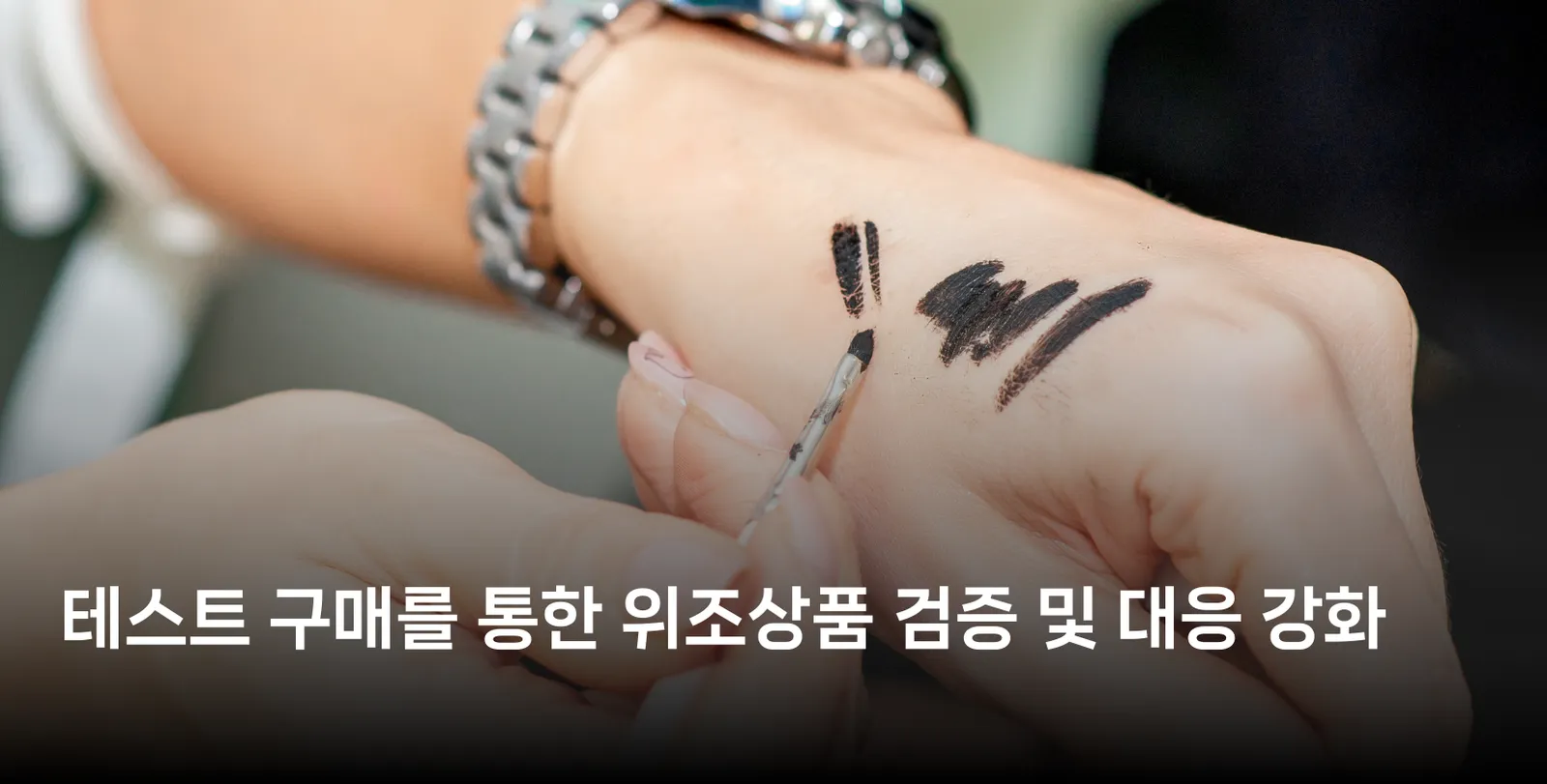
For even more thorough counterfeit blocking, you can also make test purchases of suspicious products. Given that beauty products are hard to judge from online product page information alone, suspicious products are bought directly and tested in detail. When suspicious products detected by a brand protection solution’s AI need further verification, test purchases let you carefully check the packaging, applicator, scent, texture and more. If needed, ingredient testing can be done in partnership with the brand’s cosmetics lab to increase accuracy.
Once a test purchase confirms a counterfeit, it’s reported following each marketplace’s procedures. On DHgate, for example, a product confirmed as counterfeit after purchase can be removed immediately.
Test purchases matter because they secure “physical evidence” that’s hard to get from online images or text alone. With the actual product in hand, you can document specific evidence such as the condition of package printing, mismatched lot numbers and differences in scent and texture, which can be used for marketplace reports and, if necessary, as grounds for legal action.
Test purchase results also help track patterns of the same seller operating multiple accounts. By using the shipping origin or seller contact details obtained from a single purchase to link and analyze other stores run by the same seller, you can target the core sellers doing the most damage instead of removing individual listings one by one.
What to expect after adopting a counterfeit detection solution
A counterfeit detection solution doesn’t stop at deleting fake listings. Here’s what changes brand teams can actually expect after adopting one, in four areas:
- Cleaner markets: Measure impact not by the number of removals but by how much cleaner search results that mixed genuine products and fakes have become. Focusing enforcement on core sellers delivers bigger improvements for the same effort.
- Recovered sales of genuine products: As search visibility and conversions that went to fakes return to genuine products, sales lost to fakes and pressure on pricing ease.
- Restored consumer trust: As the chance of consumers receiving fakes drops, negative reviews and refund requests fall, and consumers who had avoided the brand come back to buying genuine products.
- Saved internal resources: Automation replaces the people and time spent on manual monitoring in each country, letting your team focus on high-value work such as dealing with core sellers and legal action.
Above all, the more data accumulates by channel and seller, the more accurately brands can judge which markets and channels to focus resources on, so response efficiency increases the longer you use it.
In the beauty industry, counterfeits aren’t just a matter of lost revenue. They’re directly tied to consumer safety. For K-beauty brands to keep their credibility and grow successfully in global markets, a brand protection strategy is essential, one that manages authorized distribution channels while quickly detecting and blocking counterfeits. AI-based brand protection is one of the strongest ways to solve this. Marq AI, MarqVision’s brand protection solution, helps brands worldwide respond effectively to counterfeits and protect their value and trust.
The counterfeit problem facing K-beauty brands keeps growing, and the bigger global demand gets, the more serious it will become. Protecting the value of genuine products and building a safe shopping culture through brand protection will remain an important task.
Key checklist for choosing a counterfeit detection solution
Every solution has different strengths and limits, so it’s a good idea to compare candidates against these seven criteria before adopting one:
- Technical evaluation criteria: Check AI detection accuracy, detection scope and real-time monitoring. See whether it compares images and text with genuine product data at the SKU level, and whether it catches fakes that copy only the specs without the logo.
- Platform coverage: Check the range of supported marketplaces, social media and messaging apps. It needs to cover overseas marketplaces such as Temu and AliExpress as well as Instagram, TikTok and KakaoTalk to handle scattered distribution.
- Response speed and level of automation: Check how long it takes from detection to reporting and removal, and what share is automated. On channels with short visibility, such as live commerce, response speed determines the scale of harm.
- Reporting and insights: Check whether it shows how much market cleanliness has improved, not just removal counts. You should be able to judge resource allocation from data by channel and seller.
- Cost-effectiveness and pricing structure: Look at whether pricing is per case or flat, and whether you can choose by category or SKU. A structure that lets you focus budget on high-risk product lines works in your favor.
- Customer support and legal services: Check whether it connects to offline action such as test purchases, evidence gathering, litigation and factory raids. Online removal alone lets the same sellers come back.
- Scalability and integrations: Check whether you can flexibly reassign monitoring targets as you enter more countries or as threat channels shift, and whether it integrates with your internal systems.
Global beauty brand Anua on why brand protection matters
A representative of Anua, which leads K-beauty trends in the US, Japan and beyond, said, “By adopting MarqVision, we expect counterfeit distribution of our brand to decrease noticeably,” adding, “In particular, by taking action against sellers selling more than 1,000 counterfeits a month, we aim not only to solve the problem effectively at the distribution stage but also to make more fundamental improvements, such as enforcement against counterfeit manufacturers.”
Before expanding globally, request a free brand protection consultation to see how counterfeits are threatening your brand.
FAQ
Why is it hard to tell genuine K-beauty products from fakes?
Counterfeiters have made packaging far more sophisticated, copying the genuine product’s fonts, embossed logos, holograms and even QR codes, and fakes now sell at prices similar to genuine products, making price-based filtering impossible. On top of that, distribution is spread across many channels, including marketplaces, social media, messaging apps and live commerce, making tracking even harder.
How much health harm do counterfeit beauty products cause consumers?
According to MarqVision’s survey, 30.1% of people who used counterfeit beauty products experienced mild skin damage or discomfort, and 9.1% experienced serious health threats or allergic reactions. Harmful chemicals such as arsenic have been found in some counterfeits, and long-term use can lead to serious diseases such as skin or lung cancer.
How are AI-based brand protection solutions different from manual monitoring?
AI solutions automatically analyze millions of listings across more than 200 global platforms, comparing logo and package images and product name and description text with genuine product data to identify suspicious products. Manual monitoring, by contrast, takes a long time for each country and misses much that’s hard to spot by eye, making it inefficient. MarqVision removes more than 95% of detected counterfeits from marketplaces and analyzes patterns of the same seller operating multiple accounts to focus enforcement on core sellers.
What happens when brands show consumers how to identify genuine products?
When brands share authorized sellers and design elements unique to genuine products, or provide systems where scanning a QR code shows the manufacturing date, authenticity and list of authorized sellers, consumers can recognize a fake immediately and request a refund or report it. The more widely people know how to spot genuine products, the harder it is for counterfeit sellers to deceive consumers, and brands can build trust and curb counterfeit distribution.