.jpeg)
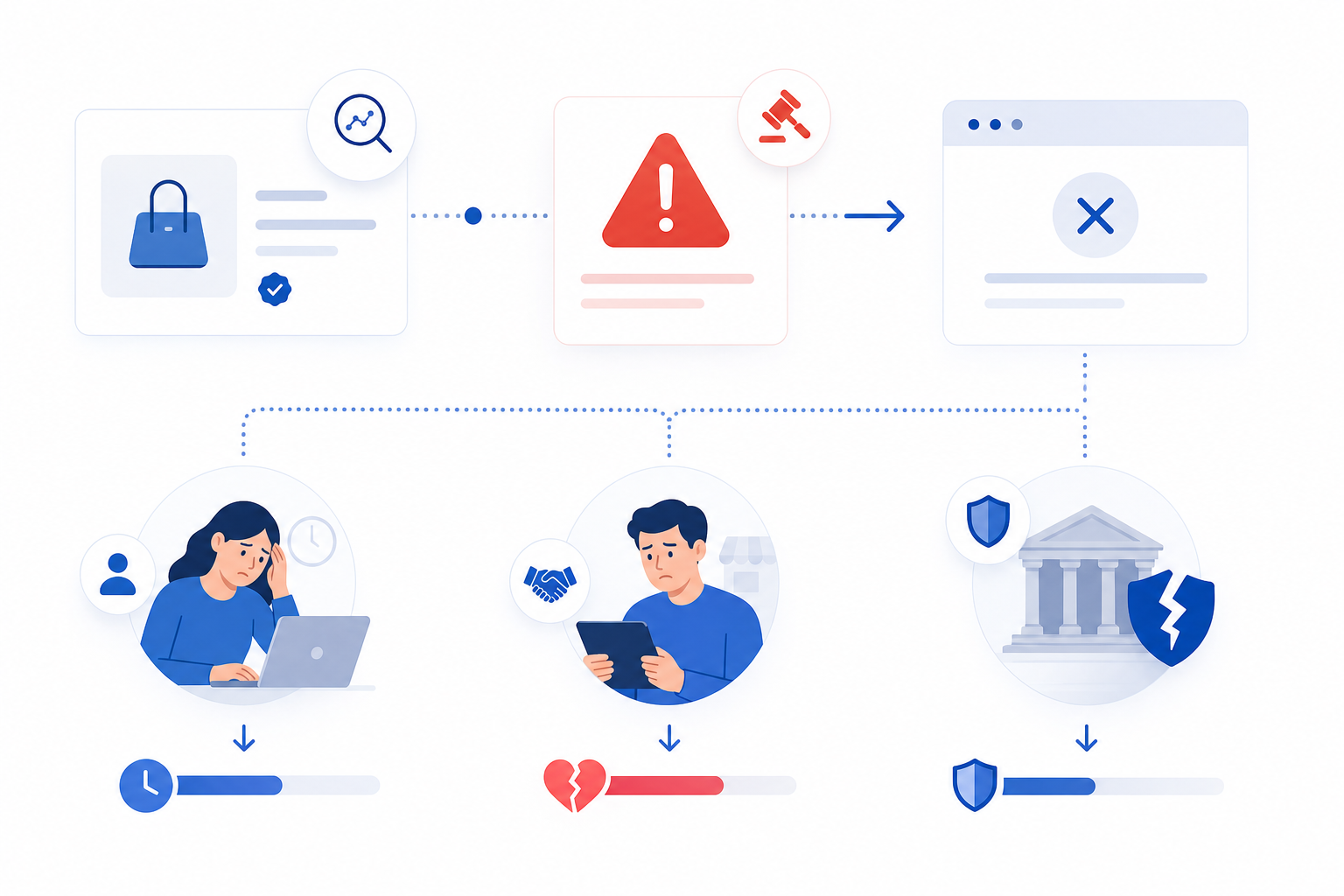
A wrongful takedown costs more than a reversal. It costs the analyst time to fix it, the seller trust to repair, and the platform credibility you'd rather spend on a real infringement. False positives in brand protection are a systems problem with real dollar consequences, and there are specific levers you can tune to reduce them without slowing your enforcement down.
TLDR:
- A false positive in enforcement is a live wrongful action, not a stray flag; it costs analyst time, partner trust, and platform credibility.
- Surface-level keyword or logo matching causes most false positives because a 96% accurate system still flags legitimate authorized sellers.
- Wrongful takedowns create three legal exposures: tortious interference claims, DMCA misrepresentation liability, and platform reporting suspensions.
- Authorized seller whitelists, multi-signal detection, and SKU-level comparison cut false positives without reducing enforcement volume.
- A tiered human-in-the-loop model routes only borderline cases to analysts, then feeds their decisions back into training to shrink the review queue over time.
- MarqVision reports 97% accuracy on enforceable item detection using SKU-level comparison and 99.8% accuracy across 48,000+ domain impersonation incidents (per internal MarqVision benchmarks).
What False Positives Mean in Brand Protection Enforcement
A false positive is what happens when your detection system flags something legitimate as an infringement. An authorized reseller gets tagged as a counterfeiter. A compliant paid campaign lands in the takedown queue. A first-party listing you control gets marked for removal. The system saw a match where none existed, and it acted on that mistake.
The word "positive" can mislead here. In enforcement, a false positive is not a stray flag sitting harmlessly in a review queue. It is a live enforcement action aimed at the wrong target, and that is what makes it costly. A dismissed flag costs an analyst seconds. A takedown filed against a legitimate seller costs a relationship, sometimes a contract, occasionally a legal response.
That gap between a bad flag and a bad enforcement action is where the real damage lives, hitting sellers and partners in ways that rarely surface on a standard accuracy dashboard for brand protection software, per a brand protection accuracy analysis.
Why AI Systems Generate False Positives at Scale
False positives are a systems problem with identifiable causes, most tracing back to how detection models are built and what they can see. Among industry systems, even a system running at 96% accuracy still flags legitimate authorized uses incorrectly. This is a known challenge for AI brand protection platforms, per an image recognition brand protection guide. The gap comes from a few recurring failure points:

- Surface-level matching. When detection leans on keyword or logo signals alone, a compliant listing that shares a brand name or product image reads as infringement, because the model matched a string or shape without reading intent.
- Thin training data for niche categories. Specialized verticals give a model fewer examples to learn from, so the boundary between genuine and fake stays fuzzy and the system errs toward flagging.
- No context for authorized sellers. A model scanning a listing in isolation cannot know a distributor holds a valid contract, so legitimate channel partners get swept into the queue.
- Variants that look identical to fakes. Refurbished units, regional packaging, and limited-edition runs can be visually indistinguishable from counterfeits on imagery alone.
How False Positives Damage Channel and Partner Relationships
When a takedown lands on an authorized reseller, the first casualty is revenue. Their listing goes offline, the buy box moves to a competitor, and their sales stop while they try to understand why the brand they distribute just filed against them. You are now working against your own distribution.
The second casualty is trust, and it takes longer to repair. A distributor flagged once starts reading every future enforcement notice as a threat instead of protection. Some escalate to their account manager. Others quietly stop promoting your products.
The deeper damage is reputational. Once a partner concludes your automated enforcement fires without discrimination, that perception spreads across the channel, and the cooperation you depend on for a proactive enforcement strategy starts to erode.
The Legal Exposure Behind a False Takedown
A wrongful takedown does not stay contained to a strained partner relationship. It can create liability for your brand.
Three exposures come up most often:
- Tortious interference. When you knock a legitimate seller's listing offline, you interfere with their contracts and business expectations. If they show the enforcement was baseless and cost them sales, that becomes a claim against you.
- Wrongful DMCA submissions. Filing a copyright takedown against content you have no valid claim to can expose you to misrepresentation liability under 17 U.S.C. 512(f). A pattern of baseless filings draws scrutiny from platforms and courts, and the standard for "knowingly" misrepresenting a claim is lower than many enforcement teams expect.
- Platform policy violations. Marketplaces track submitter accuracy. A pattern of inaccurate claims can throttle your reporting privileges or suspend your enforcement account.
How far any of this reaches depends on the jurisdiction and the marketplace's own rules, so treat it as a risk to scope, not a settled outcome.
Measuring the True Cost of False Positives
Raw takedown volume tells you how busy your enforcement is, not how accurate. One way to track this is to measure what each wrong flag actually costs, across four buckets:
Run one false positive through all four and the number climbs fast. A wrongful takedown against an authorized reseller interrupts their revenue, ties up an analyst reversing it, and spends credibility you will need on the next legitimate claim. This is a hidden cost that the best brand protection tools are designed to minimize. Track that composite figure. As covered in The End of Takedown Thinking, success is no longer measured by how many takedowns you file. It is measured by how few of them are wrong.
Product Categories Where False Positives Are Hardest to Control
Some verticals carry structurally higher false positive risk, and knowing yours before you calibrate an enforcement program saves you from correcting the same mistakes at scale.
- Used and refurbished goods: Authentic second-hand listings and fakes share the same wear, packaging, and imagery, so detection alone cannot separate a legitimate resale from an infringing one.
- Beauty and consumables: Authenticity lives in formulation, scent, and texture, none of which a listing image or title can verify.
- Collectibles: Edition numbers, production variants, and condition decide legitimacy, and generic detection models read normal variation as counterfeit.
- Gray market goods: The product is genuine; only the distribution is unauthorized, which no visual or metadata signal reliably flags. This is a recurring challenge in digital brand protection for global brands.
Reducing False Positives Without Sacrificing Scale
Accuracy and volume are not opposed. The levers that cut false positives are configurable, and any enforcement program can tune them:

- Authorized seller whitelists: Load your distributor and partner lists so legitimate sellers are suppressed from the queue before a flag ever fires. This is a foundational step covered in the brand protection starter guide, and keep them current as relationships change.
- Smart rule filters: Configure your system to suppress known legitimate signals before enforcement fires, as with listings tagged "used" in categories where authentic resale and counterfeits share the same shelf.
- Multi-signal detection: Trigger enforcement only when several indicators line up, not on a lone keyword or logo match.
- SKU-level comparison: Match listings against genuine product data to catch trademark-evasive fakes while leaving authorized variants untouched.
The Human-in-the-Loop Model for Borderline Cases
Human review and scale can work together, but the belief that they cannot leaves teams stuck. Reviewing every flag by hand sinks throughput. Reviewing none lets ambiguous cases turn into wrongful takedowns. The workable middle is a tiered model where AI handles large-scale detection and initial scoring, then routes only borderline or high-risk cases to analysts, per a tiered human-in-the-loop model.
At the review tier, an analyst checks the signals a model cannot weigh alone: seller history, marketplace behavior, authorization status, and the strength of supporting evidence. Clear-cut cases never reach a human. Ambiguous ones get judgment before enforcement fires.
Then close the loop. Log each analyst decision back into training so the next similar case scores more accurately, shrinking the review queue over time.
How MarqVision Maintains Accuracy Across 1,500+ Platforms
Everything covered so far describes the accuracy problem at scale. Our detection architecture was built to answer it.
Full-Stack Detection compares each listing against genuine product data at the SKU level instead of matching on a brand name or logo, which is where surface-level systems generate their worst mistakes. That approach reaches 97% accuracy in eliminating enforceable items, catching trademark-evasive fakes while leaving authorized variants alone.
Around it sit the guardrails this post has argued for. Smart discard rules filter ambiguous listing types automatically, such as "used" goods in categories where authentic resale coexists with counterfeiting. Authorized seller whitelists cross-reference every detected seller against your distributor lists before a flag fires. An agentic classification layer decides which listings fall within enforcement scope before any action is taken.
That discipline extends across channels. Our AI runs at 99.8% accuracy across more than 48,000 domain impersonation incidents, with human review wired into the core enforcement pipeline for the calls a model should not make alone.
FAQ
How do false positives in AI brand protection damage authorized seller relationships beyond what accuracy dashboards show?
A wrongful action against an authorized reseller knocks their listing offline, shifts the buy box to a competitor, and tells that partner your enforcement program cannot tell them apart from a counterfeiter. The listing restores; the relationship does not automatically follow. Distributors flagged once begin treating every future enforcement notice as a threat rather than protection, and that perception spreads through your channel, cutting the cooperation your legitimate claims depend on. Track partner remediation effort and platform credibility decay alongside raw takedown volume. Those numbers reveal the cost that standard accuracy dashboards miss entirely.
What is the fastest lever to pull when reducing automated takedown false positive rates without losing enforcement volume?
Start with authorized seller whitelists loaded against your full distributor list before any detection rules run. That single step removes the most common false positive source, legitimate channel partners, without touching enforcement volume. Then add smart discard filters for known ambiguous signals: "used" listings in categories where authentic resale coexists with counterfeits, for example. Layer multi-signal detection so enforcement only triggers when several indicators align rather than a lone keyword or logo match, and route only borderline cases to human review. MarqVision reports that SKU-level comparison against genuine product data reaches 97% accuracy in identifying enforceable items while leaving authorized variants untouched, per internal MarqVision benchmarks.
In which product categories is automated enforcement accuracy hardest to maintain, and how should I adjust my program in those verticals?
Used and refurbished goods, beauty and consumables, collectibles, and gray market categories all carry structurally higher false positive risk because authenticity depends on signals that listing images and titles cannot verify: wear patterns, formulation, edition variants, and distribution authorization status. In these verticals, configure smart rules that filter ambiguous listing types automatically, require multi-signal confirmation before enforcement fires, and build test purchase programs into your evidence workflow. Physical inspection can confirm cases where digital detection alone cannot draw a reliable line between a legitimate listing and an infringing one.
What legal exposure can a wrongful takedown create for my brand?
Three risks come up most often. First, tortious interference: if a legitimate seller shows your baseless enforcement cost them documented sales, that becomes a claim against you. Second, wrongful DMCA submissions: filing a copyright takedown without a valid claim can expose you to misrepresentation liability under 17 U.S.C. 512(f), and the bar for "knowingly" misrepresenting a claim is lower than most teams expect. Third, platform policy violations: a pattern of inaccurate filings degrades your submitter accuracy score and can restrict or suspend your enforcement account. Exposure depends on jurisdiction and each marketplace's own rules, so treat these as risks to factor into program design rather than settled outcomes.
How does MarqVision's accuracy compare between domain impersonation enforcement and marketplace counterfeits?
MarqVision reports 99.8% automated enforcement accuracy across more than 48,000 domain impersonation incidents, with human review built into the pipeline for the judgment calls a model should not make alone, per internal MarqVision benchmarks. On the marketplace side, Full-Stack Detection runs SKU-level comparison against genuine product data rather than relying on brand name or logo matching, which is where surface-level systems generate their worst false positives against authorized variants. Both channels use authorized seller whitelists and an agentic classification layer to filter legitimate activity before any action is taken. The shared architecture is what keeps accuracy consistent across very different enforcement surfaces.
Final Thoughts on Managing False Positives in AI-Powered Brand Protection
Accuracy in brand enforcement is more than an internal quality metric, it is a direct input to how much your partners trust you, how much credibility you carry on the platforms you file against, and how quickly your legitimate claims get resolved. A false positive that reaches enforcement is not a minor error, it is a live action pointed at the wrong target, and fixing it costs more than preventing it ever would have. The teams that get this right treat authorized seller data, multi-signal detection, and human review not as overhead but as the infrastructure that makes scale safe. See how MarqVision keeps false positives low.
Stay up to date on the latest IP Protection content from MarqVision.




4 Enforcements a Week to 400: Scale Brand Safety with Marq AI

Don’t Just Find Counterfeits. Dismantle the Entire Network.

.png)
Discover the latest trends and challenges in IP protection

Take Control of Your Trademarks with MARQ Folio
Renew and Manage Your Trademarks Easily With MARQ Folio

We’re waiting to hear from you

See the best brand protection solution in action

Don’t let piracy steal your growth

Talk to us about your brand protection problems