.jpeg)
Brand protection software detects, prioritizes, and removes counterfeit, gray-market, and impersonation activity targeting a specific brand across online marketplaces, social commerce, ad networks, and websites. It typically pairs AI-based detection with human-reviewed enforcement workflows to drive both scale and accuracy.
Counterfeits do more than steal revenue. They distort pricing, confuse customers, weaken marketplace trust, and damage your brand's reputation. For legal, ecommerce, marketing, marketplace, and brand-protection teams, the category exists because online infringement has grown too large, too fast, and too fragmented to manage manually. As this brand abuse compounds, the expense of recovery grows with it.
This guide explains what brand protection software does, which features matter, approximately what it costs, how it integrates with the rest of the enterprise stack, how to measure ROI, and how the major vendors compare.
TL;DR
- Brand protection software is not just a monitoring tool. It detects, prioritizes, and removes counterfeits, gray-market sellers, impersonation accounts, fake domains, and infringing ads — across dozens of channels simultaneously.
- AI makes scale possible, but human review keeps it accurate. Modern platforms fuse image recognition, logo detection, listing-language analysis, seller-behavior clustering, and price signals to surface the right threats before they grow — while routing ambiguous cases to human analysts.
- Saturation Rate is the metric that connects enforcement to revenue. It measures the share of infringing listings in a marketplace. Tracked over time, it converts an abstract infringement problem into a concrete revenue-exposure figure that finance and executive teams can act on.
- Cost varies widely — and the cheapest option is rarely the best one. Focused programs can run below $2,000 per month; enterprise programs may exceed seven figures. Evaluate cost against the revenue exposure and operational burden the program reduces.
- Vendor selection comes down to operating fit, not feature lists. Probe enforcement workflows, evidence quality, reporting depth, and how the platform supports the internal business case — not just which channels are covered.
What is brand protection software?
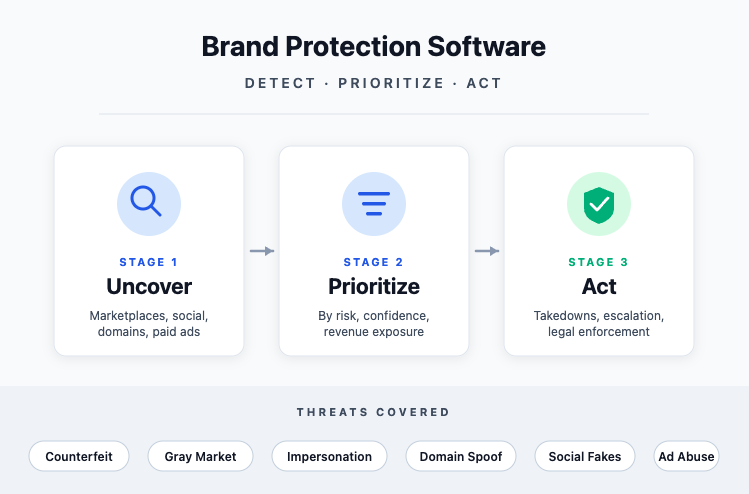
Brand protection software is the operating layer for online brand integrity. It continuously scans digital channels to identify potential infringements, prioritizes threats based on business impact, and supports takedowns through evidence collection, escalation, and reporting to tie monitoring to measurable outcomes.
In practice, every enterprise-grade platform performs three jobs in a continuous loop:
- Uncover potential abuse across marketplaces, social platforms, websites, domains, paid ads, and search results.
- Prioritize findings by risk, confidence, channel, seller behavior, product value, geography, and revenue exposure.
- Act through marketplace takedowns, social-platform reporting, registrar and hosting escalation, legal workflows, and repeat-offender tracking.
The category exists because the scale of abuse has moved beyond what internal staff can cover. A single brand may need to monitor Amazon, Alibaba, TikTok Shop, AliExpress, Instagram, regional ecommerce platforms, Shopify storefronts, domain registrations, and paid-search results all at the same time. Counterfeiters rotate sellers, recycle product images, test demand in small batches, and exploit gaps between marketplaces faster than human analysts can keep up. Generative AI and low-cost creative tools have lowered the cost of producing fake ads, lookalike sites, copycat product pages, and impersonation accounts to near zero.
The threat surface enterprise brand protection software typically covers:
The problem is well documented. The OECD and EUIPO's Mapping Global Trade in Fakes 2025 report, based on 2021 customs seizure data, estimates counterfeit and pirated goods at up to 2.3% of global trade and up to 4.7% of EU imports. Amazon's 2025 Brand Protection Report says the company identified, seized, and disposed of more than 15 million counterfeit products worldwide and blocked over 99% of suspected infringing listings before a brand had to find and report them (Amazon, 2025). This clearly shows how much detection infrastructure now sits inside the marketplaces themselves, and why enterprise brand owners increasingly need to establish a proactive posture across the channels they care about.
Brand protection as a category is undergoing a definitive shift: from reactive takedowns to proactive brand integrity. Reactive monitoring catches abuse after it has spread; proactive control reduces detection latency, separates urgent threats from low-value noise, and protects revenue before damage compounds. That distinction is why brand protection now belongs in executive conversations alongside ecommerce and marketing performance rather than siloed within legal teams.
What features should you look for in a brand protection platform?
Strong evaluations organize requirements around outcomes, not feature checkboxes. A mature program needs five things: visibility, proactive detection, scalable enforcement, evidence quality, and measurement. Treat the first four as table stakes — any vendor pitching enterprise brand protection must score well on all of them — and treat measurement as the differentiator that determines whether the program survives executive review.
The strongest platforms also vary their workflows by threat type. A counterfeit listing for a hero SKU on a priority marketplace should not follow the same path as a suspicious reseller account with limited traffic or a lookalike domain harvesting customer data. Each deserves a different prioritization, evidence package, and escalation route.
Two warnings worth surfacing during evaluation: do not buy monitoring without enforcement (a platform that mainly produces a long queue of suspicious URLs increases internal workload rather than reducing it), and do not treat all infringements as equal (prioritization must reflect revenue exposure, safety risk, customer confusion, seller history, and legal significance — not raw alert volume).
How do AI-based counterfeit detection tools actually work?
AI is what makes the category scalable. A manual analyst can review a few hundred listings per day; AI agents can review tens of millions. The accuracy advantage of modern brand protection software comes from fusing several signals, not from any single detection technique.
A suspicious marketplace listing is typically evaluated against six concurrent signals:
- Image similarity. Does the product photo resemble protected product imagery or known counterfeit patterns? Image embeddings allow near-duplicate detection across millions of listings even when sellers alter photos.
- Logo and text detection. OCR extracts text from product photos, packaging, and hangtags and matches it against registered trademarks and trade dress.
- Listing language. NLP parses titles, descriptions, and bullets for known counterfeit phrasings — replica, mirror quality, dupe, and coded counterfeit terms.
- Seller behavior. Has this seller, or a related account in the same fraud graph, appeared before? Shipping addresses, payment processors, image reuse, and listing-template similarity link related storefronts.
- Price and availability. Is the product priced far below expected retail, or offered in quantities a legitimate reseller could not source?
- Channel context. Is the listing on a priority marketplace, in a high-risk region, or in a category with elevated counterfeit prevalence?
AI does not replace human judgment; it enhances it. Its primary role is to increase the share of work that can be reviewed automatically while improving the prioritization of cases that require human attention.
The most effective approach combines automated detection, confidence-based scoring, human review of ambiguous or high-risk cases, and structured enforcement processes. Over time, feedback from reviewed outcomes can be used to retrain models and improve accuracy.
A common pitfall is placing too much trust in automation. High false-positive rates reduce confidence and create unnecessary work, while false negatives allow significant threats to go undetected. Successful programs continuously measure both and adjust their models and workflows to maintain the right balance.
What does enterprise brand protection software cost?
Most brand protection software is sold through custom annual contracts. Vendors rarely publish pricing because cost varies with the number of brands, products, marketplaces, geographies, languages, monitored channels, enforcement volume, and service levels. Buyers should think in tiers rather than expect one standard price.
Avoid treating the lowest quote as the best option. A cheaper platform that produces thousands of low-confidence alerts can increase labor costs more than it reduces them. A more expensive platform may be worth the premium if it improves detection quality, speeds enforcement, and produces evidence packages that legal teams can actually use. The right question is not "what does the software cost?" but "what does this program cost relative to the revenue exposure, customer risk, and operational burden it reduces?"
With that said, pricing varies significantly based on program scope, channel coverage, enforcement requirements, and operational complexity. Focused programs with a limited scope often fall below $2,000 per month. Growth-stage programs typically range from $25,000 to $100,000 annually. Enterprise programs have even higher variability and may extend beyond seven figures. As a result, pricing should be evaluated in the context of the risks being addressed and the outcomes being delivered, rather than as a standalone software expense
How do you measure ROI on brand protection software?
Measure ROI as the ratio of value protected to total cost of ownership.
Brand protection ROI = (revenue recovered + price-floor protection + legal-cost avoidance + operational efficiency) ÷ total cost of ownership
The primary KPI that anchors the revenue-exposure input is Saturation Rate: the percentage of infringing listings in a given marketplace. Tracking Saturation Rate before and after enforcement gives you a direct, quantified measure of counterfeit presence. Multiplied against your estimated marketplace GMV, it converts an abstract infringement problem into a concrete revenue exposure figure that finance and executive teams can evaluate. Its inverse, Cleanliness Rate, tracks the share of genuine listings and becomes the headline metric a mature brand protection program reports upward.
Numerator components
- Revenue recovered or protected. Dollar value of legitimate sales that would have been displaced by counterfeit activity, recovered through enforcement. Attribution is imperfect — you cannot prove a counterfeit sale would have converted — but a standard model applies a conservative substitution rate to the counterfeit GMV removed.
- Price-floor protection. Margin preserved when gray-market and unauthorized-reseller activity is removed and pricing returns to authorized-channel floors. For brands with selective distribution policies, this is often the largest line item.
- Legal-cost avoidance. Reactive-litigation cost avoided through proactive enforcement, plus damages recoverable through formal legal claims.
- Operational efficiency. Internal hours saved through automation, faster enforcement via templated workflows, and reduced customer-support load from counterfeit-related tickets.
- Reduced customer harm. Fewer fake products, fake sites, and impersonation incidents reaching customers, with the trust and retention implications that follow.
Denominator components
- Software subscription.
- Implementation and integration work.
- Internal team time (analyst, legal, ecommerce, regional).
- External enforcement or legal support, including any Schedule A litigation costs.
- Marketplace program fees and related operational costs.
The most credible ROI model is built on your own pilot data. Start with one category and a limited set of priority channels. Capture a baseline before the platform turns on: saturation rate (the share of infringing listings per marketplace), cleanliness rate, suspect-listing count, removal rate, time to removal, repeat-seller rate, estimated revenue exposure, customer-complaint volume, and team hours spent. Compare those numbers 90 days after the platform is live.
If pilot data does not yet exist, present ROI as a scenario model — conservative, expected, aggressive — with assumptions labeled clearly so finance, legal, and ecommerce can challenge and improve them. The single biggest reporting mistake at this stage is measuring only takedown volume. A mature program also tracks saturation rate, cleanliness rate, time to removal, recurrence, seller-network depth, product and category exposure, customer-trust indicators, and revenue impact. Volume alone does not survive an executive review; outcome metrics do.
A mature brand protection program has three operating layers — visibility and intelligence, proactive control, and scalable execution — wrapped in executive reporting that connects each layer to revenue, trust, and operational efficiency. The end state is not "more takedowns." The end state is a function that the business can trust to manage brand integrity systematically.
How does brand protection software compare across vendors?
Vendor comparison should focus on operating fit, not feature parity. Most vendors will claim AI detection, marketplace coverage, enforcement workflows, and reporting. The real differences appear in the answers to eight evaluation questions:
- Which channels are actually monitored? Confirm coverage for your highest-risk marketplaces, social platforms, search surfaces, domains, and regional ecommerce sites — not the vendor's full list of supported platforms.
- How is confidence scored? Ask how the platform reduces false positives and how human review fits into the workflow. Request the precision and recall benchmarks the vendor uses internally.
- What happens after detection? Look for clear enforcement paths with status tracking, templated submissions, legal escalation, and repeat-offender analysis. Vendors who cannot describe the post-detection workflow specifically are selling monitoring, not enforcement.
- How strong is the evidence package? Confirm the system preserves URLs, screenshots, timestamps, seller data, product data, and case history in a legal-admissible export format.
- Can teams collaborate inside the platform? Legal, ecommerce, security, and regional teams need different views and permissions.
- What reporting does leadership receive? Dashboards should show business impact — revenue exposure, recovery rate, trust indicators — not just detected-listing counts.
- How transparent is implementation? Ask about onboarding timeline, data requirements, integration scope, support model, and what the vendor needs from your team.
- Can the platform support the internal business case? Champions need proof packs, ROI outputs, and executive-ready reporting that connect brand integrity to growth.
Two related comparisons are worth flagging during evaluation. First, brand protection software and trademark monitoring are adjacent categories that solve different problems:
Frequently Asked Questions
What is brand protection software, in one sentence?
Brand protection software is an enterprise platform that detects, prioritizes, documents, and removes counterfeit, gray-market, impersonation, and IP-abuse activity targeting a brand across online marketplaces, social commerce, ad networks, and websites — combining AI-based detection with human-reviewed enforcement workflows.
How is brand protection software different from trademark monitoring?
Trademark monitoring watches for new trademark filings and legal-rights conflicts in the filing record — a legal-research function owned by IP attorneys. Brand protection software watches for active commercial abuse in market — counterfeit listings, unauthorized sellers, fake domains, social impersonation, infringing ads — and operates the takedown and escalation workflows that remove the abuse. The two are complementary: trademark monitoring informs strategy; brand protection software executes against active threats.
What does enterprise brand protection software cost in 2026?
Brand protection software is sold through custom annual contracts. Cost depends on monitored channels, brand and product scope, geographic and language coverage, enforcement volume, integration depth, support model, and whether legal services are bundled. Buyers should plan in three tiers — focused, growth, enterprise — and evaluate cost against the revenue exposure and operational burden the program reduces, not on the final price tag.
Does brand protection software actually work?
Yes, when paired with clear internal ownership, strong evidence handling, platform-specific enforcement workflows, and a realistic threat model. The way to prove impact is to capture a baseline before implementation — suspect-listing count, removal rate, time to removal, recurrence, revenue exposure, trust indicators, team hours — and compare those numbers 90 days after the platform is live.
What is the ROI of brand protection software?
Estimate ROI as the value recovered or protected divided by total cost of ownership. Numerator inputs include recovered revenue, price-floor protection, legal-cost avoidance, faster enforcement, customer-harm reduction, and internal labor savings. Denominator inputs include subscription, implementation, internal time, external legal support, and marketplace program fees.
Stay up to date on the latest IP Protection content from MarqVision.




4 Enforcements a Week to 400: Scale Brand Safety with Marq AI

Don’t Just Find Counterfeits. Dismantle the Entire Network.

.png)
Discover the latest trends and challenges in IP protection

Take Control of Your Trademarks with MARQ Folio
Renew and Manage Your Trademarks Easily With MARQ Folio

We’re waiting to hear from you

See the best brand protection solution in action

Don’t let piracy steal your growth

Talk to us about your brand protection problems