.jpeg)
Someone registered a domain that looks like yours yesterday. Another seller just listed a counterfeit version of your product on a marketplace you don't monitor. A fake customer support account is replying to complaints about your brand on social media right now. These external threats move faster than any team can track manually, and they live where your security perimeter ends.
Digital brand protection is the discipline built to watch and defend how your brand shows up across the public internet, covering phishing sites, counterfeit listings, fake accounts, lookalike apps, and leaked credentials. We're breaking down how the system works in 2026, from automated discovery scanning 5 million domains daily to enforcement workflows that remove confirmed threats with a median time of 5.3 hours.
You'll see the difference between digital risk protection vendors focused on security operations and brand protection companies rooted in IP enforcement. You'll learn why those boundaries overlap now, and what tools actually close coverage gaps. This guide covers how digital brand protection services and digital risk protection fit together, what capabilities to look for, and how to tell which approach closes your coverage gaps.
We cover brand protection cyber security, brand protection examples in business, and the metrics that prove your program is making channels cleaner instead of just logging takedowns. If you're defending a global brand against impersonation and counterfeiting, here's the framework and the tools that matter.
TLDR:
- Digital brand protection guards threats outside your firewall: phishing sites, counterfeit listings, fake social accounts, and leaked credentials.
- Counterfeit goods accounted for $467 billion in global trade in 2021, per the OECD; phishing and spoofing losses reached $215.8 million in 2025, per the FBI IC3 2025 report.
- 82.6% of phishing emails in the first half of 2026 showed AI involvement, accelerating high-fidelity brand cloning.
- Track saturation rate and mean time to reaction instead of takedown volume to measure channel health.
- MarqVision monitors 1,500 platforms across 118 countries and removes domain threats in a median of 5.3 hours.
What Is Digital Brand Protection
Digital brand protection is the practice of watching and defending how your brand shows up across the public internet, beyond your own systems. It covers threats that live where your firewall cannot reach: phishing sites mimicking your login page, counterfeit listings on marketplaces, fake social accounts posing as your support team, lookalike apps, and leaked credentials traded on forums.
Traditional cybersecurity guards what you own: servers, endpoints, internal networks. Digital brand protection guards what attackers build to look like you, from a spoofed domain registered an hour ago to a counterfeit storefront cloned from your product pages.
These external threats appear and vanish faster than manual tracking allows. That speed is why digital brand protection exists as its own discipline.
Why Digital Brand Protection Matters in 2026
Your brand identity is now an attack surface separate from anything your security team controls. The financial stakes make that shift hard to ignore. Counterfeit goods accounted for $467 billion in global trade in 2021, per the OECD, and phishing losses reached $215.8 million in 2025, per the FBI IC3 2025 report.
The market response tracks that pressure. The online brand protection software market is projected to reach $966.59 million in 2026 and climb to $4.64 billion by 2035, a 21.67% annual growth rate, per Market Reports World.
What changed the math is AI. AI powers high-fidelity brand cloning faster and cheaper, fueling fabricated listings and synthetic brand assets at scale. The signal is measurable: 82.6% of phishing emails in the first half of 2026 showed AI involvement, per phishing attack statistics. Any barrier to cloning your brand that may have existed before has collapsed.
The Threat Environment: What Brands Face Online
Brands face threats across channels that rarely overlap with the systems a security team monitors. Knowing the categories helps you map exposure before committing budget.
- Phishing and impersonation sites. Attackers register lookalike domains and clone brand pages to harvest credentials and payment data. Allure Security's 2025 detection data identified more than 326,000 brand impersonation attempts across 6,279 brands.
- Counterfeit product listings. Fake goods flood marketplaces, accounting for an estimated $467 billion in global trade in 2021, per the OECD. Nike has fought counterfeit footwear on third-party marketplaces for decades.
- Business email compromise. The FBI IC3 2024 report attributes $2.77 billion in U.S. losses across 21,442 BEC complaints to spoofed sender identities. AI sharpened these attacks: 82.6% of phishing emails in the first half of 2026 showed AI involvement.
- Social media fraud and unauthorized sellers. Fake support accounts, fraudulent ads, and gray-market resellers divert revenue and erode trust.
- Credential leaks. Stolen logins traded on dark web markets feed account takeover and impersonation campaigns.

Digital Risk Protection vs Brand Protection: Understanding the Difference
Digital risk protection grew out of cybersecurity. It watches external threats across the public, deep, and dark web: phishing campaigns, leaked credentials, executive impersonation, and exposed data traded after a breach. Brand protection grew out of legal practice, centered on trademark enforcement and pulling counterfeit goods off marketplaces.
Here is the boundary. Brand trust now functions as both a legal asset and an attack vector, so the two disciplines overlap on impersonation and fraud. The practical consequence: your legal team and your info security team work the same threats together instead of in separate queues.
How Digital Brand Protection Works: Core Capabilities
A brand protection program runs in four phases, each handing off to the next.
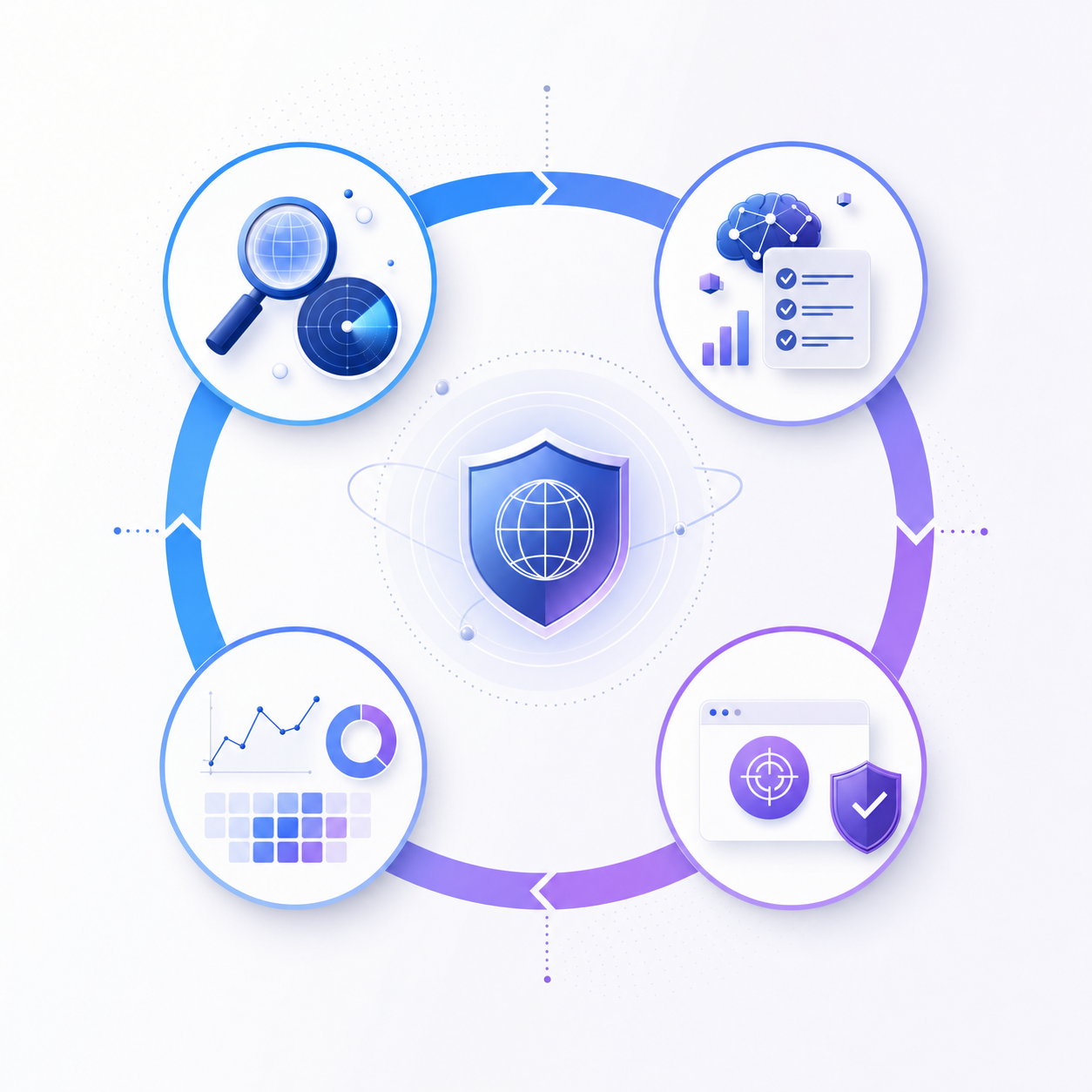
Discovery
Systems scan continuously for your brand: newly registered domains, marketplace listings, social profiles and posts, paid ads, and dark web forums trading stolen credentials. The goal is finding the signal before a customer does.
Analysis
Detected signals get validated. AI and image recognition compare a flagged listing or domain against genuine brand assets, then classify threats versus false positives, keeping your team on confirmed cases instead of noise.
Action
Confirmed threats move to takedown. Requests route through marketplace APIs, registrar abuse channels, and legal mechanisms like DMCA notices or domain disputes.
Monitoring
Tracking threat patterns over time exposes repeat offenders and organized networks operating across multiple storefronts, so enforcement targets the source.
Key Technologies Powering Brand Protection
The volume of listings, domains, and ads that need watching runs into the millions, far past what any team can review by hand. Automation closes that gap.
- Image recognition reads logos and product photography across listings and ads, flagging matches at scale so analysts triage the highest-risk cases first.
- AI classification cuts false positives, so enforcement moves on confirmed threats instead of noise.
- API integrations with Google, Meta, and Cloudflare shrink takedown times down from days to hours.
- Network analysis links sellers by shared phone numbers, contact details, and listing patterns, exposing organized groups behind dozens of storefronts.
Building a Brand Protection Strategy: Core Components
No two programs look alike. The right mix depends on where exposure concentrates across your trademarks, brand-critical domains, flagship product SKUs, and the marketplaces where you sell. Map the assets that need protection first, then point resources at the documented threat profile using brand protection software matched to your dominant threat: marketplace monitoring for counterfeiting, domain and DRP scanning for impersonation, or seller-network analysis for gray-market leakage.
- Inventory every protected asset: registered trademarks by jurisdiction, brand-critical domains and variations, flagship product SKUs and packaging designs, and executive names vulnerable to spoofing in business email compromise campaigns.
- Rank enforcement channels by infringement volume and brand exposure instead of distributing resources equally across all platforms.
- Define escalation paths by threat severity and legal risk, routing active phishing sites through immediate takedown while parked lookalike domains follow standard dispute procedures.
- Set up shared case queues across legal, security, marketing, and customer support to coordinate enforcement actions and centralize threat intelligence.
Match budget to where exposure actually sits:
- If marketplace counterfeiting accounts for most quantified brand exposure, put enforcement budget toward listing removal and seller network disruption.
- If domain abuse and executive impersonation are the primary attack vector, focus resources on discovery scanning and expedited takedown capabilities.
Measuring Brand Protection Effectiveness: Metrics That Matter
Activity proves effort. Outcomes prove the channel got cleaner. The distinction matters when an executive asks whether protection spending returns business value, because takedown volume answers the wrong question. Removing 50,000 listings means little if the first page a buyer finds is an impersonated site.
Track these instead:
- Saturation rate: the percentage of infringing listings in a marketplace, showing how clean a channel becomes over time instead of how many removals you logged.
- Mean time to reaction: speed from detection to removal, the metric that decides whether a phishing site dies in hours or days.
- Brand exposure: the total infringement spread quantified across marketplaces and regions.
Read trends, not snapshots. Saturation rate often climbs early because better monitoring surfaces exposure you never saw, then falls as enforcement compounds. A single reading tells you nothing; the slope over two quarters tells you whether the program works.
MarqVision: AI-Driven Brand Protection at Scale
Everything above maps to how we built MarqVision. We run anti-counterfeit, digital risk protection, anti-piracy, and unauthorized seller monitoring as one Growth Protection System, covering over 1,500 marketplaces across 118 countries.
We report Saturation Rate, the share of infringing listings a buyer actually sees, so legal and executive teams measure whether a marketplace got cleaner. Detection runs through AI agents that classify and investigate listings, and our anti-counterfeit automation reaches 97% accuracy on enforceable items, based on MarqVision's measured detection performance.
Our DRP module tracks 5 million domains daily and removes confirmed domain impersonation threats at a median 5.3 hours. Exclusive scraping access on Temu and Meta Trusted Reporting status drive a 99% takedown rate on fraudulent ads.
For gray-market exposure, we cross-reference distributor lists against 600,000 reseller profiles, tracing inventory leakage to its source.
Final Thoughts on Defending Your Brand Where Customers Search
Brand impersonation and counterfeiting operate outside your network perimeter, so traditional cybersecurity cannot reach them. The program that returns business value maps exposure by channel first, focuses resources on threats customers encounter most, and tracks whether the first page a buyer sees got cleaner over time. AI cuts false positives and pulls takedown speed down from days to hours, but measurement decides whether the effort mattered. Saturation rate shows you what percentage of listings in a marketplace infringe, which answers the question your executive team actually asks: did the channel improve? Request a demo to see how monitoring 1,500 marketplaces and removing threats in 5.3 hours changes that number.
FAQ
Digital risk protection vs brand protection: what's the actual difference?
Digital risk protection watches external threats from a security angle: phishing campaigns, leaked credentials, executive impersonation, and data breaches traded on forums. Brand protection focuses on legal enforcement: pulling counterfeit goods from marketplaces and defending trademarks. The boundary blurs where brand trust becomes an attack vector: impersonation and fraud now hit both queues, so your info security team and legal team work the same threats instead of separate tickets.
Can brand protection programs track marketplace cleanliness over time instead of just counting takedowns?
Yes. Saturation rate measures the percentage of infringing listings in a specific marketplace and keyword, showing how clean a channel becomes instead of how many removals you logged. A falling saturation rate proves the first page buyers see got cleaner; a high takedown count with flat saturation rate means you removed volume without changing the buyer's view. Track the trendline quarterly: early increases often surface exposure you never caught before, then the impact compounds as enforcement removes repeat offenders and organized networks.
What is digital brand protection and how does it differ from internal cybersecurity?
Digital brand protection defends how your brand appears across the public internet, covering threats your firewall cannot reach: phishing sites cloning your login page, counterfeit listings on marketplaces, fake social accounts impersonating your support team, and leaked credentials traded after breaches. Internal cybersecurity guards what you own: servers, endpoints, internal networks. Brand protection guards what attackers build to look like you, from a lookalike domain registered an hour ago to a counterfeit storefront scraped from your product pages. Both disciplines protect company assets, but brand protection operates beyond your perimeter where trademark and reputation function as the attack surface.
How long does it take to see measurable results from a brand protection program?
Saturation rate typically shows meaningful movement quarterly instead of monthly, because cleaning top search results triggers later-page listings to fill those slots in marketplace algorithms. Over six months, you can expect a measurable decrease in infringement percentage; over a year, some platforms may approach near-zero saturation depending on how organized and persistent the seller networks targeting your brand are. Mean time to reaction (speed from detection to takedown) improves immediately once API integrations and enforcement workflows activate, often dropping from days to hours within the first 90 days.
What metrics prove brand protection ROI to finance and executive teams?
Saturation rate (the share of infringing listings a buyer sees, proving marketplace cleanliness), mean time to reaction (speed from detection to removal, controlling how long threats stay live), and quantified revenue recovery (prevented losses calculated from counterfeit ticket volume, average order value, and enforcement recovery rate). Build the ROI case as an auditable financial model: pull counterfeit-related customer service ticket volume from your CRM, multiply by cost-per-ticket and estimated lost revenue per affected customer using average order value from your ERP, subtract program cost, and present the formula so finance can reconstruct the calculation independently. Track the trendline over two quarters minimum. Early readings often climb as better monitoring surfaces hidden exposure, then fall as enforcement compounds.
Stay up to date on the latest IP Protection content from MarqVision.



4 Enforcements a Week to 400: Scale Brand Safety with Marq AI

Don’t Just Find Counterfeits. Dismantle the Entire Network.

.png)
Discover the latest trends and challenges in IP protection

Take Control of Your Trademarks with MARQ Folio
Renew and Manage Your Trademarks Easily With MARQ Folio

We’re waiting to hear from you

See the best brand protection solution in action

Don’t let piracy steal your growth

Talk to us about your brand protection problems