.jpeg)
You're probably not searching for a digital risk protection solution because things are going well. Something tipped you off. Maybe a customer complaint, a suspicious domain, or a fake account. Now you're trying to figure out how deep the problem goes and which tool can actually fix it. We've pulled together the top solutions and what each one covers so you can make a faster call.
TLDR:
- Phishing breaches average $4.4 million per incident, per IBM, making brand impersonation a financial threat beyond reputational damage alone
- Point tools catch only fragments of the impersonation chain; brands using separate vendors for domains, social, and ads leave gaps attackers exploit
- Assess DRP vendors on six criteria: domain breadth, takedown speed, social coverage, paid ad enforcement, AI-native detection, and trademark integration
- Only one solution in this comparison covers paid ad enforcement and integrated trademark management simultaneously
- MarqVision monitors 1.3B+ domains, reports a 5.3-hour median domain takedown response, and covers impersonation across domains, social, ads, and marketplaces in one system
What Is Digital Risk Protection?
Digital risk protection covers the detection and removal of threats that impersonate your brand across public digital channels. Where traditional security guards the network perimeter, DRP watches the open internet, where attackers copy your identity to reach your customers directly.
The impersonation side of DRP is where most brand damage happens. It spans a few recurring threat types:
- Fake domains and typosquatted URLs registered to mimic your site URL
- Website impersonation, including cloned brand pages and phishing portals built to harvest credentials or payment data
- Lookalike social accounts posing as official profiles or executives
- Counterfeit ad campaigns that run under your name to redirect traffic
- Brand spoofing across email, messaging, and search
The stakes are financial as much as reputational. IBM reports phishing breaches average $4.4 million per incident, per its Cost of a Data Breach report, and data breaches fuel brand impersonation attacks that compound that damage.
How We Ranked These Digital Risk Protection Solutions
We did not run head-to-head trials for this ranking. Our assessment draws on publicly available vendor documentation, product pages, published case studies, and the capability details in our own knowledge base. As one of the products under review, we have flagged our position openly instead of posing as a neutral third party.
Here is what we weighed, and what your team should weigh when assessing any brand protection software vendor:
- Breadth of domain and website monitoring, including how many domains a provider tracks and whether it catches typosquats, subdomains, and cloned pages
- Detection speed and median takedown response time, since a fake site that lives for days does more damage than one removed in hours
- Social media impersonation detection across profiles, posts, and the messaging apps where your customers actually get targeted
- Paid advertising enforcement, particularly the ability to remove fraudulent ads impersonating your brand running under your name
- AI-native detection built into the core product versus features bolted onto legacy tooling
- Integration of trademark and IP management, given that platforms only act on registered marks
- Whether the solution unifies coverage or handles domain fraud alone as a point tool
Best Overall Digital Risk Protection Solution: MarqVision
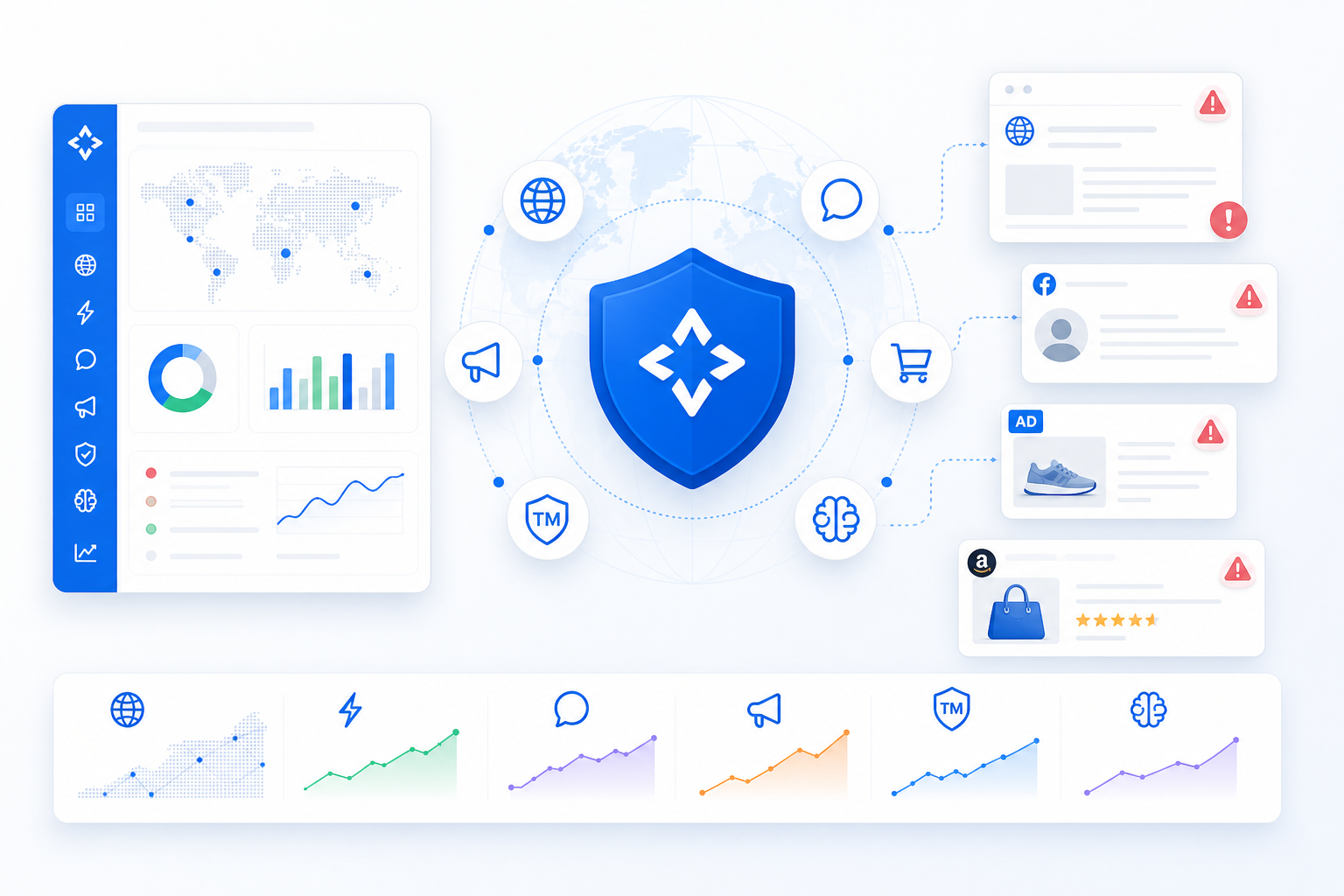
Our Digital Risk Protection module finds and removes brand impersonation before it reaches your customers. It watches domains, websites, social profiles, paid ads, and messaging apps for phishing, website impersonation, fake domains, and brand spoofing, then enforces through the same system that detected the threat.
What sets it apart:
- Monitors 1.3B+ domains and tracks 5M new or updated domains daily, with AI risk scoring across the Domain Watchlist plus fuzzy match and typosquatting detection for common brand misspellings
- Hits a 5.3-hour median domain takedown response for brand impersonation and a 99% takedown rate as a Meta Trusted Reporting partner (per MarqVision internal data, Q1 2026), backed by direct integrations through the Cloudflare Abuse API, Google TCRP, and payment provider partnerships with Stripe, Visa, and American Express
- Detects impersonation across Facebook, Instagram, X, TikTok, Reddit, Naver Band, Telegram, KakaoTalk, Discord, YouTube, and Naver Blog and Cafe, watching both profiles and posts
- Enforces against impersonator and phishing sites plus counterfeit ecommerce sites, including unauthorized Shopify storefronts, extending coverage beyond domain-only monitoring into full website content
- Uses VPN-based geo-unblocking to surface phishing and counterfeit sites that cloak themselves from US-origin scans, with detection across Europe and Korea
- Runs AI threat classification that scores every detected threat on a 0 to 10 severity scale, so your team enforces by priority without manual triage
- Combines DRP with anti-counterfeit marketplace enforcement, anti-piracy, and trademark management through MarqFolio in one system
Bottom line: if you want impersonation detection, takedown speed, and trademark-backed enforcement under a single roof, we think we are the strongest fit on this list.
Doppel
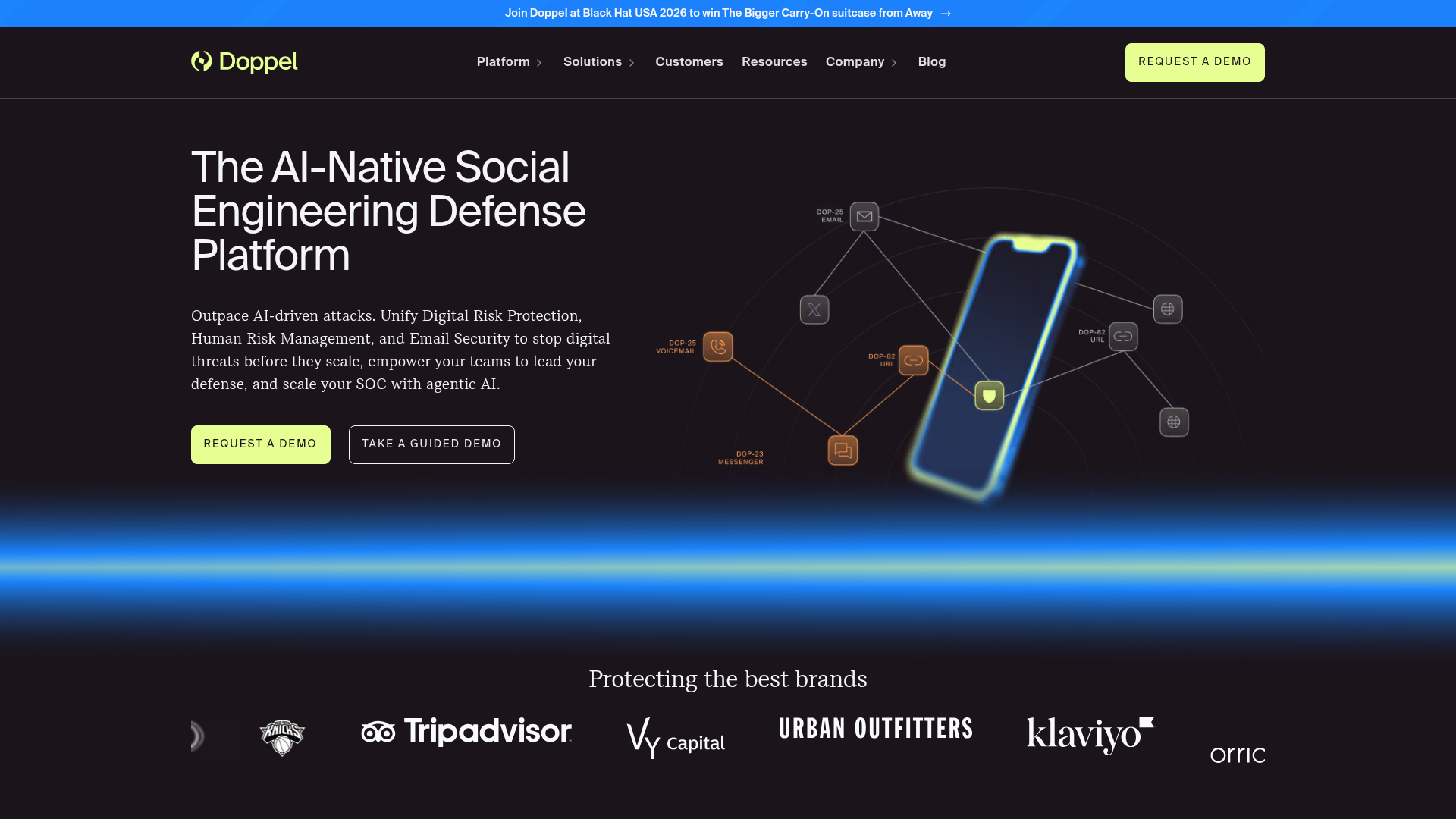
Doppel uses AI to catch brand impersonation across a wide surface, with a focus on social engineering and executive threats.
What Doppel Offers
- AI-powered detection of brand impersonation, phishing sites, fake social accounts, and deepfakes across social media, domains, and the dark web
- Executive protection monitoring for leadership-targeted threats
- A social engineering simulation feature for employee phishing readiness training
- Multi-channel takedown workflows
Good for: Security teams focused on social engineering defense, executive protection, and phishing threat management.
Limitation: Positioned as a social engineering defense tool, Doppel lacks the IP enforcement, trademark management, and marketplace counterfeit monitoring that brand protection and legal teams need for the full range of impersonation and fake domain threats. You would run separate solutions for those workstreams.
Bottom line: Doppel fits security teams whose main concern is phishing. Brands wanting unified IP enforcement, marketplace monitoring, and domain takedown in one system will find our full-coverage approach a closer match.
Netcraft
Netcraft concentrates on domain fraud and phishing takedown at scale, with detection speed as its headline strength.
What Netcraft Offers
- AI-powered domain detection and takedown, with a 33-minute median phishing takedown time (per Netcraft)
- Preemptive Domain Disruption (launched March 2026, live since Q1 2026), which identifies attacker-controlled domains before they are weaponized (announcement)
- Fraudcast automated browser blocking that interrupts impersonating sites across major browsers
- Monitoring across 100+ attack types drawing on 23B+ annual datapoints
Good for: Enterprise security teams and financial institutions focused on fast, high-volume phishing domain takedowns.
Limitation: Netcraft runs as a point solution for domain-level fraud without social media impersonation monitoring, paid ad takedown, marketplace anti-counterfeit workflows, or trademark management. Brands using it alongside broader protection end up managing separate vendor relationships instead of one system.
Bottom line: Netcraft handles domain fraud at speed and volume, but brands needing to stop impersonation across social, ads, and fake storefronts too will find our unified coverage removes the need for a separate domain-only tool.
ZeroFox
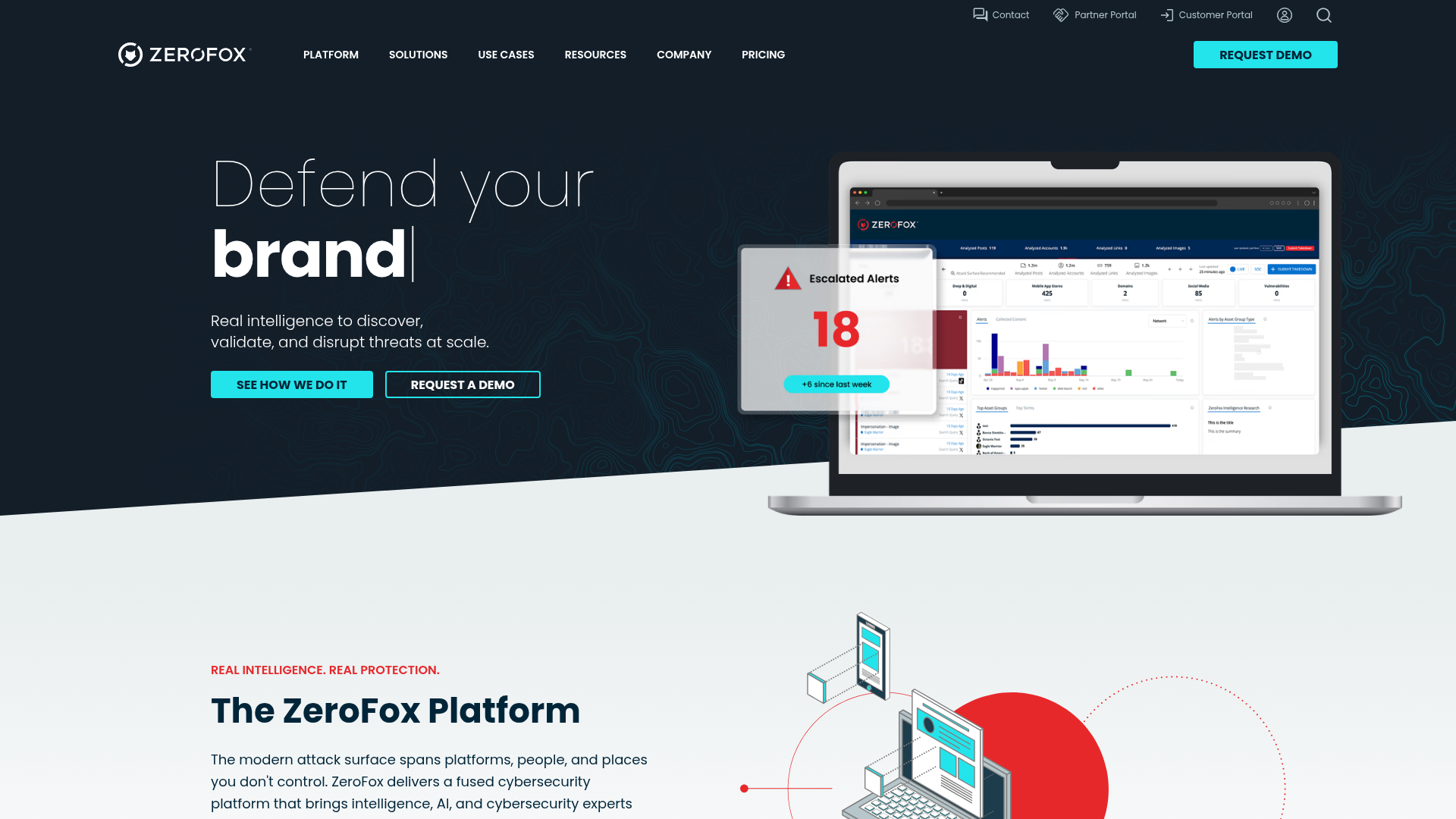
ZeroFox brings a cybersecurity lens to digital risk protection, with external threat intelligence spanning social media and the dark web.
What ZeroFox Offers
- Monitors 180+ digital channels across social media, surface, deep, and dark web for brand impersonation, phishing, and credential exposure (per ZeroFox)
- Combines AI analytics with human analyst review for threat triage and verification
- Executive protection monitoring for impersonation targeting senior leadership
- Automated takedown workflows through 80+ registrar, hosting, and social partnerships
Good for: CISOs and security operations teams needing broad external threat intelligence in a cybersecurity-focused workflow.
Limitation: ZeroFox lacks integrated trademark management, marketplace anti-counterfeit enforcement, and IP-based takedown workflows. That makes it a partial fit for legal and brand teams whose mandate runs into IP enforcement and fake storefronts.
Bottom line: MarqVision vs ZeroFox is a comparison worth reviewing directly. Brand and IP teams needing unified coverage across domain impersonation, fake ad enforcement, marketplace counterfeiting, and trademark management will find our IP-integrated approach more complete.
Bolster
Bolster leans on automation, running detection and takedown across a wide span of digital sources with minimal manual review.
What Bolster Offers
- Automated brand impersonation detection and takedown across 800+ app stores, dark web sources, social media, and all TLDs
- An LLM-powered SecOps Copilot that handles triage workflows automatically
- Claims to eliminate 75% of threats in under 60 seconds, per an independent roundup
- Dark web monitoring for leaked credentials and brand exposure
Good for: Mid-market and enterprise security teams wanting fully automated, high-speed takedowns for phishing domains and social impersonation.
Limitation: Bolster's detection is tuned for cybersecurity categories like phishing and credential theft. It leaves out trademark and IP management, marketplace counterfeit enforcement, and paid ad takedowns, while websites impersonating your brand remain a separate challenge, so the full range of brand spoofing and fake domain threats stays partly uncovered.
Bottom line: The automation speed is a real asset for security-first teams. Legal and brand protection teams needing trademark-backed enforcement, marketplace coverage, and paid ad takedowns alongside domain and social monitoring will find our coverage a fuller fit.
BrandShield
BrandShield monitors a broad threat surface for phishing, fake websites, and brand impersonation, pairing automated detection with analyst review.
What BrandShield Offers
- Multi-channel monitoring for phishing, fake websites, trademark infringement, counterfeit sales, and brand impersonation
- Social media and mobile app surveillance alongside domain monitoring
- Image recognition and dark web monitoring for fraud prevention
- Automated threat detection combined with human analyst review
Good for: Brands mainly concerned with fake website detection and cybersecurity-adjacent threats that want broad-scope monitoring without the IP enforcement depth of a full brand protection system.
Limitation: BrandShield does not publish mean time to resolve data for its takedown workflows, making it hard to benchmark enforcement speed against providers that report verified response times, such as those using MarqVision's smart rules and activity logs.
Bottom line: BrandShield spans a wide range of fake website and digital fraud threats, but brands wanting verified enforcement benchmarks, AI-native detection, and integrated IP and marketplace coverage will find us a more accountable and complete fit.
Feature Comparison Table of Digital Risk Protection Solutions
The table below shows how the six solutions compare across the capabilities that matter most for stopping brand impersonation.
Why MarqVision Is the Best Digital Risk Protection Solution
Point tools catch fragments of that chain, leaving your team stitching together separate vendors while impersonators exploit the gaps. That pattern is one reason brand protection is a cybersecurity priority for CISOs.
We built MarqVision to close those gaps in one system, connecting domain takedowns, social and paid ad enforcement, and trademark-backed IP management through AI-native detection with verified response benchmarks. For legal, IP, and brand protection teams at global consumer brands, that end-to-end completeness is what puts us first.
FAQ
How do I choose between MarqVision, Doppel, Netcraft, ZeroFox, Bolster, and BrandShield for my brand protection program?
Start by mapping your primary threat vector: if domain fraud and phishing takedown speed are your core concern, Netcraft's point-solution architecture may fit a security-first team; if social engineering and executive protection dominate, Doppel or ZeroFox align more closely with CISO-driven mandates. If your program spans fake domains, counterfeit ad enforcement, social impersonation, marketplace counterfeiting, and trademark management under one reporting structure, only MarqVision covers all of those channels without requiring separate vendor relationships for each workstream.
Is MarqVision better than ZeroFox or BrandShield for legal and IP teams that need trademark-backed enforcement?
Yes, for teams whose mandate runs into registered IP enforcement beyond cybersecurity monitoring alone. ZeroFox and BrandShield both lack integrated trademark management, which means takedown requests on platforms that require a registered mark as a legal basis will stall without a separate IP management system in place. MarqVision connects trademark registration through MarqFolio directly to enforcement workflows, so the mark you file is the mark you can action across domains, paid ads, and marketplaces without routing through a separate tool.
Which digital risk protection solution works best for security teams versus brand protection and legal teams?
Security teams focused on phishing detection, credential exposure, and social engineering defense will find Doppel, ZeroFox, and Bolster built closer to their workflow, with dark web monitoring and CISO-focused threat intelligence as headline capabilities. Brand protection and legal teams whose scope includes fake ad enforcement, marketplace counterfeiting, and IP-based takedown grounds need a solution with trademark management and paid advertising coverage built in, which narrows the field to MarqVision among the options on this list, since it is the only one with published paid ad enforcement metrics and integrated trademark management.
When should I consider running a point solution like Netcraft alongside a broader platform instead of consolidating?
A point solution like Netcraft makes sense if domain fraud and phishing takedown speed are genuinely isolated from your broader enforcement program and your security team manages that workstream independently from brand and IP. If your threat chain connects fake domains to counterfeit social accounts to fraudulent paid ads, where each vector feeds the others, consolidating into a unified system reduces the gaps that impersonators exploit between disconnected vendor relationships.
Does Bolster's 75% threat elimination speed within 60 seconds make it competitive with MarqVision for high-volume impersonation campaigns?
Bolster's automation speed is a real practical asset for phishing domain and social impersonation volume, but the comparison breaks down at the enforcement layer. Bolster does not cover paid advertising takedowns or marketplace counterfeiting, and it lacks trademark management, so high-volume enforcement against fake ad campaigns running under your brand name or counterfeit storefronts selling your products requires separate tooling regardless of detection speed. For teams whose impersonation campaigns run across ads, fake storefronts, and registered IP violations alongside domain and social threats, detection speed alone does not resolve the coverage gap.
Final Thoughts on Protecting Your Brand Across Digital Channels
Fake domains, website impersonation, and brand spoofing share one thing: they move faster than teams managing multiple point tools. Knowing where each vendor's coverage stops is the most useful output of any comparison like this one, because that boundary is where your customers get reached first. Request a demo to see how we close those gaps in a single system.
Stay up to date on the latest IP Protection content from MarqVision.



4 Enforcements a Week to 400: Scale Brand Safety with Marq AI

Don’t Just Find Counterfeits. Dismantle the Entire Network.

.png)
Discover the latest trends and challenges in IP protection

Take Control of Your Trademarks with MARQ Folio
Renew and Manage Your Trademarks Easily With MARQ Folio

We’re waiting to hear from you

See the best brand protection solution in action

Don’t let piracy steal your growth

Talk to us about your brand protection problems