.jpeg)
Online pharmacy counterfeits are one of the fastest-moving threats in brand protection right now, with 20 new illicit sites launching daily per the USTR's 2024 Review of Notorious Markets. These aren't low-effort scams. They're engineered to pass for your brand, right down to your product photography and trust badges. If you're responsible for protecting a pharmaceutical brand, this is where you start: detection, documentation, and a takedown process that actually holds.
TLDR:
- 96% of the roughly 35,000 online pharmacies operating globally run in violation of the law, per the Alliance for Safe Online Pharmacies.
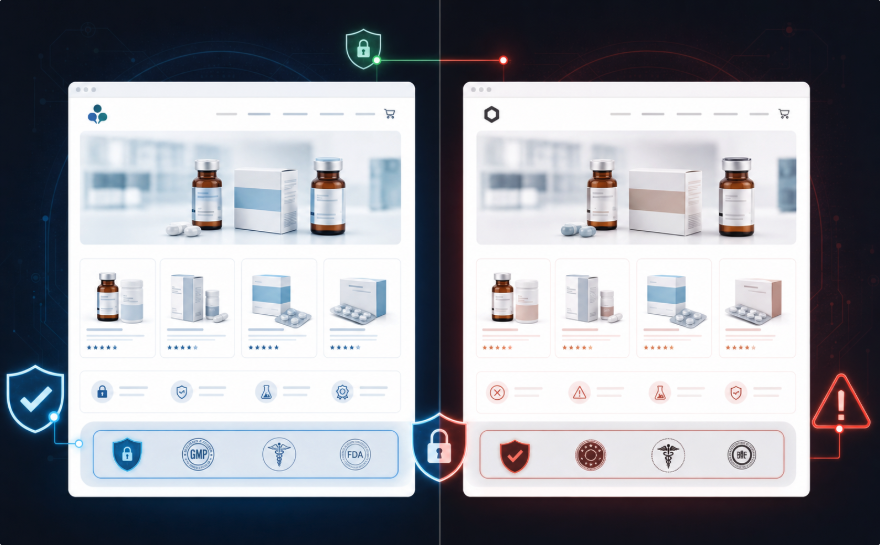
- Fake pharmacy sites use typosquatting, cloned assets, and fabricated trust seals to impersonate your brand before patients question the source.
- Preserve evidence first: screenshots, HTML, and WHOIS records must be captured before filing, since sites vanish the moment operators detect enforcement.
- Domain-level use of your registered mark supports a UDRP filing on its own; you do not need cloned assets to act.
- MarqVision monitors over 1.3 billion domains and tracks 5 million new and updated domains daily to surface lookalike pharmacy sites before they capture search traffic.
The Scale of Online Pharmacy Counterfeiting
Twenty new illicit pharmacy sites go live daily, according to the USTR 2024 Review of Notorious Markets. That cadence outpaces most monitoring programs. By the time one impersonating site is documented, several more have registered domains, cloned product pages, and captured search traffic tied to your brand.
The scale is worse than it looks. The Alliance for Safe Online Pharmacies reports that 96% of the roughly 35,000 online pharmacies operating globally run in violation of the law. Illegitimate storefronts are the norm.
Each site is a compounding liability. Every fake storefront diverts revenue, exposes patients to dangerous product, and attaches your trademark to an outcome you never controlled. The reputational damage accumulates, listing by listing.
Why Pharmaceutical Brands Are Prime Impersonation Targets
Counterfeiters follow margin and demand, and branded pharmaceuticals give them both. A patient who cannot afford or easily access a medication searches for a cheaper source, and a fake storefront wearing your trademark converts that search into a sale before authenticity crosses the buyer's mind. The stigma attached to certain prescriptions helps too, since patients buying discreetly rarely question the source or report a bad experience.
Certain categories draw disproportionate impersonation activity:
- GLP-1 weight-loss and diabetes drugs, where demand outruns supply
- Opioids and controlled substances sold outside prescription channels
- Erectile dysfunction medications bought for privacy
- Oncology treatments carrying extreme price tags
- Lifestyle drugs with steady repeat-purchase demand
Registering a domain, cloning your product pages, and standing up a checkout costs almost nothing, so organized networks launch convincing fakes faster than teams can catalog them. Brands dealing with websites impersonating their business face this compounding threat daily.
How Counterfeit Pharmacies Impersonate Legitimate Brands Online
Counterfeiters build trust by copying the visual and technical signals patients already recognize. The Pharmaceutical Security Institute recorded 7,152 counterfeiting cases across 142 countries per its 2025 annual report, an 18% rise in distinct medicines targeted over 2024, and much of that growth runs through storefronts engineered to pass for yours.
The methods cluster into a few repeatable patterns:
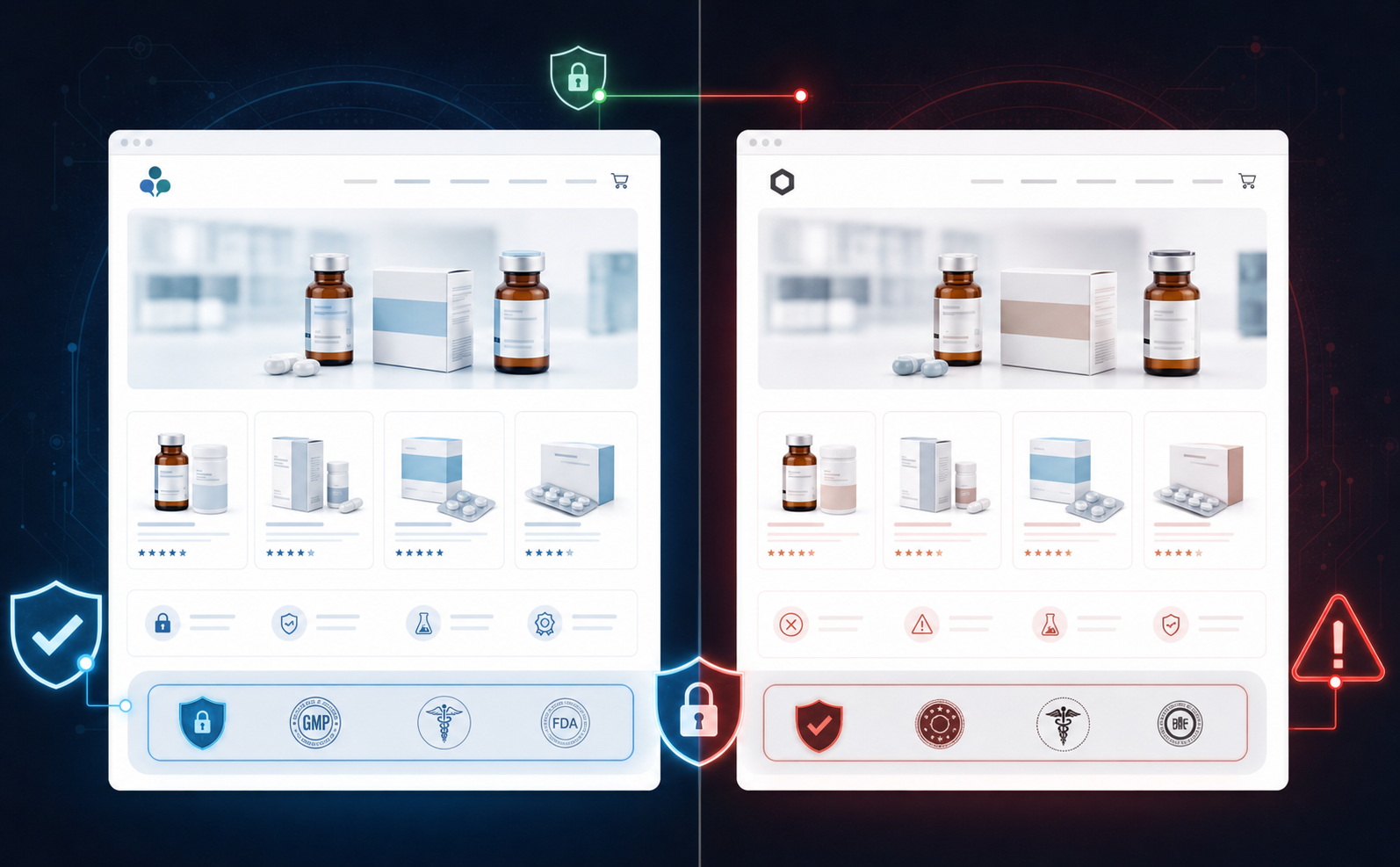
Two amplifiers make these sites harder to ignore. Fake ads impersonating your brand push the storefront into feeds alongside real brand content, and search manipulation lifts it into results next to your authentic listings. By the time a patient clicks, the fake has borrowed enough of your identity to close the sale.
Warning Signs Your Brand Is Being Impersonated by a Fake Pharmacy
Most impersonation surfaces before a patient files a complaint, if your team knows where to look. Watch for these signals across your detection queue:
- New domain registrations containing your brand name, product names, or predictable misspellings
- Your logo and product photography appearing on third-party storefronts you never authorized
- Paid ads carrying your branding that route clicks to destinations outside your verified properties
- A rise in customer service tickets tagged for wrong, ineffective, or harmful product nobody in your channel shipped
- Social accounts posing as your official pharmacy, patient support, or savings-program handles
One distinction changes how you respond: phishing sites harvest credentials without shipping, while counterfeit ecommerce sites fulfill orders and put adulterated medicine in patients' hands. Phishing threatens patient data directly, and the consequences are real. Data breaches fuel brand impersonation attacks that compound the harm well beyond the initial incident. Treat each threat type as a separate track with its own response path.
How These Sites Reach Consumers
A 2026 Michigan State University study found that more than 1 in 10 people who bought medications online suffered direct health or financial harm, and that exposure to social media ads from illicit sellers raised counterfeit purchase odds by over 12%. The acquisition funnel spans several channels, and where a threat lives determines who on your team can act on it.
- SEO built around your branded and product keywords, plus fake blog networks redirecting traffic to rogue storefronts
- Paid search ads bidding on your drug names
- Meta and other social ads pushing storefronts into feeds
- Dark web forums and closed messaging channels moving controlled substances
Search results, paid ads, and public social content sit within reach of automated monitoring. Encrypted messaging channels and dark web marketplaces demand human investigation.
The Legal and Regulatory Framework for Taking Action
Enforcement rests on the intellectual property you already hold, escalating into criminal channels when the product turns lethal. The CDC confirms counterfeit pills sold through illegal online pharmacies frequently contain fentanyl, which reframes a brand integrity problem as a criminal one and strengthens every argument you make to a registrar, host, or agency.
Your civil grounds fall into a few instruments:
- Trademark infringement, where the site uses your registered mark on domains, listings, or checkout
- Copyright infringement, for cloned logos, product photography, and page layouts lifted from your site
- UDRP filings, to dispute and recover lookalike domains through arbitration
- DMCA takedown notices, sent to hosts and registrars carrying your copyrighted assets
Safe harbor limits what you can force. Hosting providers stay shielded from liability as long as they act on valid notices, so a documented DMCA or trademark complaint moves faster than a vague abuse report.
When evidence crosses into adulterated or controlled product, refer it. The FDA's Office of Criminal Investigations handles counterfeit medicine, the DEA takes controlled substances, and INTERPOL coordinates the cross-border networks a single takedown cannot reach.
How to Take Down a Counterfeit Online Pharmacy Step by Step
Speed matters here, so run these steps in sequence and start the clock the moment you confirm a fake.
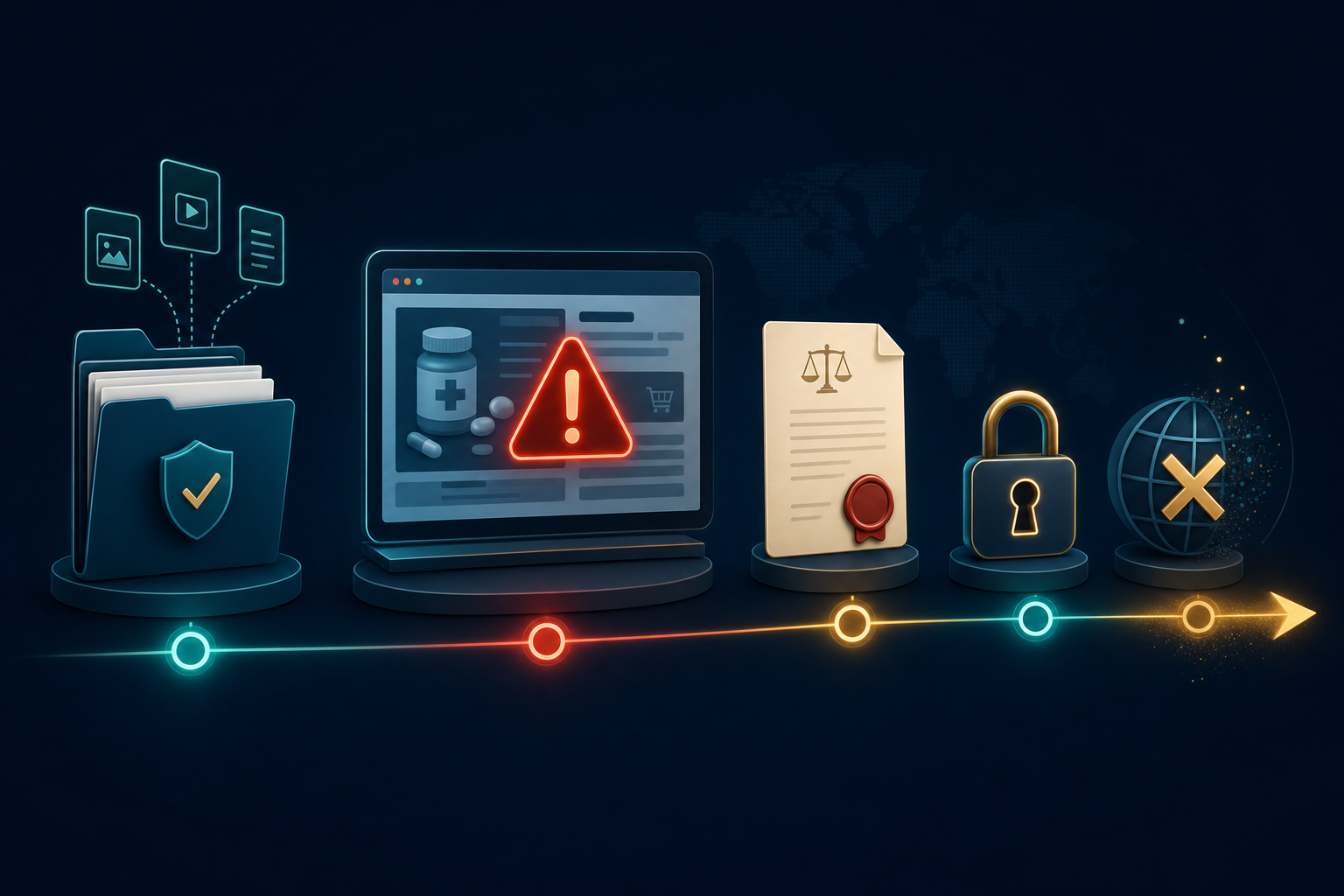
- Preserve evidence first. Capture full-page screenshots, save the HTML, and pull WHOIS records before you touch anything. A live site can vanish the instant an operator senses enforcement, and a takedown request without documentation stalls at review.
- Identify the infrastructure. Trace the hosting provider and registrar behind the domain. Privacy-shielded WHOIS records often mask the real host, so resolve the true provider before you file.
- File abuse reports with the registrar. Send a documented complaint citing the specific trademark or copyright violation, not a generic abuse flag.
- Send DMCA or trademark takedown notices to the host. Match the claim to the evidence: cloned logos and product photography support a DMCA notice, while brand-name use on the domain or checkout supports a trademark complaint.
- Request de-indexing as an immediate traffic cut. For phishing-classified sites, submit through Google Safe Browsing to strip organic search visibility while removal is still pending.
- Escalate at 30 days. If registrars and hosts have not acted by then, move the case to legal counsel for a UDRP filing or civil proceedings.
How to Coordinate with Regulators and Law Enforcement
Some cases outgrow civil takedowns. Once your evidence points to adulterated product, controlled substances, or an organized distribution network, the matter belongs with agencies that carry subpoena and arrest power.
Route the referral to the right body. The FDA's Office of Criminal Investigations takes counterfeit and adulterated medicine, the DEA's Diversion Control Division handles controlled substances outside legitimate channels, and state boards of pharmacy act on licensing violations in your jurisdiction. Multi-agency action works: INTERPOL's 2026 Operation Pangea produced 269 arrests, dismantled 66 criminal groups, and shut down roughly 5,700 sites and channels, though brand takedown timelines vary widely depending on the channel and jurisdiction.
Agencies act faster on referrals that arrive investigation-ready:
- Chain of custody for every test purchase, documenting who handled the sample from order to lab
- Lab results confirming the product is counterfeit, substituted, or adulterated
- Financial evidence tracing payment processors, wallets, and beneficiary accounts
- Infrastructure records linking domains, hosts, and registrants
A brand that hands over structured evidence, network maps, and recurring offender data moves up the queue faster than one filing a bare complaint.
Frequently Asked Questions
What's the difference between a phishing pharmacy site and a counterfeit ecommerce pharmacy site, and does it change how you respond?
Yes, and routing the wrong response to the wrong threat type wastes time while the damage compounds. Phishing sites exist to harvest credentials and payment data; they never intend to ship product. Counterfeit ecommerce pharmacy sites fulfill orders, putting adulterated or substituted medicine in patients' hands. The first calls for domain takedown, de-indexing via Google Safe Browsing, and credential-theft reporting. The second requires the same domain enforcement plus physical test purchases to document what was actually shipped, since ingredient-level counterfeiting cannot be confirmed through listing images or metadata alone.
How do I build a takedown case against a fake pharmacy domain when the WHOIS record is privacy-shielded?
Resolve the true hosting provider before filing anything. Privacy-shielded WHOIS records mask the registrant, but the underlying host can be identified through tools that unmask the real infrastructure. Cloudflare's API integration, for example, surfaces true hosting providers behind privacy-protected records. Once you have the actual host, file a specific, documented notice tying your registered trademark or copyright to the exact infringing URLs. Vague abuse reports stall; a valid DMCA notice or trademark complaint with screenshots, registration evidence, and offending links moves under safe harbor obligations.
Should I file a UDRP or go straight to host-level takedown for a lookalike pharmacy domain impersonating my brand?
Run both in parallel, not sequentially. A UDRP proceeding takes roughly two months and recovers or cancels the domain, but it leaves the hosting infrastructure and underlying operator untouched; the storefront can resurface on a new domain within days. Host-level takedown cuts off the active site while arbitration proceeds. If the registrar and host have not acted within 30 days of your initial complaint, move the case to legal counsel for UDRP filing or civil proceedings, but do not wait on UDRP before pursuing the host.
What evidence does a law enforcement referral for a counterfeit online pharmacy actually need to move up the queue?
Agencies act faster on referrals that arrive investigation-ready, not as bare complaints. Structure yours around four categories: chain of custody documentation for every test purchase showing who handled the sample from order to lab; lab results confirming the product is counterfeit, substituted, or adulterated; financial evidence tracing payment processors, wallets, and beneficiary accounts; and infrastructure records linking domains, hosts, and registrants into a network map. The FDA's Office of Criminal Investigations handles counterfeit and adulterated medicine, the DEA's Diversion Control Division takes controlled substances outside legitimate channels, and INTERPOL coordinates cross-border networks. Matching the referral to the right agency with the right evidence type is what separates an actionable case from one that sits in the queue.
Can digital-only monitoring confirm that a counterfeit pharmacy is selling adulterated product, or does it require physical verification?
Digital monitoring identifies the site, traces the infrastructure, and flags IP violations, but it cannot confirm what is actually inside the product. Image recognition and text analysis can detect packaging replicas and unauthorized sellers, but ingredient-level or formulation-level counterfeiting requires hands-on authentication. A test purchase produces the physical evidence platforms and agencies increasingly require before acting: package inspection, applicator verification, and lab component testing that listing data cannot supply. For pharmaceutical enforcement, treat test purchases as a mandatory second layer, not an optional escalation step.
Does a parked domain versus an active phishing site change my enforcement priority?
Yes. An active phishing or fulfilling storefront is taking patient data or shipping product now, so it takes precedence. A parked domain carrying your mark sits dormant, and enforcement is preventive. Watch parked domains closely: operators register early, wait out monitoring cycles, then activate once the domain reads as low-risk, a pattern that makes automated takedown services for persistent fake websites worth considering.
How MarqVision Supports Pharmaceutical Brand Protection Against Fake Online Pharmacies
Every threat mapped in this post sits inside a channel we already monitor. Our Digital Risk Protection module scans over 1.3 billion domains and tracks 5 million new and updated domains daily, so a lookalike pharmacy domain surfaces while it is still fresh, before it has captured your search traffic.
Different channels demand different tooling, and we route accordingly:
- Social Media Network Search maps seller networks across platforms, a capability our team has found particularly effective for the pharmaceutical industry
- Google TCRP, the Cloudflare Abuse API for true host identification, and Meta Trusted Reporting with a high takedown rate per Meta's reported program metrics hit the domain, hosting, and paid-ad stages at once
When digital signals cannot confirm counterfeiting at the ingredient or formulation level, our MarqLaw global IP enforcement division runs test purchases that produce the physical evidence platforms and agencies increasingly require before they act.
The scale of online pharmacy fraud is real, but so is your ability to act on it. Preserved evidence, the right legal claims, and early referrals to the FDA, DEA, or INTERPOL all move the needle in ways that a single takedown cannot. If you want to see how this works in practice for a pharmaceutical brand, request a demo with MarqVision.
Stay up to date on the latest IP Protection content from MarqVision.




4 Enforcements a Week to 400: Scale Brand Safety with Marq AI

Don’t Just Find Counterfeits. Dismantle the Entire Network.

.png)
Discover the latest trends and challenges in IP protection

Take Control of Your Trademarks with MARQ Folio
Renew and Manage Your Trademarks Easily With MARQ Folio

We’re waiting to hear from you

See the best brand protection solution in action

Don’t let piracy steal your growth

Talk to us about your brand protection problems