The Rise of Social Media Impersonation and e-Commerce Counterfeiting
The importance of social media in our social and business worlds cannot be overstated. These channels rank among the most powerful tools in business today.
However, brands are not the only ones using social media and ecommerce to their advantage. Counterfeiters are also looking for ways to use these powerful channels, giving rise to rampant growth in online counterfeiting and business impersonation.
Counterfeit products attack the name of a legitimate business and the value of the products it offers and, in many cases, can cause harmful, and sometimes fatal, consequences for unsuspecting buyers.
Not long ago, customers were better able to easily identify fakes and distinguish between what they knew were genuine products vs counterfeit impersonations. But in the world of ecommerce and online sales, the lines between real and fake products are becoming less and less clear.
Sneaky infringers will even use a brand's legitimate logos, images, and other visually recognizable features to dupe unsuspecting customers into purchasing counterfeit products, or at a minimum leave customers guessing between what items are real and which are fake. Brands like MSCHF have faced exactly this challenge as counterfeiters attempt to profit from their viral product drops.
Worse yet, brands may be forced to compete against their own products. If a counterfeiter competes with your brand by offering customers a copy of your product at a lower price, your brand could lose sales to these cheaper fakes. In some industries, counterfeits have become serious competitors to real businesses, and they can gut a company's cash flow if left to operate freely.
According to the OECD's 2025 Trade in Fakes report, counterfeit goods represented USD 467 billion in global trade, roughly 2.3% of all global imports, and the problem reaches across every sector and industry.
TL;DR
- Counterfeit goods reached USD 467 billion in global trade per the OECD's 2025 report, roughly 2.3% of all global imports, and the problem spans every sector.
- When customers unknowingly buy fakes and receive poor quality, they blame your brand, driving negative reviews, damaged reputation, and lost trust that is hard to recover.
- The threat is accelerating: generative AI lets bad actors clone brand websites in minutes, fabricate social media profiles at scale, and flood social commerce channels like TikTok Shop and Instagram faster than manual teams can respond.
- Legal enforcement alone is slow and costly; automated brand protection software offers faster detection, broader marketplace coverage, and higher takedown success rates.
- Defending your brand requires proactive, continuous monitoring across marketplaces, social media, and domains; reactive legal action is no longer enough.

The Reputation Cost of Counterfeit Goods
Another malicious side-effect of counterfeiting is the potential for irreparable damage to a brand’s reputation when counterfeit goods are purchased. Since many customers aren’t aware that the product they’ve just bought is fake, when the knock-off item fails to work correctly, is inferior quality, or doesn’t meet their expectations, the customer blames the authentic company, damaging their reputation and brand image.
Customers might also leave negative reviews online, cementing the new reputation crisis and furthering the idea that the real brand makes low-quality goods.
Word of mouth is still one of the most powerful forms of marketing. So, when these customers receive poor copies of a product, negative word of mouth stating that the product is not up to scratch spreads like wildfire.
As a business owner you know that as hard as it is to incite positive word-of-mouth marketing, it’s almost impossible to come back from negative word-of-mouth suggesting that your product is poor quality or doesn't work as advertised.
The consequences carry even greater weight in industries where product quality directly affects personal safety. In beauty and personal care, counterfeit cosmetics have been found to contain toxic heavy metals, bacteria, and unlabeled allergens, with any resulting injuries traced back to your brand name by consumers who had no way of knowing the product was fake. MarqVision works with beauty brands to combat these dangerous counterfeits before they reach consumers. In pharmaceuticals, fake products sold under your label can cause serious harm or death. A brand that has built trust over decades can see that trust collapse in weeks once safety incidents circulate on social media. Beyond the human cost, brands in safety-sensitive industries may then face product recall demands, regulatory investigations, and civil litigation tied to counterfeits they had no hand in producing.
With it being so easy to impersonate a business or brand online, now it's more important than ever to protect your goods and products and keep them easily distinguishable against the backdrop of increasing fakes.
How the Threat Has Grown: 2025 and Beyond
The scale of this problem is larger than many brands realize. The OECD's 2025 Trade in Fakes report found that counterfeit goods accounted for an estimated USD 467 billion in global trade, representing 2.3% of total global imports. Projections put the global cost of fakes at over $600 billion annually by 2030.
Generative AI has dramatically accelerated the problem. Bad actors can now recreate a brand's website in minutes, generate synthetic social media profiles at scale, and produce deepfake videos of executives to run fraudulent ad campaigns. Brands tracked a 3x year-over-year increase in impersonation incidents through 2024. For legal, IP, and brand protection teams, the threat environment is now moving faster than manual monitoring can keep up with, making automated detection and takedown capabilities more important than ever.
The attack surface has broadened considerably. Counterfeiters have moved far beyond obscure grey-market websites. Today they build convincing storefronts on social commerce channels like TikTok Shop and Instagram, where purchase decisions happen fast and brand verification checks are minimal. A coordinated seller network can operate dozens of accounts at once, cycling through new storefronts as quickly as old ones are flagged and removed. Generative AI compounds this speed advantage: bad actors can produce high-quality product images, fake customer reviews, and branded packaging mockups in bulk with minimal effort or cost. Homograph attacks, where domain names use visually identical characters from different alphabets to mimic a real brand's URL, have become a common deception tactic as well. For IP and brand protection teams working through manual processes, the sheer volume of threats means enforcement will always lag behind.
What Can You Do to Stop it?
The United States has several key federal laws in place to protect against copyright infringement and the impersonation of people and entities — including the Digital Millennium Copyright Act (DMCA), the Lanham Act (which governs trademark rights), and the Trademark Counterfeiting Act, which makes trafficking in counterfeit goods a federal crime. These laws protect both individuals and businesses from being taken advantage of by others. But, as you'll read below, sometimes having laws and regulations in place isn't enough to prevent others from trying to profit off your brand's value and intellectual property.
During the last two decades, many countries have taken steps toward introducing legislation that makes product counterfeiting a criminal offense. The liability can either be based on general matters of criminal law, such as an attempt to defraud or result from provisions in trademark legislation.
However, despite the development in legislation, intellectual property rights (IPR) owners may still face difficulties in persuading enforcement authorities to take action against counterfeiters. This is due to a number of factors: i) counterfeiting is often given a low priority compared to other criminal offenses, ii) it may be difficult to uncover the full scale of a counterfeiter’s activities, and iii) the procedural rules are often too complex to make it worthwhile to enforce the law.
Rights owners also face several problems in trying to initiate administrative intervention in some countries, where they are often required to provide very specific information about the suspect consignment, which can be difficult to obtain and often includes high costs when applying for suspension.
That said, there are concrete steps your team can take before turning to litigation or authorities. Start by securing your IP registrations in every market where you sell or manufacture: trademarks, design rights, and copyrights filed in relevant jurisdictions give you the legal standing to act quickly. Record your trademarks with customs agencies (such as U.S. Customs and Border Protection or the EU's EUIPO customs recordal program) so border officials can seize infringing shipments at the point of entry. Enroll in marketplace brand programs: Amazon Brand Registry, Alibaba's IPP program, and Meta's Brand Rights Protection program each offer rights owners faster reporting tools and direct lines to enforcement teams. Finally, map your threat exposure before acting: identify which marketplaces, social channels, and domains are carrying the highest volume of infringing content so your team can focus resources where they have the most impact. These foundational steps make every downstream enforcement action, whether manual or automated, faster and more effective.
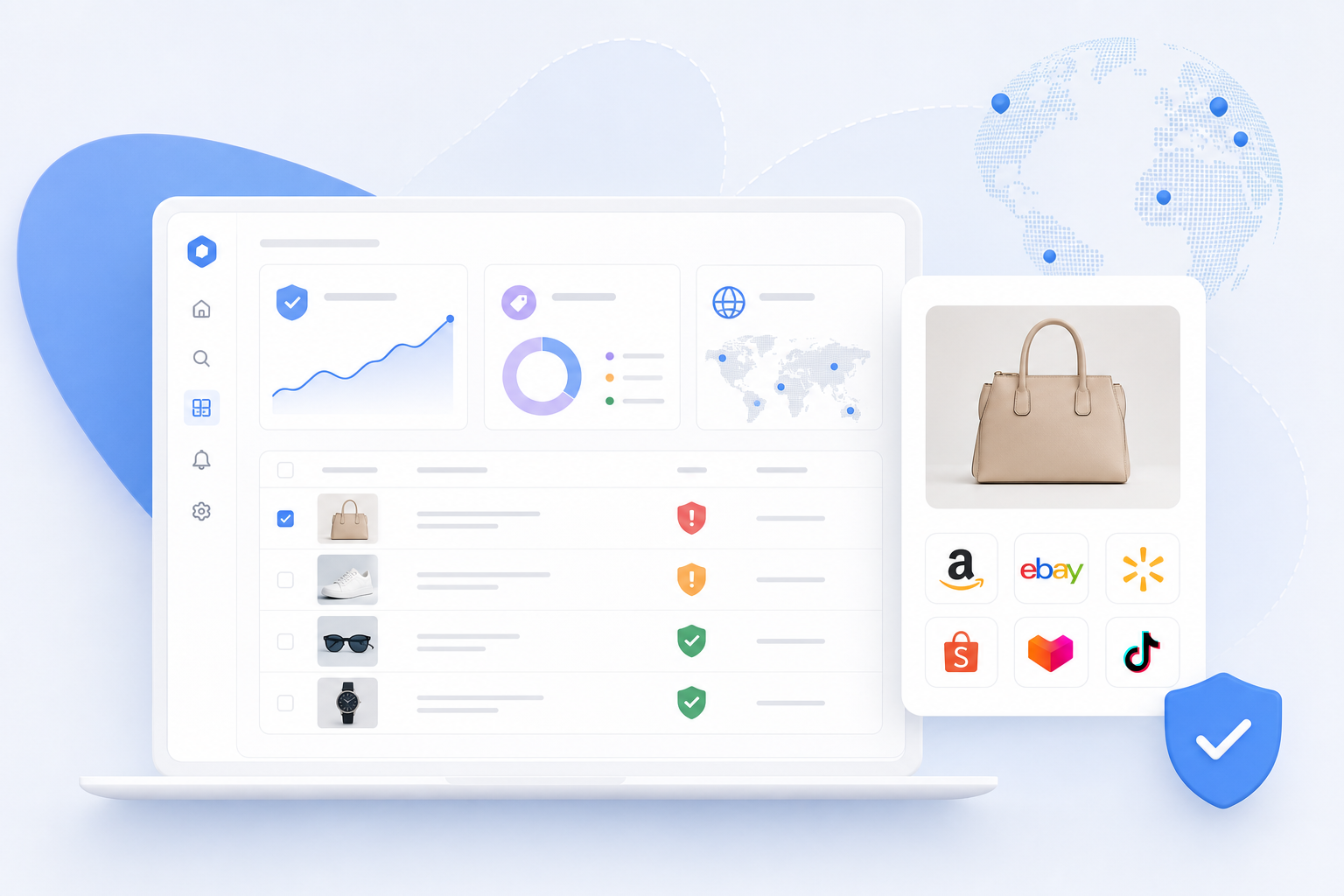
But while intervention from authorities can be difficult or expensive to receive, more and more businesses are taking matters into their own hands through the use of brand protection software that helps track, identify, and report counterfeit goods and products.
Software options like these offer multiple benefits to businesses, namely:
- Lower costs: automated detection generates enforcement reports up to 10x faster than manual processes, cutting legal fees and staff hours
- Broader coverage: scans millions of listings across 50+ channels including Amazon, eBay, Alibaba, TikTok Shop, and regional marketplaces simultaneously
- Higher removal success rates: direct reporting to site administrators achieves up to 99% takedown rates on channels like Meta, bypassing slow legal proceedings
- Deep channel integration: built-in connections to major ecommerce and social commerce channels allow for enforcement actions tailored to each channel's rules and workflows
Since most of the counterfeit products being sold are sold online, software targeting allows businesses to detect counterfeits and report them to the site administrators directly without having to take legal action in the country where the site is based or where the goods are being sold.
This approach makes detecting and removing counterfeit goods and impersonating profiles smoother and faster for ecommerce and social media businesses.
Growing your brand in a positive light is imperative to building profitable business and brand solidity.
Frequently Asked Questions
What is social media impersonation and how does it affect my brand?
Social media impersonation happens when bad actors create fake profiles, pages, or accounts that mimic your brand's official presence. They may use your logo, brand name, or product images to deceive customers into purchasing counterfeit goods, sharing personal data, or trusting fraudulent promotions. The direct impact on your brand includes lost sales, damaged reputation, and customer trust that is difficult to rebuild once broken.
How do counterfeit products damage a brand's reputation?
When customers unknowingly buy a counterfeit product and it fails to perform as expected, they blame your brand — not the counterfeiter. Negative reviews, word-of-mouth complaints, and social media posts cement the false perception that your products are poor quality. In safety-sensitive industries like beauty, health, or pharmaceuticals, the reputational fallout can be severe and lasting, sometimes triggering regulatory investigations and civil liability.
Why is legal enforcement alone not enough to stop counterfeiting?
Legal enforcement is slow, expensive, and inconsistent across jurisdictions. Counterfeiting is often treated as a low-priority offense by authorities, and rights owners must provide highly specific information about suspect consignments — information that is frequently difficult to obtain. Meanwhile, counterfeiters can spin up new storefronts faster than legal proceedings can shut them down. This makes reactive legal action insufficient as a standalone defense.
What is brand protection software and how does it work?
Brand protection software monitors thousands of ecommerce marketplaces, social media channels, and websites simultaneously to detect counterfeit listings, fake profiles, and infringing content. When a violation is identified, the software reports it directly to site administrators, bypassing the need for legal proceedings. This results in faster takedowns, broader coverage, and lower costs compared to manual or legal-only approaches.
How has generative AI changed the counterfeiting threat?
Generative AI has given bad actors the ability to clone brand websites in minutes, fabricate convincing social media profiles at scale, produce fake customer reviews, and even generate deepfake videos of executives for fraudulent ad campaigns. What previously required substantial resources and time now costs almost nothing to produce at volume. For brand protection teams, the speed and scale of attacks have outpaced manual monitoring, making automated detection a necessity, not a luxury.
Stay up to date on the latest IP Protection content from MarqVision.




4 Enforcements a Week to 400: Scale Brand Safety with Marq AI

Don’t Just Find Counterfeits. Dismantle the Entire Network.

.png)
Discover the latest trends and challenges in IP protection

Take Control of Your Trademarks with MARQ Folio
Renew and Manage Your Trademarks Easily With MARQ Folio

We’re waiting to hear from you

See the best brand protection solution in action

Don’t let piracy steal your growth

Talk to us about your brand protection problems