Is your trademark being used in a domain without permission? Resolve it with a UDRP dispute
Someone registered a domain with your trademark? UDRP eligibility, each step of the process, timelines and fees, and what to check before you file.
 Irene Lee4 min read

On this page5
Cases of brand trademarks being used in domains without permission are on the rise. It goes beyond simple impersonation: sites designed to look like the official one lure shoppers into transactions and leak card numbers, home addresses and other details, causing serious confusion and harm.
So how can you respond? In this post, we take a detailed look at one strategy against domain impersonation: the UDRP domain dispute and how it works.
What is a UDRP domain dispute?
The UDRP (Uniform Domain Name Dispute Resolution Policy) is the official procedure ICANN established to resolve disputes over domain names.
If someone is using a domain that misuses your brand’s trademark, a UDRP dispute can 1) transfer ownership of the domain to your brand or 2) have the domain name canceled.
What is ICANN?
ICANN (Internet Corporation for Assigned Names and Numbers) is the organization that oversees the global domain name system. Anyone can register and lease a domain, but misuse can happen along the way, so a system for resolving it after the fact is needed. The UDRP is that system, run through dispute resolution providers such as WIPO (World Intellectual Property Organization).
UDRP eligibility
To bring a domain dispute under the UDRP, you must meet all three conditions:
- The domain name is identical or confusingly similar to your trademark
- The current domain holder has no legitimate rights or interests in it
- The domain was registered or is being used in bad faith
If these conditions are met, you can formally file a dispute through an official UDRP provider designated by ICANN, such as WIPO (World Intellectual Property Organization) or an ADR (alternative dispute resolution) provider.
How a UDRP dispute works
As noted above, if a domain similar to your trademark is in use, you can file with an ICANN-designated UDRP provider, including WIPO and ADR providers, to have the domain deleted or recover ownership. The UDRP process works much like a court case. The complainant must submit evidence of the trademark misuse and the grounds for the complaint, and the whole process takes place online.
The UDRP has six stages.
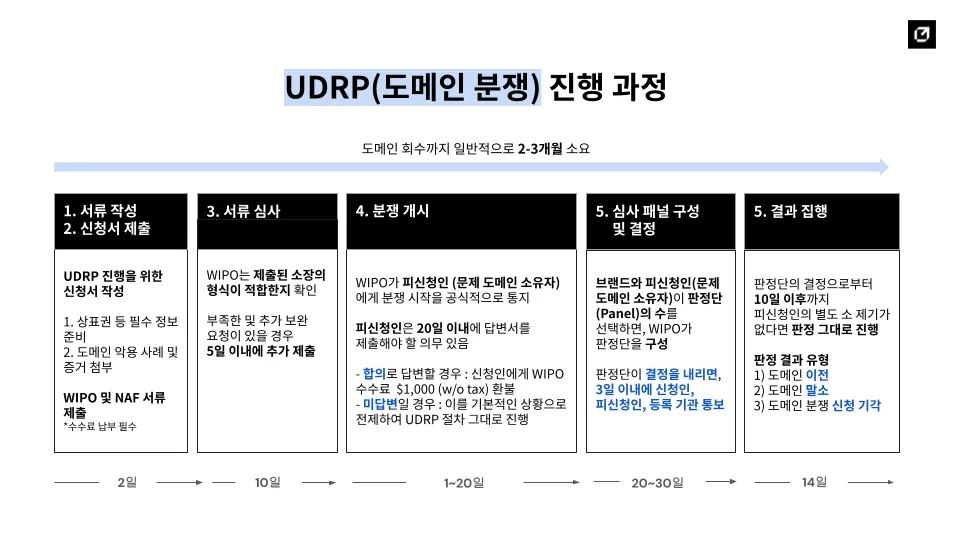
1. Draft the complaint
The brand filing a UDRP dispute must prove the domain was registered and used in bad faith. UDRP proceedings often don’t follow the same principles as trademark law, so getting expert help is important for things to go smoothly.
Required items in the complaint
- Representative details (optional): if filing through a representative
- Respondent details (optional): information on the domain registrant
- Disputed domain details: the domain name in question and registrant information
- Grounds: the basis on which the domain infringes your trademark rights
- Evidence: material proving bad-faith use of the domain
Pre-filing checklist
1. Prepare your brand’s trademark information
2. Gather detailed information on the disputed domain
3. Collect examples and evidence of the domain’s misuse
2. Submit the documents
The UDRP complaint can be submitted online through the WIPO (World Intellectual Property Organization) or ADR (Alternative Dispute Resolution) platform. Once the complaint is received, it goes through three rounds of review, and each result is available within 10 days on average.
After filing, you must also pay the dispute resolution fee to the account WIPO designates. The base fee is $1,500. Note, though, that the fee can vary with the number of domains. Once the fee is paid, the proceedings formally begin.
3. Document review
WIPO reviews the complaint’s format and evidence. After a 10-day review, if anything needs to be supplemented, you must submit it within 5 days. If the documents are in order, the dispute formally begins.
4. Commencement of the dispute
Once the complaint is accepted, WIPO formally notifies the domain holder (the respondent), who must submit a response within 20 days.
If the domain holder responds by agreeing to settle, the complainant can get $1,000 (excluding tax) of the WIPO fee refunded. However, UDRP proceedings generally assume the respondent will not reply, and if there is no response, the case proceeds to a decision anyway.
5. Panel appointment and decision
Once the complainant and respondent choose the number of panelists, WIPO appoints the panel, which makes the final decision.
6. Implementation of the decision
Depending on the decision, the domain may be transferred, canceled, or the complaint denied. If the respondent does not file a separate lawsuit within 10 days of the decision, the complainant, respondent and registrar are notified within 3 days. Recovering a domain typically takes two to three months.
Once the UDRP decision is communicated, the registrar must transfer the domain to the complainant within about two weeks.
The UDRP process can be tedious. Move through it quickly and efficiently with MarqVision, and keep your domains safe.
What to know before starting a UDRP: FAQ
Q1. Are all domains covered by the UDRP?
No. The UDRP applies only to generic top-level domains (gTLDs) such as .com, .org, .info and .biz.
There are many types of domains, but they fall into two broad groups:
1) Generic top-level domains (gTLDs): .com, .net, .org and so on
2) Country-code top-level domains (ccTLDs): .kr, .cn, .us, .jp and so on.
gTLDs are overseen by ICANN, so disputes can be resolved through the UDRP. ccTLDs follow each country’s own rules, so you need to check individually whether the UDRP applies.
See the domain dispute policies of major countries here.
Q2. How long does the UDRP take?
It usually takes about two to three months after filing, but it can take longer once you account for the time needed to prepare evidence. That’s why thorough preparation matters. With MarqVision, AI-based detection and evidence collection make the process faster and more efficient.
Q3. Can we handle several domains (say, 5 or 10) at once?
Yes. But time and cost can vary with the number of domains, and the procedure can differ by domain type (gTLD or ccTLD).
Q4. Is the UDRP conducted in Korean?
UDRP proceedings are usually conducted in English. They generally follow the language of the registrar’s registration agreement, so they are likely to be in English or another language. MarqVision’s global team across offices in the US, Europe and elsewhere works alongside a dedicated Korean-speaking manager, so we can support proceedings in both English and Korean.
Q5. Does the trademark need to be registered?
You need a registered trademark to bring a UDRP dispute. Trademark registration is an important legal basis, and be sure to check your trademark’s registration and expiry dates before starting a UDRP. They can be key evidence that a registered trademark was used in a domain in bad faith.
How do you check your brand’s trademark information? You can look it up in real time on the MarqVision trademark management dashboard, and check international registrations on WIPO Trademark Search.
Resolve UDRP domain disputes quickly and easily with MarqVision

A UDRP requires a range of material, including trademark information and examples of domain misuse. Preparing it can take longer than expected, and most complaints are written in English, which can be a burden for brands.
Move through the UDRP quickly and accurately with MarqVision’s AI and IP experts. Scan for domains misusing your trademark with AI, and tackle first the domains that confuse consumers or threaten your brand’s reputation.
Beyond the UDRP, we offer a range of other measures to take down websites impersonating your brand. We start with steps such as sending soft notices (warnings), and if the problem isn’t resolved, we remove or recover the domain through the UDRP. MarqVision’s IP experts bring UDRP experience across many industries and a high success rate to protecting your brand.
Impersonator websites keep multiplying online. Protect your brand with MarqVision’s AI-based solution and grow safely in global markets.