Direct national filing vs. the Madrid Protocol: choosing the right strategy
Which way of registering trademarks abroad suits your business? We compare direct national filing with the Madrid system and answer common questions.
 Irene Lee4 min read

On this page5
“Should we file directly in each country, or use the Madrid system?”
In our consultations on filing trademarks abroad, many people ask about how to file. On the surface, Madrid filing is often seen as better than direct national filing because one application covers several countries at once. But once you factor in the real time and cost involved, the best route can differ from company to company. The choice should be weighed carefully against each company’s situation, such as when it plans to enter overseas markets and whether it already holds a trademark at home.
In this post, we explain the difference between direct national filing and an international application under the Madrid system, and offer guidance on filing abroad for different types of companies.
- Understanding the differences between filing routes
- Choosing the filing route that fits your business
- FAQ: common questions about trademark filing
Understanding the differences between filing routes
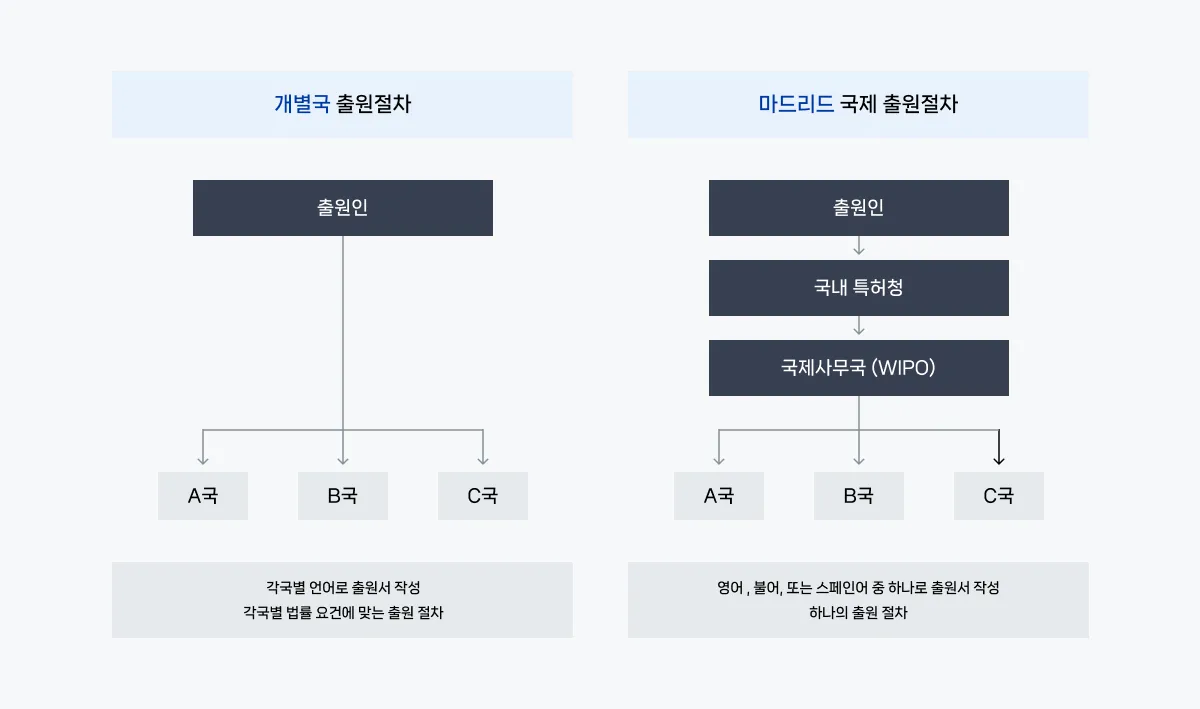
The most important concept in trademark filing is territoriality: trademark rights are valid only in the country where the mark was filed, so you have to file separately under each country’s trademark law. That leaves two main routes:
- Direct national filing: filing a trademark directly with the trademark office of each country where you need protection
- International application under the Madrid system: filing in several countries at once through the World Intellectual Property Organization (WIPO)
Pros and cons of direct national filing
Direct national filing means filing separately with each country’s trademark office. Its advantage is that you can build a differentiated protection strategy for each country.
Pros:
- Country-specific strategy: you can optimize your strategy for each country’s trademark law and market, focusing on specific markets
- Higher success rate: because the trademark is reviewed country by country, it’s more likely to be approved by each office
Cons:
- Legal requirements: trademark laws differ by country, so preparing the filing requires local legal advice
- Complex process: each country’s requirements and procedures differ, which makes management complex and time-consuming
MarqFolio’s online dashboard lets you manage the status of your trademark registrations in every country at a glance.
Pros and cons of Madrid filing
An international application under the Madrid system lets you file a trademark in several countries at once with a single application, which makes things simpler for companies considering multi-country filings.
Pros:
- Simple application: one international application covers many countries, streamlining the process
- Centralized management: after filing, you can manage your trademarks in the designated countries centrally through WIPO
Cons:
- Risk of central attack: if the base mark is refused or invalidated, the trademark loses its effect in every designated country, a major risk
- Limited customization: the same mark must be filed in the same form in every designated country, which makes it hard to meet each country’s requirements, and the process takes a long time
Choosing the filing route that fits your business
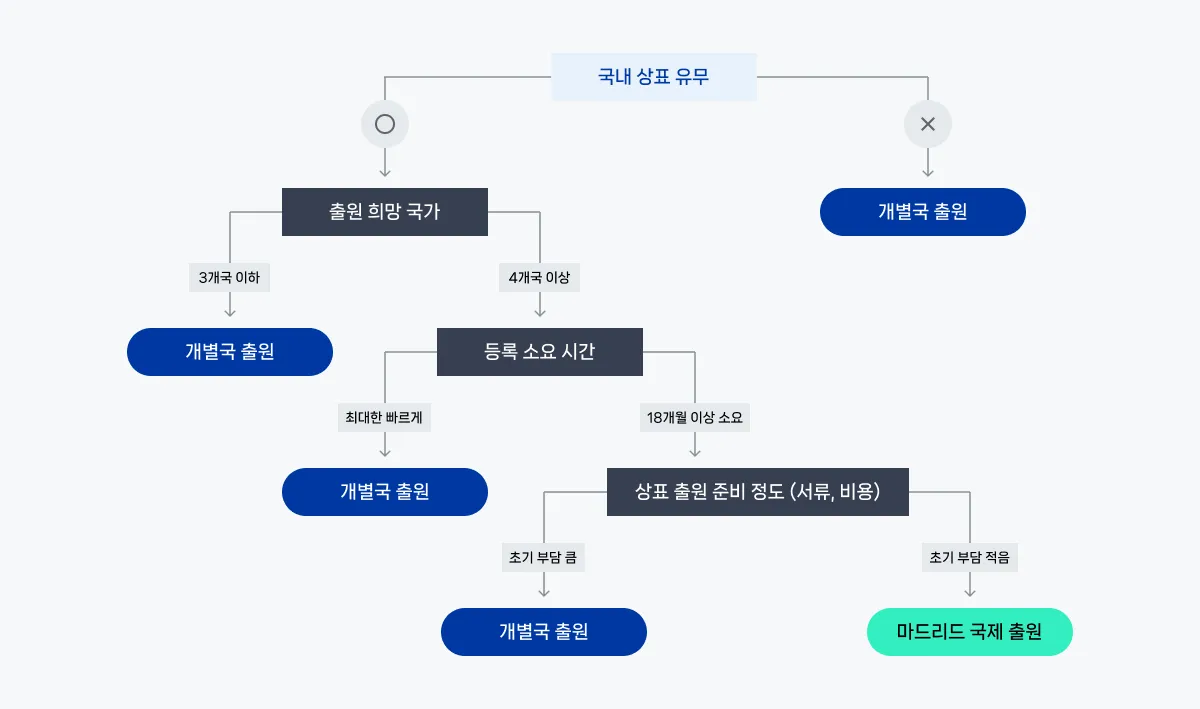
The choice of filing route should take into account your company’s size, target markets and budget. Here are our recommendations by situation.
1. Companies that need trademark rights as fast as possible
-> Direct national filing
A Madrid application goes through administrative procedures at the WIPO International Bureau, so it takes at least 10 to 12 months longer. Companies that have already started talking to overseas buyers or need to enter markets soon should secure trademark rights quickly through direct national filing.
2. Companies that want to reduce the risk of office actions and extra costs
-> Direct national filing
A Madrid application can save resources upfront, but responding to office actions, such as amending the description of designated goods, can bring extra costs. When an unregistered mark needs further discussion, direct national filing lets you prepare each country’s required documents in advance and reduce the risks that arise along the way.
3. Companies whose trademark isn’t yet registered at home
-> Direct national filing
A Madrid application can be made while the home trademark is still pending, but if the home registration is refused or later invalidated, every mark registered through Madrid risks being canceled. Madrid filing is usually chosen when filing in four or more countries, and filing costs can run to several million won or more per mark. Direct national filing is the safer option to avoid the risk of trademark rights won over a long period being invalidated.
4. Companies that want to minimize the resources spent on filing and managing trademarks
-> International application under the Madrid system
When filing one fixed mark in as many countries as possible at once, the simpler paperwork and cost advantages of Madrid are hard to ignore. Madrid makes registration and renewal in bulk convenient. Madrid suits companies that file the same way in every country and can’t invest heavily in trademark filing.
FAQ: common questions about trademark filing

Q1. Can the Madrid system be used in every country?
A. Only in countries that are members of the Madrid system. It’s a good idea to check the list of members before filing.
Q2. Can we use Madrid and direct national filing at the same time?
A. Yes. Filing directly in strategically important countries and using Madrid for the rest can be an effective approach.
Q3. How long does each route take?
A. Direct national filing varies by country; in China, the fastest, it can be completed in as little as four to six months. A Madrid application, by contrast, takes about 18 months for examination alone, and the whole process can take longer.
Q4. Can we change the trademark after filing?
A. You can’t change the essential elements of a mark, but some details can be amended. Rules vary by country, so take care.
“If we want to file directly, what do we need to prepare for each country?”
Look out for our next post, which will cover filing strategies for key markets and each country’s laws and procedures.
Not sure whether direct national filing or the Madrid system is right for you? At MarqFolio, MarqVision’s trademark management service, IP experts offer a free consultation on a trademark strategy tailored to your company. Book a consultation and you’ll also receive our newsletter with IP insights.