A holiday-season strategy for K-beauty brands: the threat of counterfeits and the damage to consumer trust
What US consumer research says about the challenges K-beauty brands face in 2025, and an effective strategy to protect your brand's IP.
 Irene Lee4 min read
On this page4
The year-end holidays are a busy time for beauty brands running events and promotions for Christmas and the New Year. But bad actors are busy too, ramping up the distribution of counterfeits.
Counterfeits have become far more sophisticated. They are now so close to the real thing that even discerning shoppers are easily fooled, and even beauty brands themselves struggle to identify them. These fakes are a serious threat to a brand’s reputation and to consumer trust.
In a recent survey on fake beauty products, 68.8% of consumers said that when they unknowingly bought a counterfeit, the negative experience mainly hurt the beauty brand itself. Consumers grow frustrated with the official brand, its reputation suffers, and some share their bad experiences on social media. In big shopping seasons like the holidays, that poses a major challenge for K-beauty brands and can threaten their long-term success.
Bad actors know exactly how to fool shoppers with fake beauty products
Beauty shoppers don’t want counterfeits, but bad actors reach them and push them to buy. According to our US Beauty Market Insight Report, most consumers didn’t seek out fakes. They were tricked into buying them.
Of 500 US consumers, 70.8% said they believed the product they bought was genuine when it was in fact a counterfeit. Shoppers avoid fake beauty products not only because of poor quality but because, at worst, they can harm their health. Harmful substances such as lead, mercury and other heavy metals, and bacteria, are frequently found in counterfeits.
In fact, 30.1% of consumers who bought fake beauty products experienced mild skin irritation or discomfort, and 9.1% experienced serious skin reactions or health problems. It’s no surprise that shoppers prefer genuine products to avoid these risks.
So why do fake beauty products still reach consumers?
Because bad actors use sophisticated, advanced tactics to deceive them. They exploit the reach of social media to use or steal beauty brands’ IP without permission, confusing shoppers into thinking they are dealing with the official brand.
Bad actors first catch shoppers’ attention, then steer them to other marketplaces or fake websites to complete the purchase. Along the way, they use generative AI to write fake customer reviews in no time, making fakes look popular and trustworthy. 49.8% of survey respondents said they rely on user reviews to check a product before buying. Reviews act as a persuasive basis for purchase decisions.
Bad actors also use the latest technology, such as cloaking, to evade brand protection monitoring. For more on cloaking, see our earlier post “New IP threats targeting K-beauty brands and how to respond: impersonator websites and social accounts.”
These technology-driven tactics still work. Even when shoppers are careful, they are naturally exposed to counterfeits and end up buying them without realizing it.
When it comes to counterfeits, consumers blame the beauty brand more than the bad actors
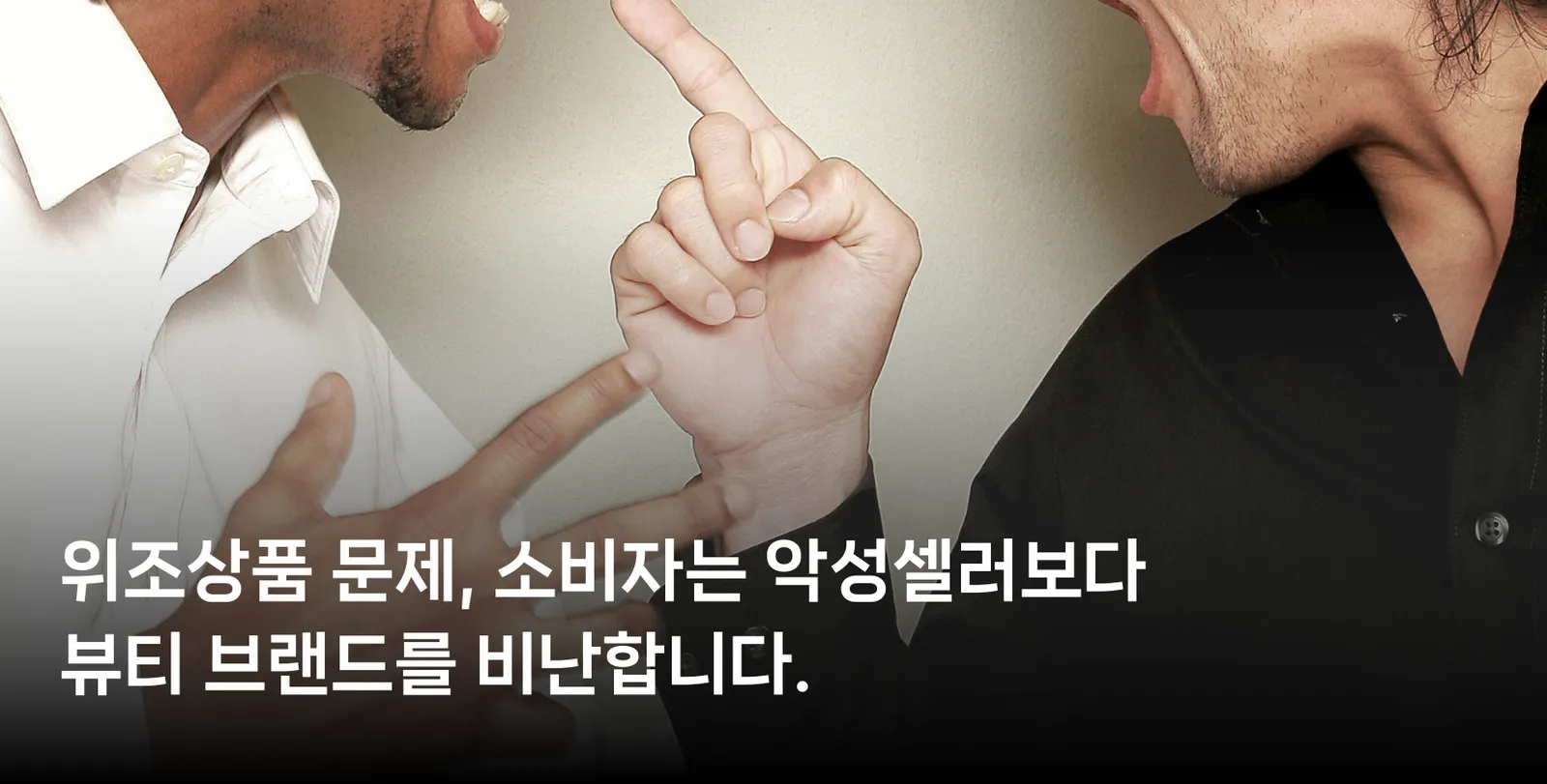
When fake beauty products disappoint or harm consumers, the official brand takes the biggest hit. According to MarqVision’s US Beauty Market Insight Report: the new challenge for K-beauty brands, consumers who bought counterfeits held the beauty brand they trusted more responsible than the bad actors.
In the survey of US consumers, 29.4% said they would never buy from the brand again after a counterfeit experience, and 23.6% said their trust in the brand declined. Consumers expect beauty brands to deliver high-quality genuine products, and the results show that, whoever is at fault, the brand’s reputation and sales can suffer badly.
In other words, consumers expect beauty brands to protect them from counterfeits, and when that expectation is broken, trust in the brand can drop sharply.
During shopping seasons like the holidays, bad actors confuse shoppers with ever more sophisticated tactics. K-beauty brands, which are hugely popular in the US, are prime targets. That undermines efforts to win new customers in new markets as well as relationships with existing ones, and poses a major challenge for K-beauty brands.
The insight report surveyed and analyzed US consumers who knew they had bought a counterfeit. Consumers who never realized they had bought a fake beauty product weren’t included. That suggests far more consumers than we think may have unknowingly bought counterfeit beauty products. Brands should keep in mind how disappointed and negative consumers who used low-quality fakes may feel about the brand.
After a counterfeit experience, consumers turn to social media
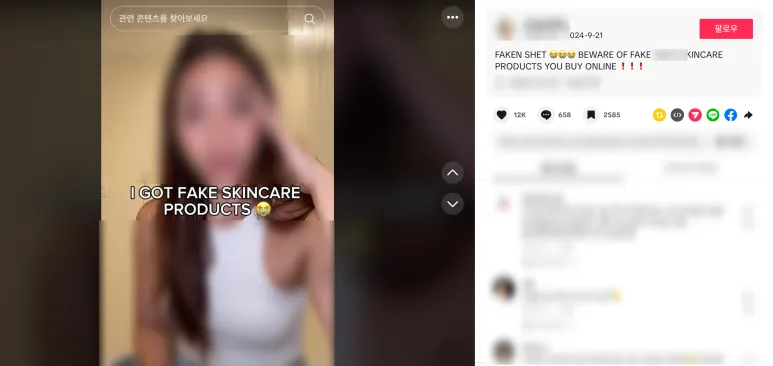
Consumers who realize they were fooled by a counterfeit don’t stay silent. They actively share their experience on social media. According to the survey, 26.2% of consumers who bought a counterfeit went public with their experience to warn others. Many told friends and family directly, and some warned a wider audience on social media. These posts can quickly gain attention and go viral, spreading negative perceptions of the beauty brand widely.
Shoppers today rely heavily on reviews and recommendations, and social media use rises during the holidays, so the impact of a negative experience can grow even larger. That can seriously hurt not only a beauty brand’s short-term sales but its long-term trust and growth.
How to protect K-beauty brands during the holiday shopping season
During the holiday shopping season, K-beauty brands, especially those popular abroad, need to act decisively now. Fake beauty products not only give consumers a bad brand experience but rapidly erode trust in the brand. Protecting beauty brands, consumers and products online and offline requires fast, effective action.
Because bad actors use the latest technology to sell fakes cleverly, one of the most effective responses is to use artificial intelligence (AI). Marq AI quickly detects and blocks counterfeits sold not only on online marketplaces but across social media, messaging apps and other channels. During year-end shopping seasons with big promotions, counterfeit experiences can seriously damage a brand’s reputation, so fast, accurate response on every channel is essential.
MarqVision uses generative AI to converse with bad actors in real time and identify counterfeits sold on social media. For suspicious products, our test purchase program lets you buy and inspect fake beauty products and take action in days, not weeks.
To learn more about the US consumer report discussed in this post, download the report here. It covers US consumers’ main shopping channels, popular products, experiences with counterfeits and more. If your K-beauty brand is planning to enter the US or is already there, download it now and build an effective response strategy.