The gray-market risks every FMCG brand needs to know, and how to respond
Why the FMCG market favors gray-market and rogue resellers, the two tactics they use most, and the practical steps and solutions FMCG brands can put in place.
 Irene Lee4 min read

On this page5
Fast-moving consumer goods (FMCG) are an inseparable part of daily life. Products we use every day, such as detergent, wet wipes, diapers, toothbrushes, shampoo and hand wash, are household essentials with steady demand. That lets brands plan distribution around predictable, repeat buying patterns.
But that very stability makes the market highly attractive to unofficial distribution, or “rogue resellers.” Cases of resellers exploiting the market’s high turnover and low risk to disrupt distribution are becoming more complex and sophisticated.
Why the FMCG market favors rogue resellers
Several characteristics make FMCG products prime targets for malicious resellers:
- High purchase frequency: short consumption cycles make demand steady and predictable
- Low unit prices: low prices mean low barriers to buying, and promotions are frequent
- Hard to tell genuine from fake: authenticity is hard to judge from appearance, which lowers the barrier for unauthorized sellers
- Online-first distribution: most purchases happen on online marketplaces, making it hard for brands to control every distribution route
The FMCG market allows “fast deals” at relatively low risk, so rogue resellers can get in easily. As a result, unofficial distribution outside the channels the brand intended can spread quickly, which makes brand protection and control of online distribution a major challenge.
Two tactics rogue resellers use
So how do rogue resellers resell FMCG brands’ products without authorization? Their tactics fall into two broad categories.
1. Unofficial stores spread through communities
Shoppers for household essentials are very price-sensitive when choosing where to buy. That tendency ties naturally into “lowest price tips” shared on community channels such as parenting forums, blogs, open chat rooms and social media.
Word of mouth like “This seller is the cheapest, it’s genuine and delivery is fast” spreads outside official distribution, creating channels the brand can’t control. In the end, sellers of unknown identity indirectly represent the brand’s image, leading to disrupted distribution, consumer complaints and a heavier customer service burden.
2. Bulk buying during promotions, selling later
Many FMCG brands run two or three big sale events a year on average to win new customers and boost sales. Rogue resellers target these periods, buy in bulk from official channels, then resell at or near full price after the event ends.
That causes problems such as:
- Weaker new-customer acquisition: potential customers buy from rogue resellers even after the sale ends, reducing the brand’s acquisition effect.
- Weaker price competitiveness for authorized partners: distribution partners struggle to match unauthorized sellers’ prices and are put at a disadvantage.
The kinds of damage rogue resellers cause brands

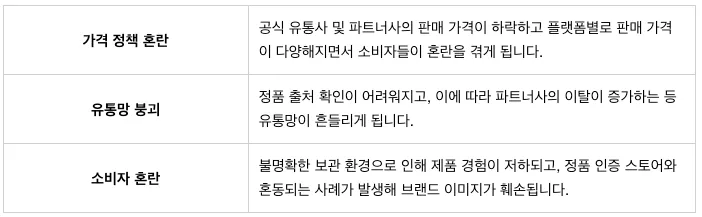
Rogue resellers’ activity goes beyond unauthorized resale and can cause problems across a brand’s operations, such as:
How FMCG brands can respond: real-time monitoring and seller analysis
Fighting rogue resellers goes beyond reporting and enforcement. The key is analyzing distribution flows with data and building a real-time detection and response system. Brands can build a systematic response like this:
- Monitor every online channel more closely: Build monitoring that covers not just major commerce platforms but social media, blogs and communities.
- Analyze sales patterns and price anomalies: Analyze quantitative data such as repeat purchases by a single ID, buying concentrated around sales, and repeated selling at low prices.
- Classify rogue sellers and request enforcement: Identify rogue sellers with data, then work with the relevant platforms to request that sales be stopped.
- Specify distribution routes in contracts and train partners: As part of partner management, include a clear no-resale clause in contracts and train partners on what happens if it’s violated.
An all-in-one IP protection solution for FMCG brands
MarqVision provides AI technology that helps FMCG brands, so closely tied to consumers’ daily lives, gain control of distribution in a fast-changing online market and effectively protect consumers, products and the brand.
- Automated multi-platform monitoring: Automatically scans a range of channels, including major marketplaces such as Coupang and Naver.
- AI analysis of malicious patterns: Identifies and analyzes patterns of the same seller selling unofficially across multiple platforms.
- Automated document drafting: AI analyzes violations and evidence and quickly drafts the documents needed for reports, based on the required photos and materials.
- Results reports: Reports show price recovery from enforcement and progress, monthly or in real time.
In the FMCG market, rogue resellers are more than a short-term revenue loss. They’re a major risk to brand image, partner trust and customer satisfaction. Regaining control over your entire distribution network through regular monitoring and data analysis is the core of a long-term brand protection strategy.
Monitor and respond to gray-market (unauthorized) sales efficiently with MarqVision.