.jpeg)
Fashion carries more counterfeiting risk than most categories because logos and prints are instantly recognizable and easy to copy. A single design spawns thousands of fakes within weeks, gray market distribution erodes pricing control, and impersonation scams route customers toward counterfeit storefronts. Legal, IP, and brand protection teams at global consumer brands need a strategy that catches counterfeit clothing across marketplaces, traces unauthorized sellers back to the source, and removes digital impersonation before it converts. We built this comparison around the tools that measure success by marketplace cleanliness, not takedown counts that show effort without proving improvement.
TLDR:
- Fashion brand protection solutions monitor marketplaces, social media, fake websites, and paid ads to detect and remove counterfeits, unauthorized sellers, and impersonation attempts.
- In fashion, logos and prints are easy to copy, and a single design can generate thousands of fakes within weeks of a product launch.
- MarqVision tracks Saturation Rate to measure whether marketplaces get cleaner over time rather than focus on takedown volume.
- Entrupy provides physical authentication for luxury resale but lacks marketplace monitoring and enforcement capabilities.
- Choose based on your threat profile: marketplace counterfeit detection, digital risk protection, or domain-centric security.
What Are Fashion Brand Protection Platforms
Fashion brand protection solutions combine software and managed services that find, track, and take down counterfeit goods, unauthorized sellers, and impersonation attempts wherever they surface online. The work spans several channels at once:
- Online marketplaces like Amazon, eBay, Alibaba, and Temu
- Social media profiles, posts, and shoppable content
- Standalone websites and lookalike domains
- Paid advertising that routes shoppers toward fake storefronts
Fashion carries a heavier burden than most categories. Logos, prints, and silhouettes are easy to copy and instantly recognizable, which makes visual identity theft a constant threat. A single handbag design or seasonal print can spawn thousands of fakes within weeks. Counterfeit goods accounted for $467 billion in global trade as of 2021, per the OECD, with fashion and apparel representing a substantial share of that volume. Gray market sellers and unauthorized distributors also erode pricing and channel control. These solutions give legal and brand teams one system to detect the abuse, document it, and enforce against it.
How We Ranked Fashion Brand Protection Platforms
No hands-on trials were run for this ranking. The assessment draws on vendor-published documentation, third-party review sites, public case studies, and related industry analysis. With that evidence base in mind, each solution was judged against six criteria that matter most to fashion brand protection teams:
- Detection coverage across marketplaces, social media, and standalone websites
- Enforcement effectiveness and takedown speed
- AI and automation depth, including how much manual review the tool offloads
- Fashion-specific capabilities like counterfeit product detection, image recognition for prints and logos, and unauthorized reseller monitoring
- Outcome metrics that prove marketplace cleanliness over time, weighed above raw activity counts
- Fit for legal and brand teams managing enforcement at scale
Where a vendor reports its own performance figures, we attribute those claims to the vendor instead of presenting them as independently verified.
Best Overall Fashion Brand Protection: MarqVision
We built our brand protection service for fashion and apparel teams fighting counterfeits, gray market sellers, and digital impersonation at once. Anti-counterfeit detection, digital risk protection, unauthorized seller monitoring, and trademark management run inside one system, with the goal of measurable marketplace cleanliness instead of takedown counts that prove effort but not results.
Core Strengths
- AI detection across 1,500+ marketplaces, including Amazon, eBay, Alibaba, Walmart, Temu, and regional channels, with 97% accuracy in automated counterfeit identification based on internal testing
- Our Saturation Rate metric, which measures infringing listings as a share of total listings, so you can see a marketplace get cleaner over time
- Fashion-specific tooling: image recognition for copyright enforcement, SKU-level product matching, and rotation-based monitoring that moves coverage toward new threat channels
- Coverage spanning fake website takedowns, social media impersonation removal, paid advertising enforcement, and seller intelligence drawn from a 600,000-seller database
- Channel access including Temu scraping, Amazon allowlist status, Meta Trusted Reporting at a reported 99% takedown rate (per our internal reporting), and TikTok Real IP Owner Program support
Unique Advantages
We run as a full-stack AI service, pairing detection automation with brand protection specialists. Our Copyright Image Flag catches sellers reusing official product photography even when they keep your name out of listing titles. Category-specific contracts let you target high-risk product lines instead of monitoring the full catalog. For unauthorized distribution, Seller Match cross-references your vendor lists against our seller database to trace inventory leakage and block bad distributors at the source.
Bottom line: For fashion brands that need counterfeit detection, digital risk protection, and unauthorized sales monitoring tied to proof of marketplace cleanliness, we are the strongest overall choice.
Entrupy
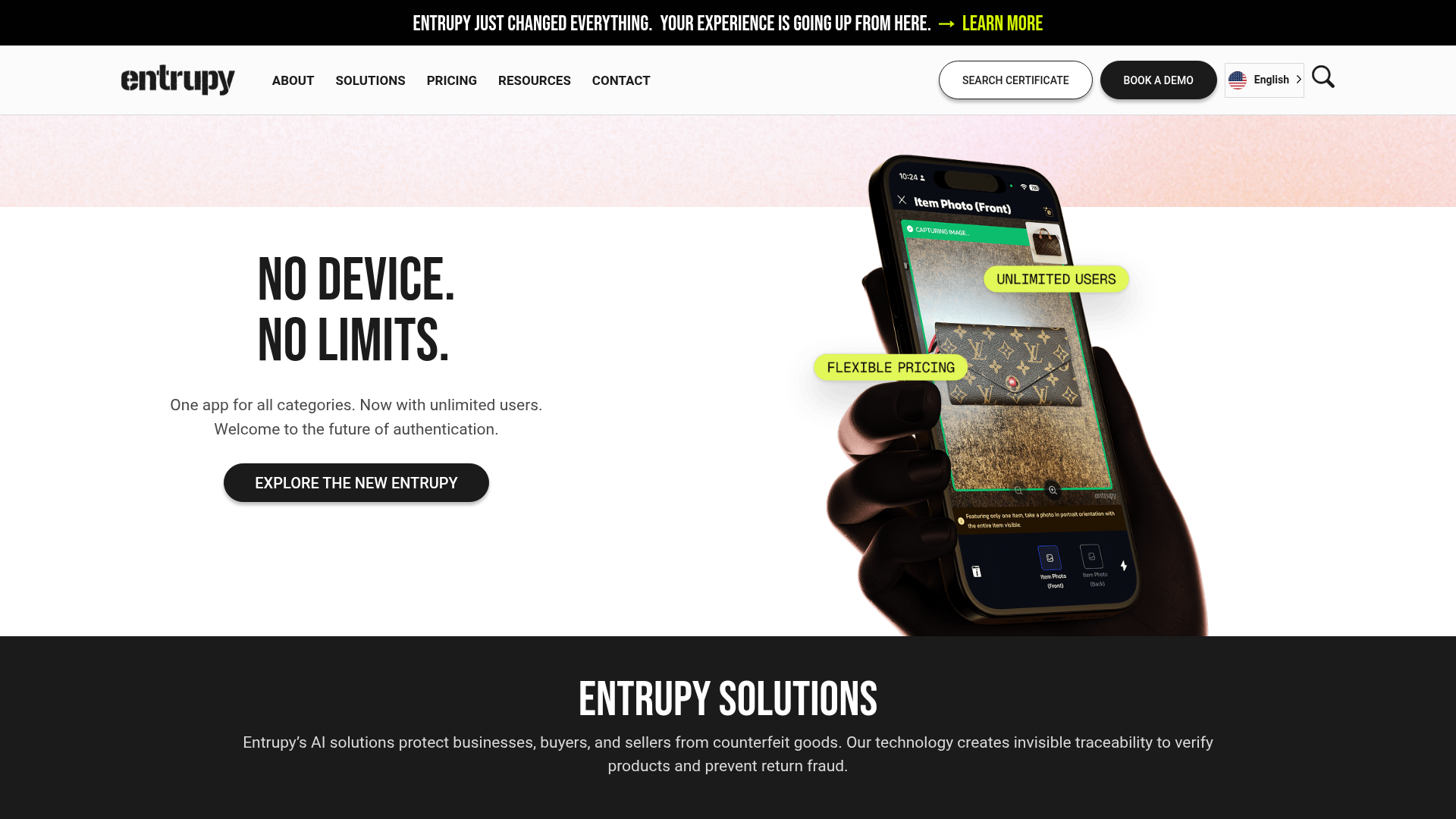
Entrupy takes a different angle from marketplace monitors. It is an AI authentication service using microscopic imaging and machine learning to verify luxury handbags, sneakers, and apparel, with the company reporting over 99% accuracy. It serves as an official authenticator for TikTok Shop and works with retailers and secondhand shops worldwide.
What They Offer
- A microscopic imaging device capturing high-resolution images of materials, stitching, logos, and distinctive product features
- Authentication coverage for 22 luxury brands, including Louis Vuitton, Gucci, Chanel, Prada, Hermès, and Dior, per Entrupy's 2026 State of the Fake Report
- Real-time results delivered in minutes, paired with a digital certificate of authenticity
- $3.34 billion authenticated in 2025, at a 99.86% accuracy rate per Entrupy's own reporting
Good for: Luxury resale businesses and secondhand retailers needing point-in-time verification of individual high-value items through physical inspection.
Limitation: Entrupy is an authentication service, not a brand protection solution. It does not run marketplace monitoring, counterfeit listing detection, takedown enforcement, seller intelligence, or digital risk protection that fashion brands need across channels.
MarkMonitor
MarkMonitor builds its business on domain management, with brand protection layered on top to fight counterfeiting, piracy, cybersquatting, and paid search scams. Com Laude, owned by PX3 Partners, acquired the company in January 2026, following its 2022 purchase by Newfold Digital.
What They Offer
- Global enforcement and dispute resolution, including UDRP filings, ccTLD actions, automated and manual takedowns of infringing sites and social content, and cease and desist programs
- Domain portfolio management, trademark watch services, counterfeiting detection, digital piracy removal, and brand impersonation detection
- An AI-native product roadmap, with more detection, prioritization, and enforcement automation expected through 2026
- Operations across 80 countries, with regional hubs in Boise, London, Shanghai, and Tokyo
Good for: Large enterprises with complex global domain portfolios wanting registrar-backed security paired with brand protection.
Limitation: The brand protection, anti-piracy, and anti-fraud business was sold to OpSec Security in 2020, separating domain management from the enforcement capabilities fashion brands want as one integrated offering.
BrandShield
BrandShield is a digital risk protection tool that monitors, detects, and mitigates online brand abuse and IP infringement across websites, social media, and ecommerce channels. Its AI-powered services cover phishing removal, trademark infringement, and counterfeit sales across pharmaceuticals, finance, fashion, retail, and tech.
What They Offer
- Real-time threat detection, automated takedowns, and protection against phishing, trademark infringement, and social media impersonation
- Machine learning models that flag infringements with fewer false positives by reading visual brand elements, contextual usage, and impersonation tactics
- Coverage spanning counterfeits, fake listings, brand impersonations, fraudulent ads, phishing, domain squatting, and rogue mobile apps
- An enforcement team of licensed attorneys running takedowns in full transparency
Good for: Brands wanting strong digital risk protection and phishing defense across social, web, and paid advertising, particularly those facing threats beyond marketplace counterfeits.
Limitation: BrandShield covers marketplace counterfeit detection and social takedowns, but lacks dedicated seller intelligence to trace unauthorized inventory back to the distributor source, and does not offer outcome metrics like saturation rate to measure whether a marketplace gets cleaner over time.
Corsearch
Corsearch delivers AI-powered trademark and brand protection through data, analytics, and services aimed at safeguarding IP. In May 2025 it launched Corsearch Zeal 2.0, an AI-native system built to counter counterfeiting and online brand abuse.
What They Offer
- A proprietary Cleanliness Score that measures brand health across online channels in real time, moving past takedown counts toward a quantifiable read on consumer and commercial risk
- Deep semantic detection and AI search trained on cross-brand datasets, with image recognition built to surface disguised infringements carrying no explicit brand identifiers
- Processing of roughly 150,000 listings per client each day
- Managed services for investigation and enforcement, with multilingual, multi-jurisdiction support
Good for: Large enterprises needing integrated trademark clearance, domain monitoring, and brand protection paired with legal-focused workflows.
Limitation: Corsearch does not offer a dedicated seller intelligence database for tracing unauthorized inventory back to distributor sources, and its workflow is built around trademark clearance and legal teams rather than channel-specific marketplace enforcement. Fashion brands that need direct platform access programs, such as Temu scraping or TikTok Real IP Owner Program support, will find those capabilities absent.
Feature Comparison Table of Fashion Brand Protection Solutions
The table below lines up the five solutions against the capabilities fashion teams ask about most, from marketplace detection through managed service delivery.
Why MarqVision Is the Best Fashion Brand Protection Solution
Fashion brands face three threats at once: marketplace fakes, digital impersonation, and unauthorized distribution that undercuts pricing. We built our service to handle all three under one program instead of splitting them across vendors who each cover a slice.
Measuring What Matters
The difference shows up in what we measure. Saturation Rate tracks whether a marketplace actually gets cleaner, answering the question legacy providers dodge when they report takedown volume without proof of improvement.
Our enforcement reach compounds that. Direct partnerships give us channel access most competitors cannot match, and our seller intelligence traces unauthorized listings back to the distributor leaking inventory. That turns enforcement from repeat takedowns into contract action against the source.
Final Thoughts on How to Protect Your Brand From Counterfeit Clothing
Marketplace fakes, digital impersonation, and gray market sellers each need different enforcement tactics, but most brands end up splitting them across three vendors who never talk to each other. Industry organizations like AAFA increasingly focus on integrated platforms that coordinate enforcement across channels instead of isolated point solutions. The smarter approach pairs counterfeit detection, social takedowns, and seller intelligence under one system so you can measure whether the marketplace is actually getting cleaner. Want to see how that works in practice? Request a demo and we'll show you the difference between activity reports and proof of results.
FAQ
How do I choose the right fashion brand protection solution for my organization?
Start with a clear assessment of where your threats concentrate: marketplace counterfeits, digital impersonation, or unauthorized distribution. Match that threat profile to vendor capabilities and look for platforms that measure marketplace cleanliness with outcome metrics like saturation rate instead of reporting takedown volume alone. Review channel coverage against the platforms where your brand actually sells, and confirm the vendor can enforce in the jurisdictions where your threats originate.
Which fashion brand protection tools work best for luxury brands versus fast fashion?
Luxury brands facing high-value handbag and apparel counterfeits should focus on solutions with physical authentication capabilities and strong unauthorized seller intelligence, while fast fashion brands managing high-volume marketplace abuse need automated detection at scale across global ecommerce channels. Both require image recognition and social media monitoring, but luxury brands often need deeper investigative services and offline enforcement coordination that mass-market apparel brands can automate more fully.
Can brand protection platforms detect counterfeits when sellers avoid using my trademark in listings?
Advanced platforms use image recognition and SKU-level product matching to catch counterfeits even when sellers strip brand names from titles and descriptions. Copyright Image Flag technology identifies when sellers copy official product photography, and AI models trained on visual brand elements can detect logo placement, print patterns, and product silhouettes that signal infringement without requiring text-based trademark use.
What is Saturation Rate and why does it matter more than takedown counts?
Saturation Rate measures infringing listings as a percentage of total listings in a marketplace search, showing whether a channel actually gets cleaner over time. A brand can remove 50,000 listings per month and still leave the first page of search results contaminated. Saturation Rate answers the question takedown volume ignores: what share of listings a real shopper sees is counterfeit, unauthorized, or abusive. It moves enforcement from activity metrics to business outcomes.
How long does it take to see measurable results from a fashion brand protection program?
Most platforms require an initial learning phase of 30 to 90 days to baseline your threat profile and calibrate detection models to your brand's product catalog. Measurable marketplace cleanliness improvement typically appears within six months, with saturation rates declining as repeat offenders are removed and enforcement coverage expands. Full automation and predictable enforcement rhythms often take 12 months as AI systems learn from your approval patterns and seller networks are mapped.
Stay up to date on the latest IP Protection content from MarqVision.



4 Enforcements a Week to 400: Scale Brand Safety with Marq AI

Don’t Just Find Counterfeits. Dismantle the Entire Network.

.png)
Discover the latest trends and challenges in IP protection

Take Control of Your Trademarks with MARQ Folio
Renew and Manage Your Trademarks Easily With MARQ Folio

We’re waiting to hear from you

See the best brand protection solution in action

Don’t let piracy steal your growth

Talk to us about your brand protection problems