.jpeg)
A fake ad using your brand does more than steal a sale. It takes the trust your customer had in you and hands it to a scammer. Counterfeit advertising on Meta and Google keeps scaling faster than the platforms can police it, so more brand teams are looking at dedicated tools to close that gap. Here's how the main options stack up.
TLDR:
- Fake ads intercept high-intent shoppers on Meta and Google, routing them to phishing sites before the purchase reaches your brand.
- Imposter scams cost consumers $3.5 billion in 2025, per the FTC, and Google removed 8.3 billion ads that year yet fraudulent supply kept regenerating faster than the platform could remove it.
- Trademark registration is jurisdiction-matched, so a mark filed in one country does not cover fake ads served to shoppers in another.
- Enforcing only against the ad creative leaves the destination phishing site live, keeping the full click path open for the next victim.
- MarqVision holds a Meta Trusted Reporting partnership and reports a 5.3-hour median domain takedown against an industry baseline measured in days.
What Are Fake Ads Impersonating Brands?
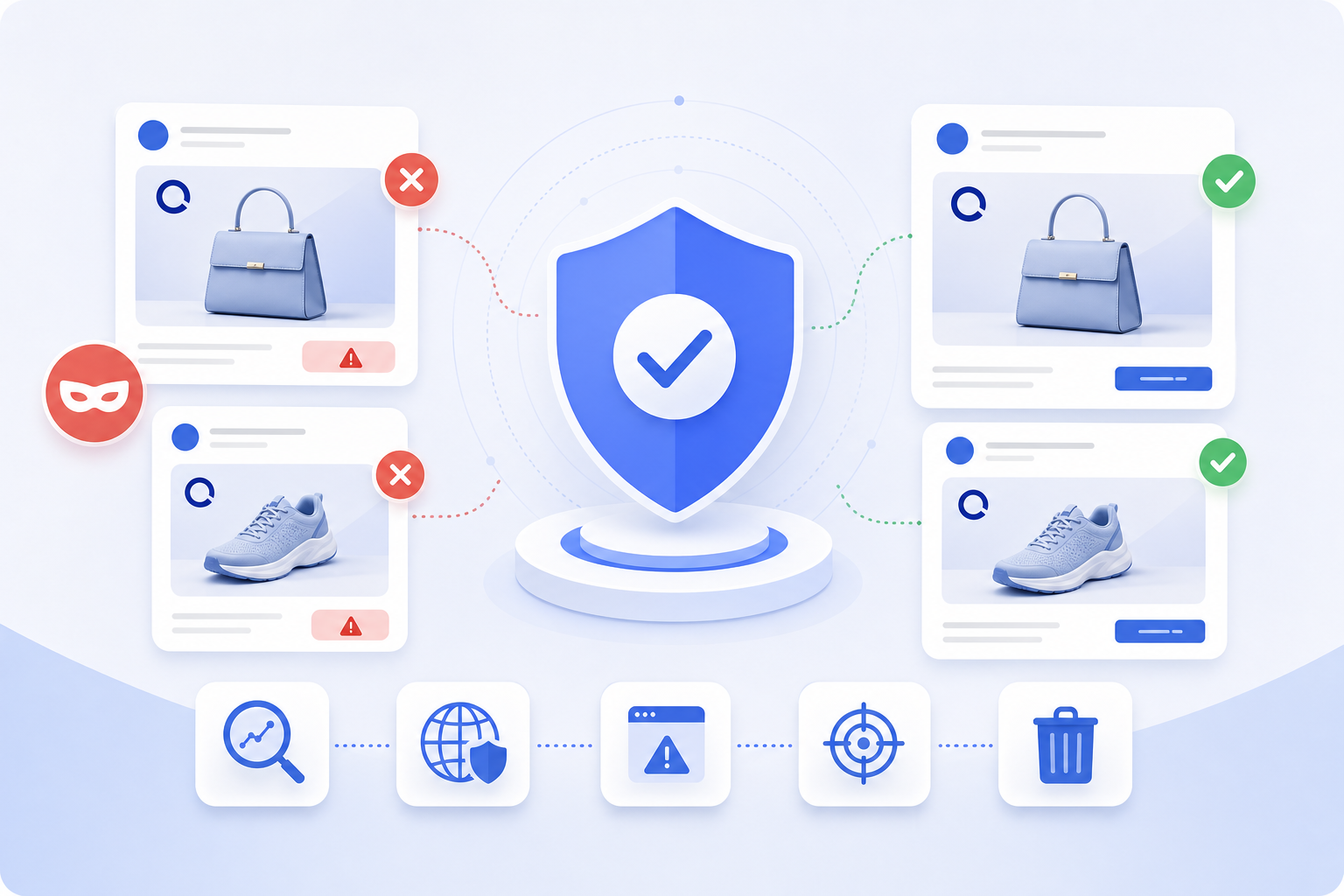
A fake ad is a paid placement that borrows your brand identity to sell something you never authorized. Threat actors buy space on Meta surfaces like Facebook and Instagram, or Google search results, then dress it in your logo, product photography, and messaging. It runs inside the same channels your real campaigns depend on.
The mechanism is what makes this dangerous. Fake ads intercept high-intent shoppers at the exact moment they search for your products, then route them to phishing pages or counterfeit storefronts. Brands that need actionable steps can review how to block fake brand ads. The customer converts before the click reaches your site.
This sits apart from general ad fraud. Click fraud and bot traffic drain media budget. Brand impersonation ads (see our buyer's guide) target your customers directly, capturing purchases and trust that should have been yours.
Why Fake Ad Removal Is a Brand Protection Priority
Start with the money. Imposter scams cost consumers $3.5 billion in 2025, per the FTC's June 2026 consumer fraud report, and a share of that damage runs through paid ads carrying your name. Google reported blocking or removing 8.3 billion ads across 2025, yet fraudulent supply keeps regenerating at machine scale. The platforms cannot police this alone.
For your team, the fallout lands in three places:
- Trust erosion. A customer defrauded through an ad wearing your logo blames you, not the impersonator.
- Inflated acquisition costs. Fake placements that outbid or intercept your real campaigns make you pay more to reach shoppers who were already yours.
- Legal liability. Regulators and defrauded buyers increasingly look to the brand whose identity was used, not the anonymous advertiser behind it.
Platform enforcement leaves these exposures open between the moment an ad goes live and the moment it comes down. Teams managing smart rules for brand impersonation can cut that window by a measurable margin.
How We Ranked These Tools
We built this ranking around the questions your team has to answer when a fake ad goes live. Every assessment draws on publicly available information and vendor-disclosed specs, including product documentation, partnership status, and stated benchmarks. We ran no hands-on trials, so treat vendor-reported metrics as claims.
Here is what we weighed:
- Meta Ads enforcement, including Trusted Reporting status and takedown rates across Facebook, Instagram, Messenger, and Threads.
- Detection speed and MTTR, from the moment an ad surfaces to the moment it comes down.
- Destination enforcement, whether a tool removes the landing domains and counterfeit storefronts an ad points to, not the creative alone.
- Channel breadth across paid social and search surfaces.
- AI detection accuracy and false-positive control.
- Trademark-based enforcement prerequisites, since most takedowns stall without a registered mark in the relevant jurisdiction.
- Support model, dedicated managed service versus self-serve reporting.
- Cross-border reach across the regions where your customers get targeted.
Best Overall Fake Ad Detection Tool: MarqVision
We built our service to close the gap most fake ad tools leave open. MarqVision covers the full counterfeit advertising lifecycle in one workflow: detecting fake ads across Meta surfaces, enforcing against the domains those ads route traffic to, and removing the phishing sites and counterfeit storefronts waiting at the end of the click.
As a Meta Trusted Reporting partner, we report a 99% takedown rate with an 11.3-hour median ad response across Facebook, Instagram, Messenger, and Threads. Our Domain Watchlist scans over 100 million newly registered domains daily using AI risk scoring, with fuzzy match and typosquatting detection to catch lookalikes before they resolve.
The dual-layer piece sets us apart. When we flag a fake ad, enforcement extends to the destination domain, with a 5.3-hour median takedown against an industry baseline measured in days.
A few mechanisms make that speed possible:
- Cloudflare Abuse API and Google Safe Browsing integrations for hosting-level takedowns and immediate de-indexing as a first response.
- Direct partnerships with payment providers including Stripe, Visa, and American Express to disrupt payments on counterfeit storefronts. See how AI-powered rapid takedowns for brand impersonation make this possible.
- AI threat classification with 0-10 severity scoring, so the highest-risk cases get actioned first.
One prerequisite is worth stating plainly. Paid ad enforcement on Meta requires a registered trademark in the relevant jurisdiction. Without it, complaints stall at platform review regardless of evidence quality, so every action we file carries valid legal standing.
Bolster
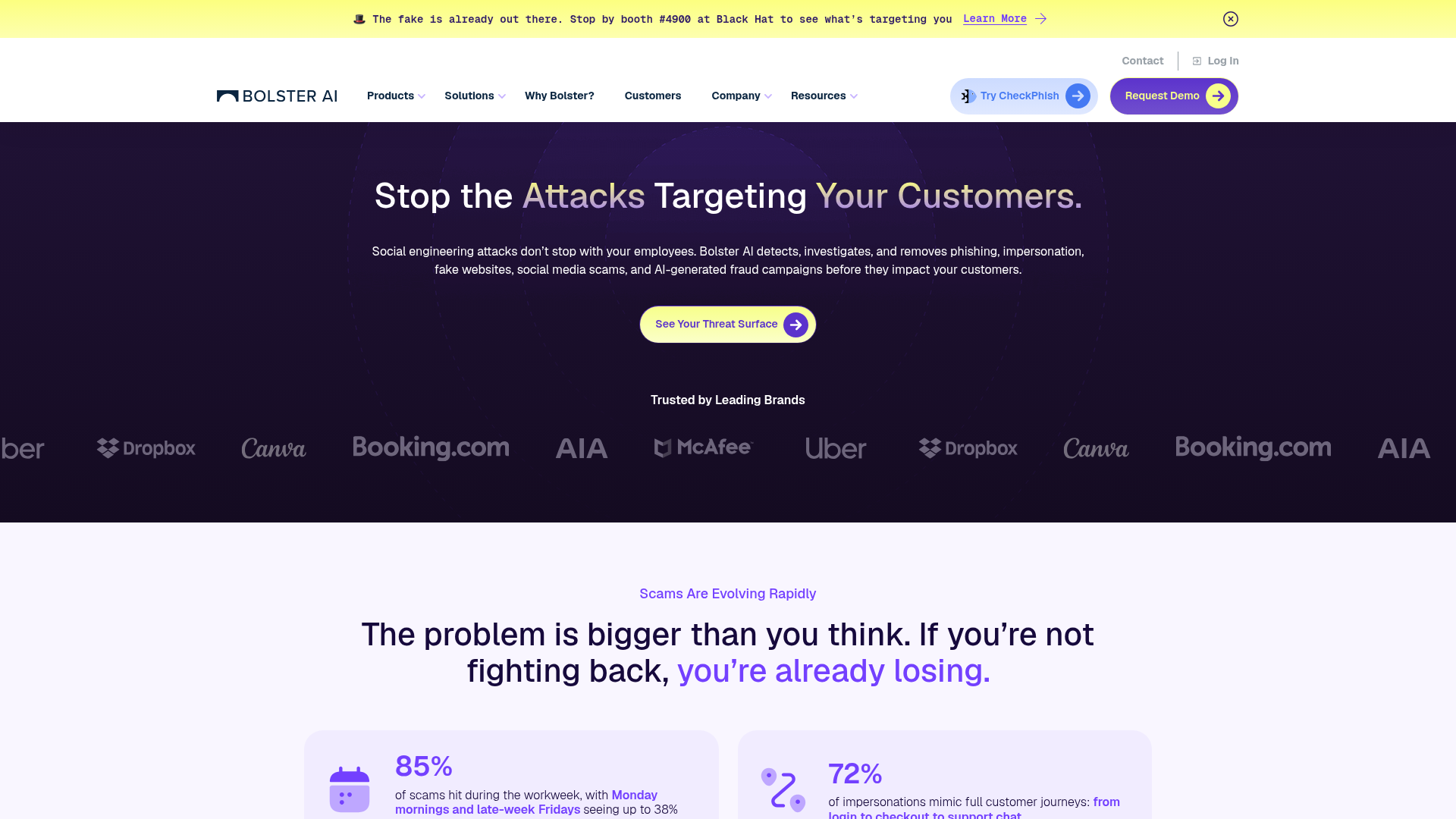
Bolster AI is a cybersecurity-focused brand security tool built around detecting and removing phishing sites, fake domains impersonating your brand, and impersonation campaigns. In July 2026, it launched Fraudulent Ads Monitoring and Takedowns, extending into paid search and social advertising.
What They Offer
- Detection of fraudulent paid ads across search and social channels
- Domain monitoring and phishing site takedowns across web and social media
- Marketplace monitoring and counterfeit listing detection, launched May 2026
- AI-powered detection with automated takedown initiation for phishing campaigns
Good for: security and fraud teams whose primary threat is high-volume phishing and domain abuse over trademark-specific enforcement.
Limitation: Bolster's fraudulent ads capability launched in July 2026, giving it no published enforcement history on Meta surfaces. The company holds no documented Meta Trusted Reporting partnership and publishes no Meta-specific takedown metrics, leaving the capability's real-world performance on Facebook, Instagram, and related surfaces unverified. Legal and IP teams enforcing on registered marks may also find the workflow model misaligned with trademark-based enforcement.
Bottom line: Bolster works for security teams managing phishing and domain fraud at scale, but brands centered on trademark-based ad takedowns and integrated IP workflows are better served by a purpose-built approach with a verified Meta partnership.
Sources
Red Points
Red Points is one of several brand protection tools covering marketplaces, social media, paid ads, websites, and domains for over 1,300 brands, pairing AI detection with managed enforcement.
What They Offer
- Marketplace counterfeit detection across major global platforms
- Paid ad and social media monitoring for brand impersonation
- AI models processing over 2.7 billion data points monthly
- Seller network intelligence and enforcement workflows
Good for: brands needing broad marketplace detection across Western channels tolerating a 1 to 3 day resolution window.
Limitation: third-party comparisons reference a 1 to 3 day resolution window for confirmed takedowns. Chinese platform coverage (Pinduoduo, WeChat, Douyin, and others) is gated behind the Enterprise tier, making it unavailable to brands on lower plans. Legal and IP teams enforcing trademark-based ad takedowns may also find the workflow model misaligned with jurisdiction-matched enforcement requirements.
Sources
BrandShield
BrandShield detects fake websites, phishing domains, and cybersecurity threats targeting brands, with its offering built around web-based fraud and domain abuse monitoring. Understanding how data breaches fuel brand impersonation helps contextualize why these threats keep regenerating.
What They Offer
- Fake website and phishing domain detection and takedown
- Social media account impersonation monitoring
- Paid ad and trademark infringement detection across digital channels
- Brand mention monitoring across web and social channels
Good for: organizations whose primary focus is phishing site detection where cybersecurity teams own brand protection.
Limitation: BrandShield publishes no Mean Time to Resolution benchmarks, making it hard for legal and IP teams to set a defined enforcement window in their SLAs. The tool also does not offer pre-enforcement informal outreach notices to infringers before formal takedown filings are submitted.
Bottom line: adequate for phishing threats, but thin on verifiable SLAs and full-stack ad enforcement.
Bustem
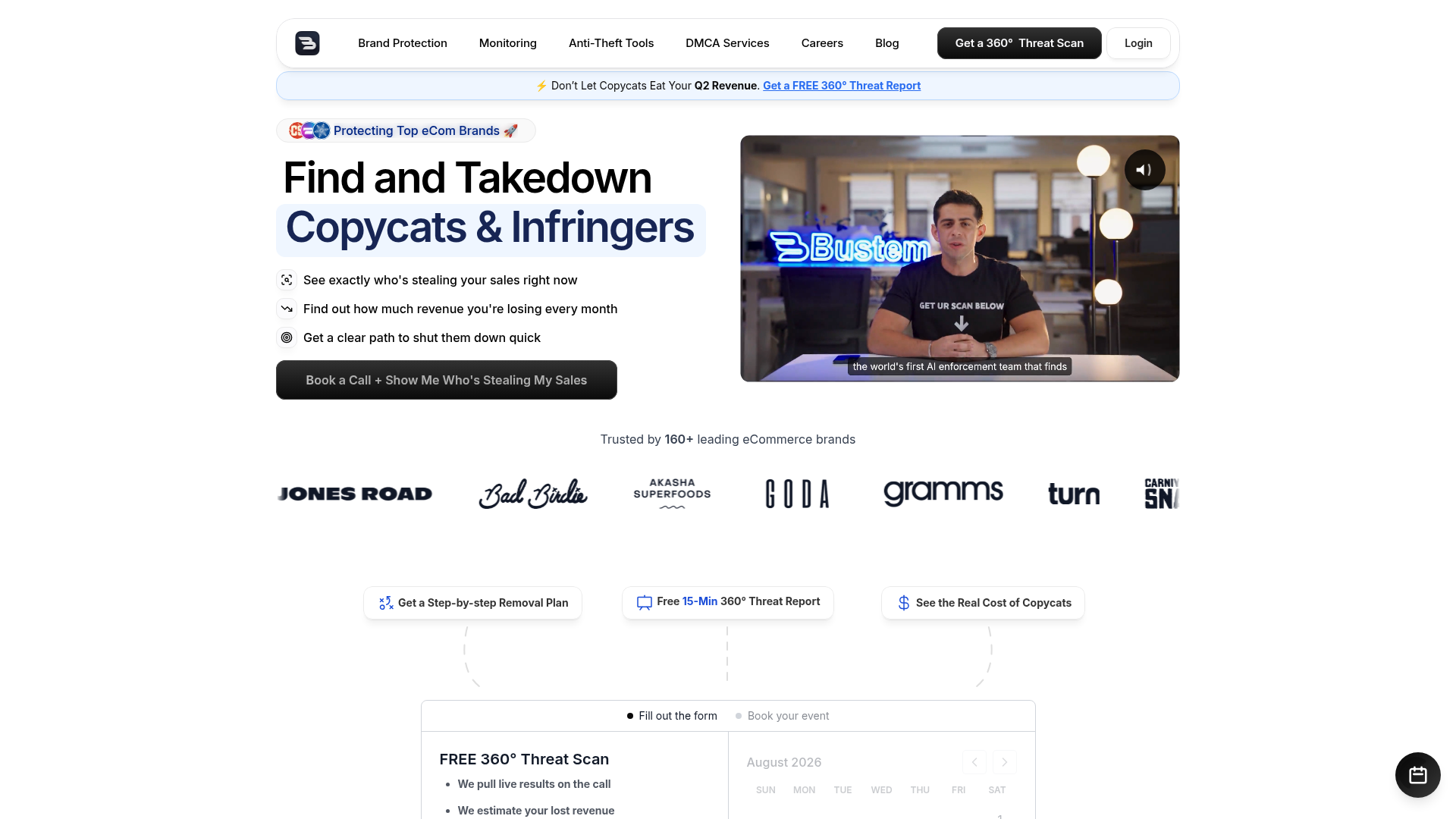
Bustem is an early-stage brand protection tool offering marketplace counterfeit detection and takedown enforcement, primarily for North American brands. It targets cost-sensitive buyers as a lower-priced alternative.
What They Offer
- Marketplace scanning for counterfeit product listings
- Trademark-based takedown enforcement for flagged listings
- Basic reporting on detected infringement activity
- Counterfeit detection across a limited set of marketplaces
Good for: small North American brands with limited budgets seeking entry-level detection.
Limitation: Bustem does not publish a documented marketplace count, leaving international coverage unverifiable. The tool is positioned for North American eCom brands, and no public feature page or channel list confirms cross-border reach. Bustem's website lists a 95% takedown success rate, though no independent benchmarks verify this figure. Cross-border reach outside North America and weekend enforcement coverage are not confirmed by any published documentation.
Podqi
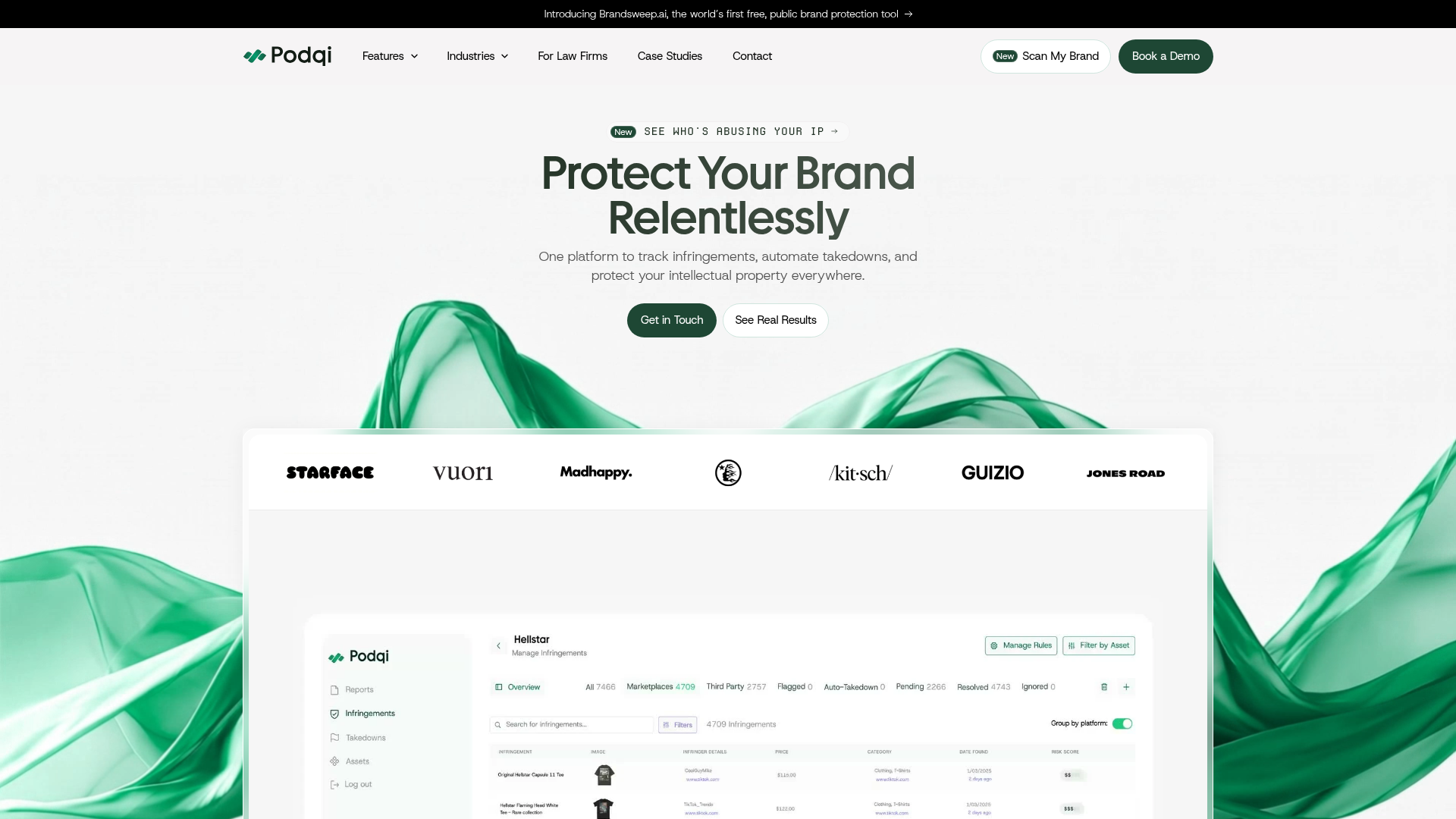
Podqi is an early-stage brand protection startup founded in 2024, headquartered in San Francisco, and backed by a $3M seed round raised in March 2025, led by General Catalyst with participation from Soma Capital, Afore Capital, and a group of strategic angels. The company claims coverage across 1,500+ marketplaces, domains, app stores, and social platforms globally. Its team remains small relative to enterprise enforcement demands, and the platform has no published case studies or independent benchmarks confirming performance at the scale or complexity typical of multi-market global brands. That context matters when evaluating SLA commitments, CSM depth, and cross-border enforcement operations under high case volume.
What They Offer
- Brand monitoring and infringement detection across digital channels
- Domain enforcement and takedown services
- Counterfeit and impersonation detection workflows
- Detection-to-enforcement reporting for brand teams
Good for: brands familiar with Podqi's workflow who want a transitional option while assessing longer-term vendors.
Limitation: Podqi's homepage now lists 1.2 average days to resolution as their headline proof point. For context on what realistic timelines look like, see how long brand takedowns actually take. No independent benchmarks verify cross-border enforcement performance across non-English or non-Western markets. Podqi is an early-stage, VC-backed company, and no published documentation confirms the depth of its international enforcement operations at scale.
Bottom line: Podqi's vendor-reported 1.2-day resolution time and claimed global coverage across 1,500+ channels are unverified by independent benchmarks. For brands that need confirmed performance at scale, across high-volume or multi-market enforcement programs, the absence of published case studies and the company's early-stage size introduce meaningful execution risk.
Feature Comparison Table of Fake Ad Detection and Removal Tools
Here is how the six tools line up across the capabilities your team weighs before signing. Values reflect vendor-disclosed information, so read blanks as "not published" and not confirmed absence.
Why MarqVision Is the Best Fake Ad Detection and Removal Tool
We built MarqVision to close the gap other tools leave open. Each option on this list covers one slice well. What sets us apart is the combination: a verified Meta partnership, ad-plus-destination enforcement in one workflow, AI-native detection built for scale, and trademark and legal support that gives every takedown legal standing.
See how AI-native platforms are replacing legacy BPOs.
No other option folds those layers into a single service. When your fake ad exposure runs from the creative through the click to a counterfeit storefront, that end-to-end coverage is what protects you where the platforms fall short.
FAQ
How do I choose the right fake ad detection tool from options like MarqVision, Red Points, BrandShield, and Bolster?
Start by mapping your primary threat vector: if fake Meta ads routing traffic to phishing sites or counterfeit storefronts are your core exposure, you need a tool with a verified Trusted Reporting partnership and destination domain enforcement, because ad creative removal alone is not enough. If your threat is centered on phishing and domain abuse without a strong paid ad component, Bolster or BrandShield may fit your security team's workflow better than a trademark-focused platform.
Is MarqVision better than Red Points for brands with China market exposure?
Yes, for China-specific enforcement. Red Points has no documented coverage on Pinduoduo, WeChat, Xiaohongshu, or Douyin, which are the primary surfaces where China-based counterfeit distribution runs. MarqVision covers Chinese social platforms and operates direct enforcement channels in that market, making it the stronger choice when your fake ad or counterfeit traffic originates from or targets Chinese consumers.
When does dual-layer enforcement matter more than single-layer ad takedown tools like BrandShield or Podqi?
Dual-layer enforcement matters any time a fake ad routes traffic to a live phishing site or counterfeit storefront, because removing the ad creative leaves the destination fully active and capturing purchases from other traffic sources. Single-layer tools that take down the ad without touching the destination domain leave the click path open, and a new ad pointing to the same site can go live within hours.
Does registered trademark status affect which of these tools can actually file a takedown on your behalf?
Yes, and this applies across every tool on this list, MarqVision included. Paid ad enforcement on Meta and Google requires a registered mark in the jurisdiction where the infringing ad runs. Without jurisdiction-matched registration, platform review stalls regardless of evidence quality. If your trademark portfolio has geographic gaps, resolve those before scoping any paid ad enforcement program, regardless of which vendor you choose.
Which tool works best for brands that need fast resolution over detection monitoring alone?
If sub-12-hour mean time to resolution is your benchmark, MarqVision is the only tool on this list with a published MTTR under that threshold, reporting an 11.3-hour median for Meta ads and a 5.3-hour median for domain takedowns. Red Points publishes a 1 to 7 day window and Podqi reports 1.9 days, both of which are unsuitable for brands facing short-window phishing campaigns or product launch impersonation where damage concentrates in the first hours after a fake ad goes live.
Does trademark registration in one country cover a fake ad running in another?
No. Enforcement is jurisdiction-matched. A mark registered in the EU supports takedowns on EU-targeted placements, but a fake ad served to US shoppers may need a US registration to clear platform review. File where the ads actually run before scoping a program.
What happens when a fake ad points to a site hosted in a non-cooperative country?
Full takedown stalls when hosting ignores abuse reports. The fallback is de-indexing through Google Safe Browsing plus browser warning flags, which cuts organic traffic even when the registrar stays silent. Single-layer ad tools have no answer once the creative comes down.
Should one team own both the ad and the phishing site behind it?
Yes, and match the evidence to the channel. Paid ad impersonation is malvertising, so detection lives in ad consoles, while the destination phishing page needs domain and hosting evidence. A tool that separates these into disconnected workflows leaves the click path open between the two takedowns.
Final Thoughts on Choosing a Fake Ad Removal Tool for Your Brand
Every tool on this list solves part of the fake ad problem. The part that usually goes unsolved is what happens after the click, when the customer lands on a phishing page or counterfeit storefront that your takedown never reached. Your enforcement coverage should match the full path your customers travel, starting with the creative they see first and extending all the way through the destination. See how MarqVision covers that full path.
Stay up to date on the latest IP Protection content from MarqVision.




4 Enforcements a Week to 400: Scale Brand Safety with Marq AI

Don’t Just Find Counterfeits. Dismantle the Entire Network.

.png)
Discover the latest trends and challenges in IP protection

Take Control of Your Trademarks with MARQ Folio
Renew and Manage Your Trademarks Easily With MARQ Folio

We’re waiting to hear from you

See the best brand protection solution in action

Don’t let piracy steal your growth

Talk to us about your brand protection problems