Your ad spend is funding phishing: MarqVision's AI solution for brand impersonation
Traffic your ads paid for is leaking to fake sites. Marq AI blocks fake domains in under 5 hours and fake ads in under 12, with 99.8% AI accuracy. See a demo.
 Jinie Park4 min read

On this page9
- How generative AI changed brand impersonation and phishing
- Three ways brand ad spend ends up funding phishing
- Why traditional brand protection doesn’t work against phishing and impersonation
- Marq AI: real-time, AI-based response to brand impersonation and phishing
- An AI agent that never stops, from detection to takedown
- Speed, accuracy and coverage in impersonation response, without compromise
- Intelligence beyond brand protection
- Don’t let your ad spend fund phishing
- FAQ: MarqVision’s AI solution for brand impersonation
A brand launches a new product. It goes viral.
Within 72 hours, fake domains are registered and phishing ads carrying the brand’s name start running on Instagram. Campaign traffic the brand worked hard for leaks to fake stores. Customers who get scammed complain to the brand’s support team. Trust collapses because of sites the brand never built.
This isn’t one brand’s story. It’s what more than 90% of MarqVision’s customers are dealing with right now.
How generative AI changed brand impersonation and phishing
Just a year ago, copying a brand took specialist skills and time. Now AI can produce a fake site, domain and ads in half a day.
By one estimate, a new fake site is created about every 11 seconds, and the US Federal Trade Commission (FTC) named brand phishing the top fraud type of 2025, with $12.5 billion in losses. According to MarqVision’s latest report, 85% of brands are exposed to AI-driven impersonation threats that didn’t exist two years ago.
The time between a fake going up and coming down is exactly when a brand’s ad spend turns into profit for phishing criminals.
Three ways brand ad spend ends up funding phishing
The damage from brand impersonation is no longer abstract. It happens in three places at once.
Hijacked ad clicks and lost revenue: Fake ads bid on the brand’s own keywords. Customers who click land on phishing sites. The brand’s ad spend becomes phishing revenue. ROAS falls, conversion drops, and the marketing team ends up writing explanations.
Damage that spreads while response lags: 57% of brands say fake content spreads within a week of appearing. Customers share it and take screenshots. Response needs to happen in hours, not days, yet the industry average is still 2 to 8 days.
Threats on every channel at once: Blocking one domain doesn’t end it. Attacks hit paid ads, social media and website content at the same time. When customers get scammed on a phishing site, they don’t blame the fake. They blame the brand.
Why traditional brand protection doesn’t work against phishing and impersonation
Manual review can no longer keep up with AI. Fakes made by AI are created faster and more cheaply than people can review them.
Yet traditional brand protection platforms were built for marketplace counterfeits. Paid ad monitoring, fake domain tracking and real-time web content detection are outside what they were designed to do.
The result: days or weeks of processing time, fragmented reporting, and legal hours wasted on false positives. Legal action is the right tool for complex cases. It can’t keep pace with phishing.
Marq AI: real-time, AI-based response to brand impersonation and phishing
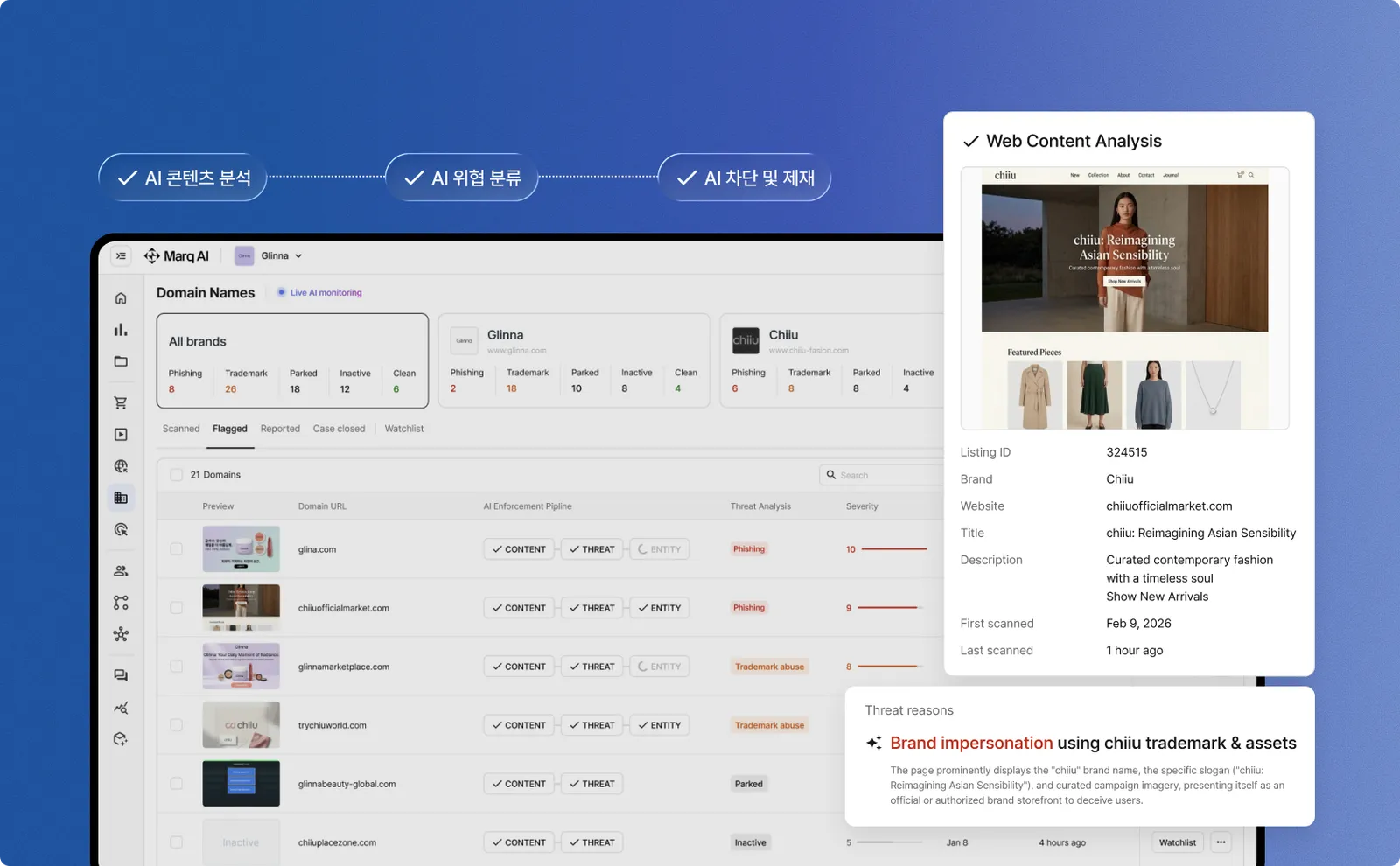
To close the gaps in traditional protection and respond in real time, MarqVision is launching a new AI solution for brand phishing.
Marq AI is MarqVision’s AI enforcement engine, built for the speed, accuracy and coverage brand protection demands in 2026. AI enforcement, with human confirmation for safety, runs across three channels: domains, paid ads and website content (social media coming soon).
An AI agent that never stops, from detection to takedown
Step 1: Real-time detection and analysis
Marq AI detects and analyzes every channel in real time. For fake domains, it analyzes HTML, JavaScript, metadata and visual snapshots. In paid ads, it detects keyword hijacking and stolen creative. On websites, it finds phishing pages that copy brand assets and checkout flows. Detection and analysis run around the clock on every channel.
Step 2: Threat analysis and risk scoring
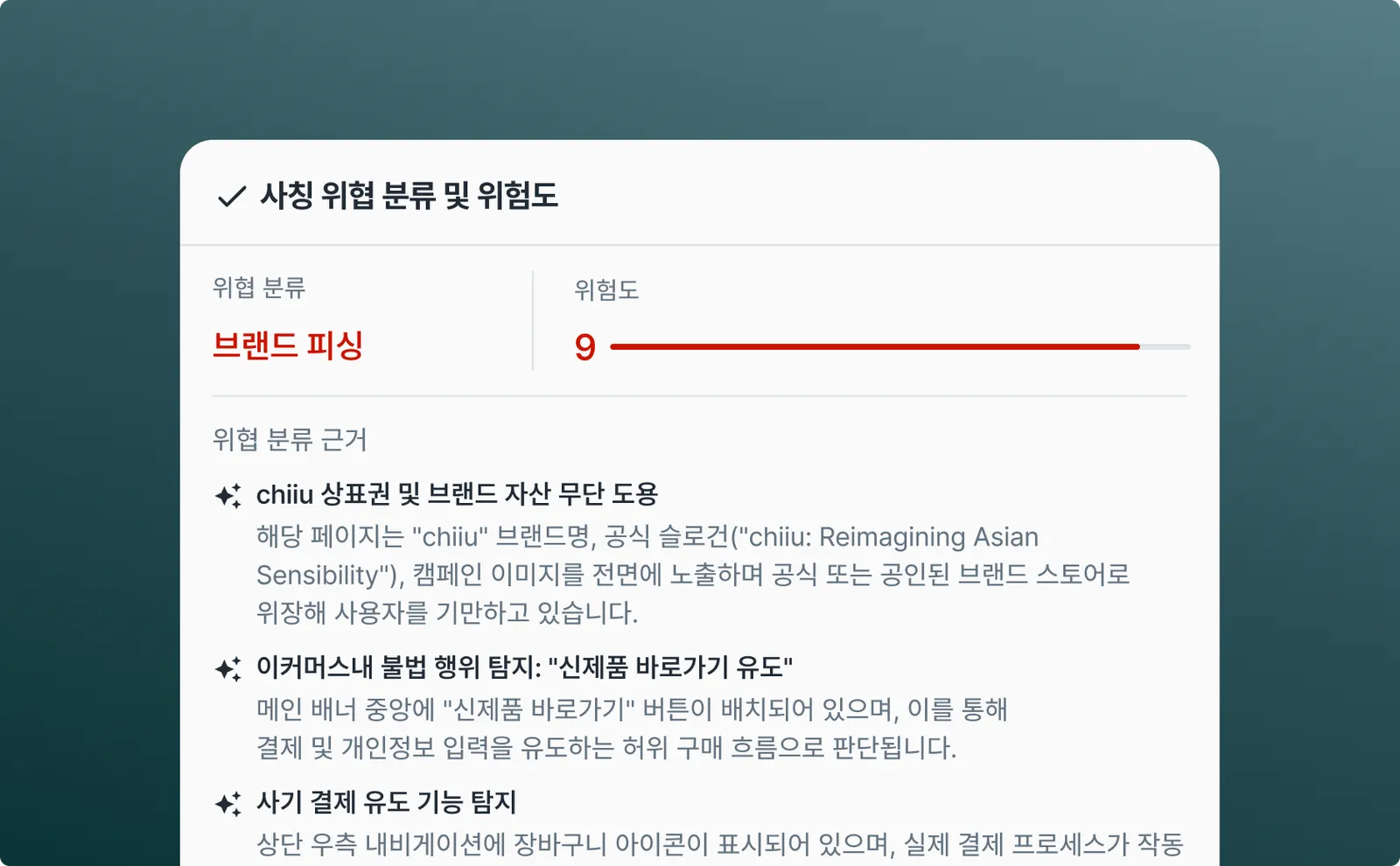
Multi-agent AI assesses whether something is a threat and scores its risk with clear reasoning, whatever the type: look-alike domains, fake ads or cloned web pages. With the AI’s risk score in hand, your team can enforce on solid grounds.
Step 3: Immediate blocking and removal
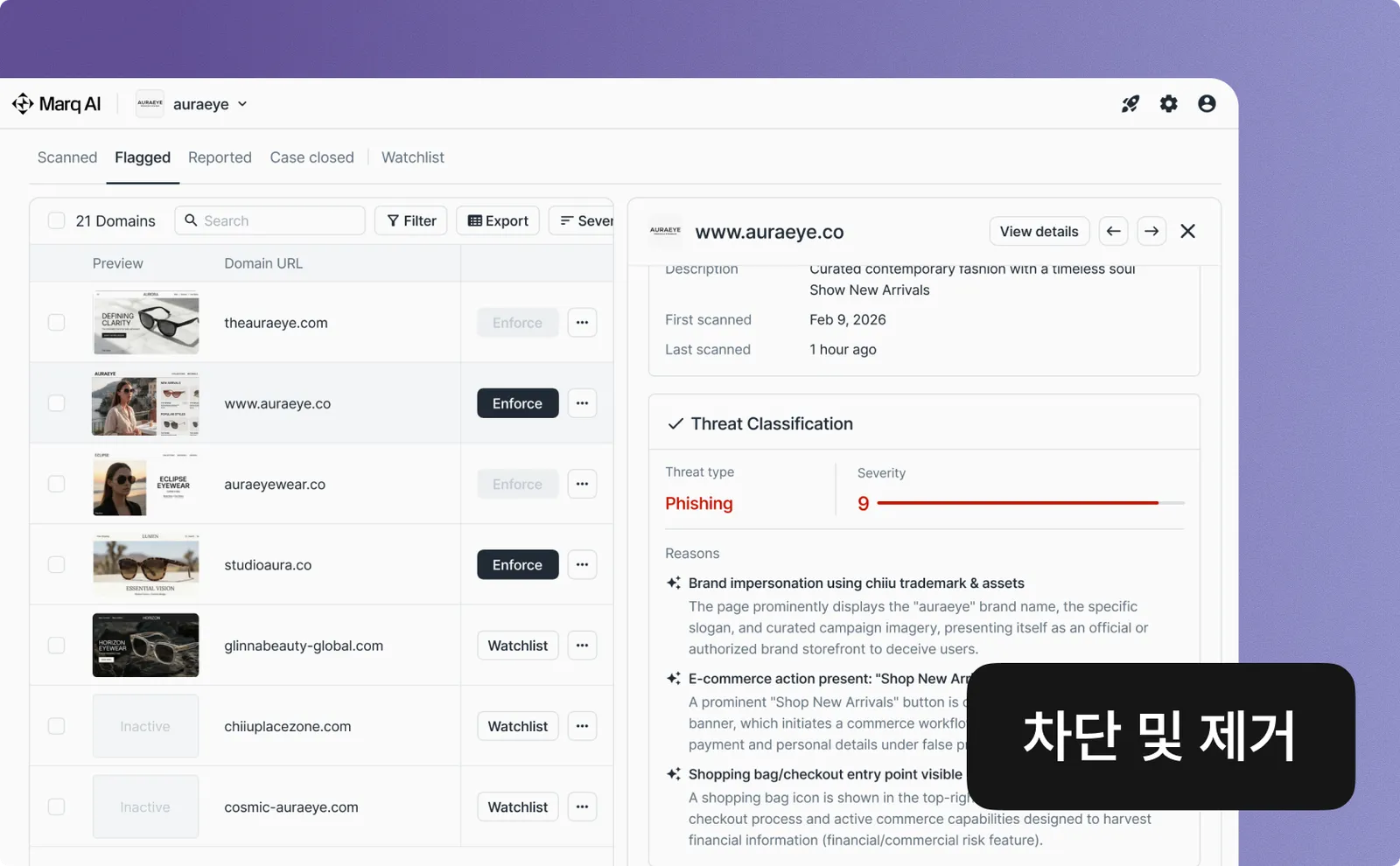
Marq AI works out everything needed for immediate blocking and removal. It analyzes domain registrars and hosts for fake sites, Google and Meta for fake ads, and hosting and CDN providers for illegal content, and automatically builds an enforcement package for each channel. The final removal decision is made after your team confirms it.
Speed, accuracy and coverage in impersonation response, without compromise
Three things set Marq AI apart from other brand protection solutions.
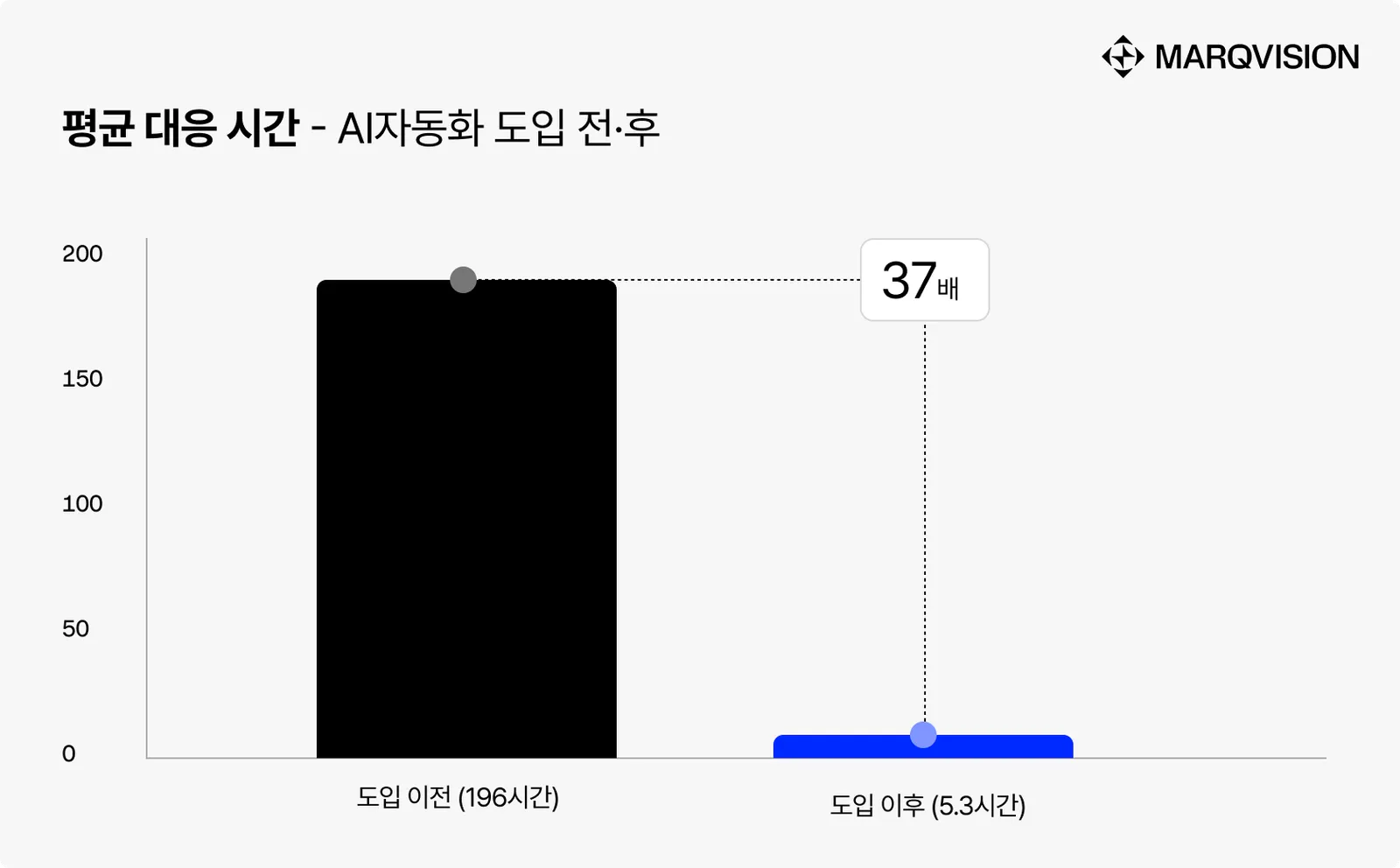
Speed: Across more than 50,000 real actions during the beta, the average response time was under 5 hours for fake sites and under 12 hours for ads. That’s 37 times faster than the industry benchmark.
Accuracy: Marq AI achieved 99.8% accuracy across more than 50,000 domains, and 86.3% on paid ads. Every final enforcement decision is made after your team has reviewed it, overridden it if needed, and checked the reasoning.
Coverage: Marq AI covers every brand channel: domains, paid ads, website content and social media. With an average response time under 12 hours across all channels, it’s the first brand protection platform to protect e-commerce and marketing channels end to end: the places where revenue is actually made.
Intelligence beyond brand protection
MarqVision is after more than detecting fakes. It wants an environment where e-commerce, marketing and legal teams work from the same real-time platform, where every fake is identified and removed before it reaches customers, and where brands operate with confidence instead of anxiety.
To get there, MarqVision is building the brand intelligence layer the market has been missing. It gives visibility into what is really happening on every channel where customers meet the brand, and provides predictive threat intelligence before attacks begin. It replaces fragmented vendor tools, manual escalation and reactive processes with a single platform.
Don’t let your ad spend fund phishing
The global e-commerce and marketing leaders MarqVision met at ShopTalk 2026 shared one feeling: helplessness as fakes spread, and the sense that every new campaign means competing with phishing criminals. Part of every ad dollar is at risk.
Marq AI was built to solve this. It gives brands the speed, accuracy and coverage to get ahead of fakes instead of chasing them. Stop your ad spend from becoming phishing revenue, starting now.
[Request a live demo]
FAQ: MarqVision’s AI solution for brand impersonation
Q. How is AI-based impersonation detection different from traditional methods?
Traditional solutions were designed around marketplace counterfeits. Marq AI covers fake domains, phishing ads and cloned websites at the same time, and completes detection to takedown in 5 to 12 hours on average: 37 times faster than the industry average.
Q. What happens when fake ads hijack brand keywords?
When phishing ads bid on brand keywords, CPCs rise and conversion falls. Customers sent to phishing sites have their payment details stolen, and their complaints come back to the brand’s support team and reviews. The brand’s ad spend becomes phishing revenue.
Q. How are false positives prevented?
Marq AI uses a two-layer system: multi-agent AI scores the risk, and final enforcement goes ahead only after your team confirms it. It achieved 99.8% accuracy across 50,000 domains and 86.3% on paid ads.
Q. Which channels does Marq AI cover?
It currently runs on three channels: domains, paid ads (Google and Meta) and website content, with social media coming soon. The average response time across all channels is under 12 hours.