Takedown counts can no longer protect brand trust: a counterfeit and gray-market strategy
Why does brand value fall as counterfeit and gray-market takedowns rise? The limits of takedown-first enforcement, and a data-driven way to manage risk instead.
 Jinie Park4 min read

On this page6
The invisible crisis your performance reports miss

Every month, a brand protection team’s report includes a line like this:
“1,284 intellectual property (IP) infringements enforced in total”
Removing thousands of counterfeit links and blocking gray-market sellers is no small task. But it’s worth asking one hard question:
As takedowns rise, are your brand’s value and trust recovering too?
It isn’t that simple. Takedown counts measure activity. They don’t show how stable the market has become. Focus on the numbers, and you can create an illusion that hides the structural problems a brand faces.
The strategic limits of takedown thinking

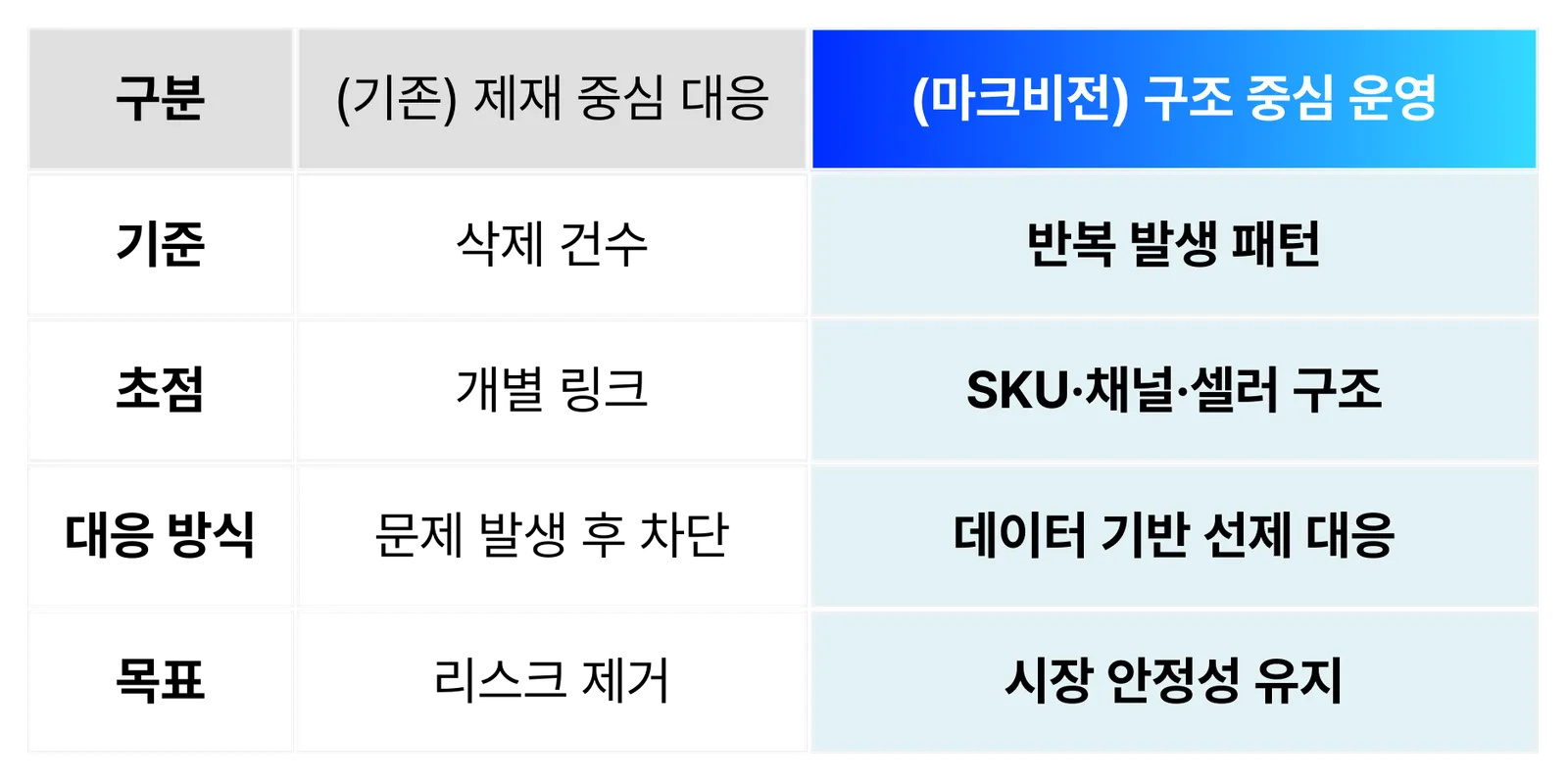
Traditional brand protection has focused on detecting infringements and removing them. When a problem appears, you find it, report it and take it down. But this approach has clear limits.
1. The fatigue of one-by-one enforcement: While you block individual URLs and sellers, the sellers switch accounts and names and come right back. Brands are stuck repeating “find, report, remove” over and over.
2. Infringement sped up by AI: Generative AI has cut the cost of producing counterfeit product pages, ad images and review content to nearly zero. For every one listing removed, ten similar ones go up. Brand protection has become a race against speed.
3. A gap with the customer experience: Inside the brand, a figure like “90%+ enforcement success rate” may mean something. But if shoppers still see distorted prices and fakes on the first page of search results, brand trust doesn’t recover. The standard for brand protection now lives on the shopper’s screen, not in the report.
Brand integrity: managing the structure, not just removals
Brand protection is moving beyond legal enforcement to a bigger question: how to manage the market as a whole.
The brand integrity MarqVision talks about doesn’t ask “How many did we remove?” Instead, it looks at:
- Which products (SKUs) keep running into problems
- Whether price distortion starts in particular channels
- How sellers come back
- Whether the gray market and counterfeits are connected
In other words, it’s about managing patterns and structure, not incidents.
Four strategic questions for controlling risk

To take your brand protection strategy further, you need to be able to answer these questions.
1. What links repeat sellers together?
Are repeat sellers using the same logistics routes, payment methods or distribution paths? You should be able to say whether you look at the structure behind them, rather than stopping at removing individual sellers.
2. Are certain SKUs more vulnerable?
If infringement concentrates in certain product lines, are there gaps in your pricing policy or distribution structure? Check whether the problem started in your own strategy, not just outside.
3. Are you analyzing how channels connect?
Is a price collapse on one e-commerce channel feeding the spread of fakes on social media or gray-market inflow offline? Risk doesn’t stay in one channel.
4. Are you ready for AI-driven infringement?
Can your current system keep up with altered images, keyword workarounds and auto-generated content? As technology evolves, your brand protection system has to evolve with it.
Brand protection is now strategy, not operations
Counterfeits and the gray market are no longer isolated incidents. They’re structural problems tied to a brand’s distribution strategy, pricing policy and digital customer experience. The goal isn’t a number of takedowns. It’s an environment where risks don’t keep coming back. Brand trust is proven by order in the market, not numbers in a report.
Global brands are already moving away from takedown-first enforcement. Brand protection is no longer about “how many did we remove” but about how much control you have over the results your growth creates.
With AI, demand created by marketing spills quickly into counterfeits and the gray market. Uncontrolled growth becomes risk.
MarqVision’s “A practical guide to managing brand results in the AI era: the 2026 State of Brand Integrity Report” shows how global distribution order is being distorted, how AI-driven infringement spreads, and which new KPIs can redefine brand protection results by connecting them to revenue. Now is the time for a strategy that protects your results, not just a response.
Pre-register for the report now and be the first to get it.
FAQ: taking your brand integrity strategy further

Q1. How should we change KPIs built around takedown counts?
Keep takedown counts as an activity metric, but make consumer-facing metrics such as “share of genuine listings shown” and “average exposure time of infringing content” your core KPIs.
Q2. Is the gray market directly linked to brand trust?
The gray market is a sign of uncontrolled distribution. Price collapses fuel the spread of fakes and ultimately damage the entire brand experience.
Q3. How does an AI-based structural response work?
It combines image similarity analysis, analysis of relationships between sellers and price trend monitoring to identify the core seller groups that keep reappearing, then prioritizes and acts on them.
(Original article: MarqVision Blog - The End of Takedown Thinking)