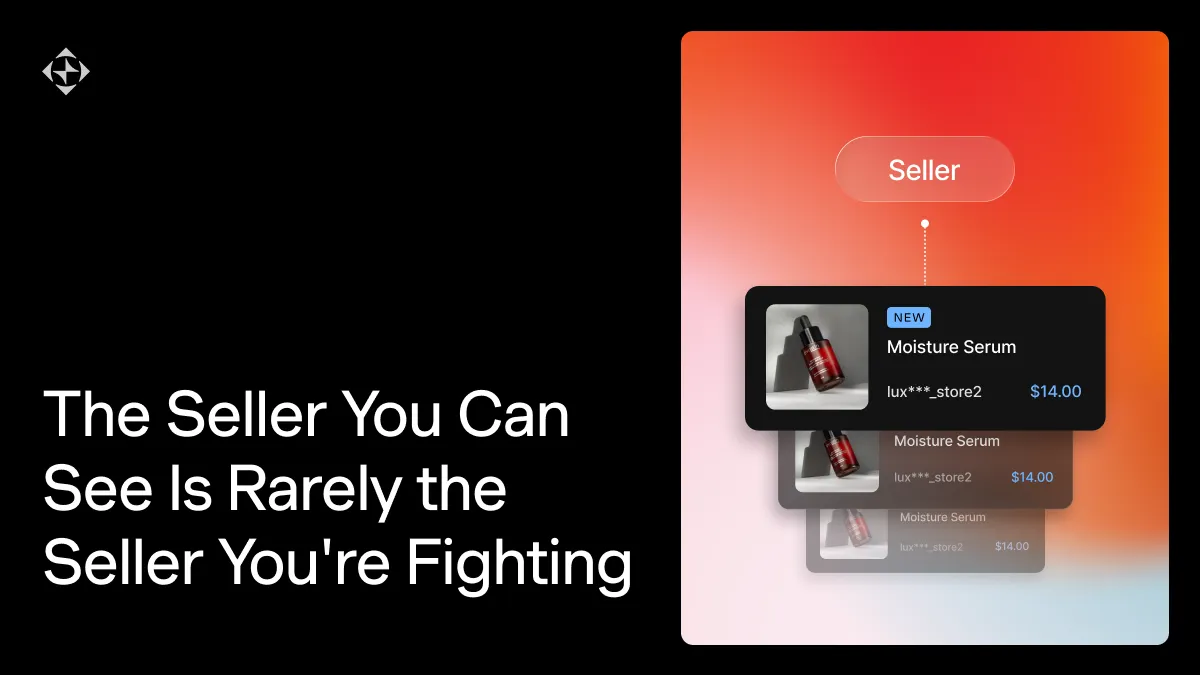
Counterfeits surge after you go viral: brand protection in the era of the AI tax
Why do counterfeits surge after a product goes viral? The Op Games case and the 2026 State of Brand Integrity Report on leaking results and brand protection.
 Jinie Park4 min read

On this page5
Going viral usually happens without warning. One day search volume explodes, inventory sells out fast and your marketplace ranking shoots up.
Every metric points to success. But you’re not the only one watching that data. Counterfeiters monitor it in real time too. Products with soaring search volume, items that hit No. 1 in their category, brands mentioned again and again on social media: to counterfeiters, these are proven profit models.
Going viral proves the demand, and that proof is a signal to copy. From that point, counterfeit listings start spreading at once across global marketplaces such as Amazon, Temu, TikTok Shop, Alibaba, Coupang and Naver.
How generative AI speeds up the spread of counterfeits

Counterfeits used to take time to appear. Someone had to get product photos, write descriptions, set up a store and translate everything.
Now it’s a completely different story. In just a few minutes, generative AI can:
- Rewrite product descriptions
- Mimic a brand’s tone and style
- Rework images
- Generate listings in multiple languages
The cost of copying has dropped to almost zero. The demand a brand creates through marketing is still there, but counterfeits and impersonator accounts now absorb it before it can convert through official channels.
This is where results leak away, and where the AI tax kicks in.
Counterfeit risk that came with success: The Op Games

The Op Games grew explosively after going viral on TikTok.
Sales jumped in a short time from about 40,000 units a year to more than 1.4 million, the company hit No. 1 in Amazon’s board game category, and months of inventory sold out in two weeks.
Every metric pointed to success, but counterfeit listings surged at the same time.
On Temu, just five counterfeit listings sold 17,000 units in 30 days, eating up about $375,000 (about 500 million won) in sales: around 15% of the SKU’s monthly revenue.
Counterfeits spread as fast as the success did. But after the company adopted MarqVision’s AI-based automated counterfeit detection, things changed.
Detections grew from an average of about 500 a year to an average of about 500 a week, response became 10 times faster than with competitors, and the company recovered 15% of lost revenue.
In just one month, counterfeit listings dropped noticeably.
Counterfeits aren’t a legal problem. They’re a revenue stability problem
Many organizations still file counterfeit response under legal or operations. The reality is different: the impact of counterfeits goes well beyond illegal distribution.
Counterfeits:
- Eat directly into sales
- Fill the gap when you’re out of stock
- Drag down ratings and search rankings
- Lower marketing ROI
That makes it a revenue stability problem. According to the upcoming 2026 State of Brand Integrity Report, 89% of brands have already experienced AI-driven threats, and 78% estimate that 5% or more of their annual revenue is being eroded.
Growth still matters. But now brands also have to manage where the results of that growth end up.
What brands need to keep their results after going viral

Going viral is clearly an opportunity. But a viral moment left uncontrolled becomes a risk. So the question is:
When your next viral moment hits, can your brand hold on to the results and turn them into lasting success?
The key to managing brand results in the AI era is turning counterfeit response from a cost into a revenue protection engine. The 2026 State of Brand Integrity Report, out next week, goes deeper into the leaking results and the AI tax covered here.
It covers how AI accelerates the spread of counterfeits, a framework for designing brand protection ROI, strategies for shifting performance metrics toward revenue, and real examples from global brands.
Pre-register for the report now and be the first to get it.
FAQ: responding to counterfeits after viral success

Q1. Why do counterfeits increase so quickly after a product goes viral?
Going viral means demand has already been proven. Rising search volume, climbing rankings and sold-out inventory act as low-risk market signals for counterfeiters. Add generative AI, and listings are copied and spread far faster than before.
Q2. Why are counterfeits no longer just a legal issue?
Counterfeits aren’t simply an illegal distribution problem. They’re a financial issue that eats into revenue and lowers marketing efficiency. That’s why brand protection should be treated as a strategic priority tied directly to revenue stability.
Q3. What matters most when responding to counterfeits after going viral?
Speed and accuracy. Manual monitoring alone can’t keep up with how fast a viral moment spreads. To keep results from leaking away, you need AI-based automated detection and enforcement that scales.