.jpeg)
Your dashboard count goes from a manageable dozen listings to several hundred overnight, then several thousand by the end of the week. The product photos you commissioned last season now appear under unauthorized brand names on marketplaces you don't monitor, linked to domains registered three days ago, promoted through ads you never approved. This is the inflection point every brand protection team remembers: the moment abuse stops being containable and shows up everywhere.
One network runs the marketplace storefront, the lookalike domain, the social media ad, and the supply chain that keeps restocking no matter how many posts you pull down. Your enforcement program probably runs three or four separate vendors: one for marketplaces, one for domains, one for social takedowns. Each vendor sees its channel, bills for its removals, and reports takedown volume that tells you nothing about whether the operation actually stopped. Once counterfeits and impersonation cross every channel you sell through, partial coverage cannot stop the network. Your budget splits across contracts that each see only their own slice, while the operation moves freely between them.
TLDR:
- Counterfeit networks run one operation across marketplaces, domains, social ads, and supply chains simultaneously.
- Fragmented programs with 3-5 separate vendors each report takedown volume but none can see the full seller network.
- Takedown count is the wrong KPI; saturation rate and marketplace cleanliness measure what buyers actually see.
- Replacing removal activity with outcome metrics lets your CFO and General Counsel defend the budget.
- MarqVision reports removing 60 million+ infringements at a 99.1% verified takedown approval rate, per 2025 internal data.
The Inflection Moment
There is a day every brand protection team remembers. You log into the dashboard expecting the usual short list of flagged listings, and instead the count has jumped from a dozen to several hundred. By the following week, it reads in the thousands. The same product photography you shot last season now sells under names you never authorized, on marketplaces you barely monitor, through ads pointing at domains registered three days ago.
That count is the moment brand abuse stops behaving like a nuisance. Counterfeit listings divert revenue you forecasted. Fake storefronts erode the trust your customers placed in your name. Impersonated domains pull phishing traffic that lands, eventually, in front of your legal team and your board.
You already know this moment, because you have lived some version of it. The real question is what you do when abuse stops being occasional and becomes the norm.
Why Brand Abuse Sprawls Across Every Channel
A counterfeit operation is rarely one seller with one listing. The same network runs an impersonation storefront on one marketplace, buys fake ads across social channels, registers lookalike domains, and recruits buyers through group chats and live commerce streams. Trace the inventory back far enough and it ends at a physical supply chain that keeps shipping no matter how many listings you pull down.
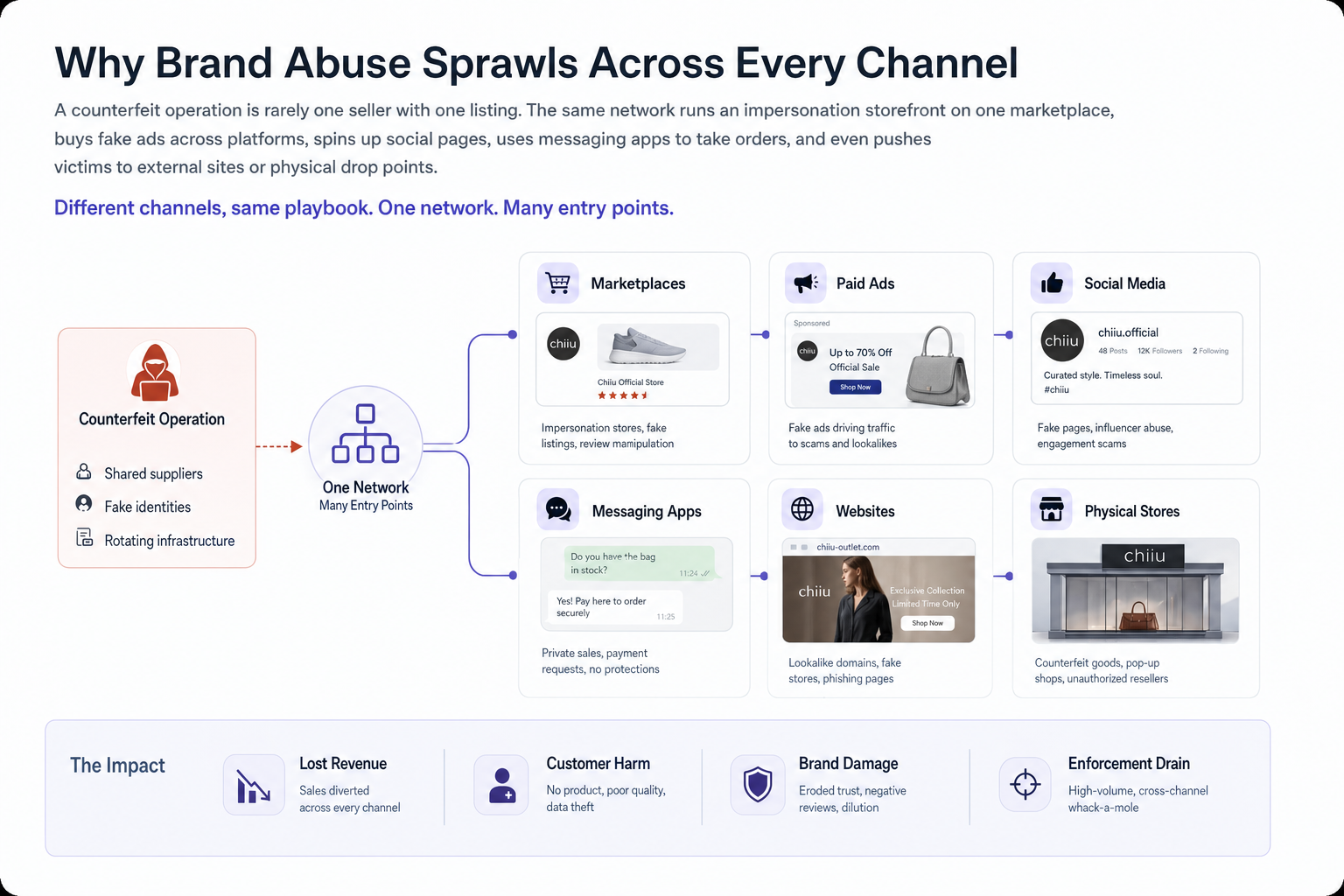
Generative AI made all of this cheaper to reproduce. Cloning your product photography, your logo, your packaging copy, and an entire storefront once demanded time and money. Now it takes a prompt. As of 2025, an estimated 74% of new web pages use AI, and impersonation incidents have tripled year over year. High-profile cases like Lafufu vs Labubu show exactly how fast counterfeit networks spin up near-identical products under a slightly different name. The same seller who loses a marketplace listing on Monday registers a lookalike domain by Wednesday and runs social ads pointing to it by Thursday. Each channel hop looks like a new incident to the team watching it; to the operator behind it, it is the same business with a new front door.
That sprawl is why single-point tools fall short. A domain monitor watches domains. A marketplace tool watches marketplaces. Each one covers a sliver, and the abuse keeps migrating into the gaps between them.
Two Faces of the Same Network
The two enforcement problems most teams treat as separate budgets share the same operators. Pull the threads and they connect.
Anti-Counterfeit: Marketplaces at SKU and Seller Level
Removing a fake listing accomplishes little when the seller opens three more by Friday. Effective marketplace enforcement maps the operation, not the post. We classify listings against genuine product data at the SKU level, then cluster the sellers behind them using shared phone numbers, addresses, and listing patterns, so the same actor relisting under a fresh account gets caught as a repeat offender instead of a new incident. The scale is brutal: according to the OECD global counterfeit trade report, counterfeits are spread across millions of listings on Amazon, Alibaba, Temu, and regional marketplaces, backed by networks built to outpace any one-listing-at-a-time response.
Anti-Impersonation and Digital Risk: Domains, Phishing, Brand Spoofing
The same network selling fakes also registers lookalike domains, clones your checkout page to harvest credentials, and buys impersonation ads across social channels. The pattern is consistent: a domain registered to mimic your brand at checkout funnels real customer payment data to the same operator running the fake storefront. A social ad spoofing your promotions drives traffic to that domain. Your customers lose money, and the incident lands in your legal queue under a different case number than the marketplace complaint filed the same week. Most brands route this to a separate vendor with a separate contract. The bad actors are the same; the masks change by channel. Treating them as separate problems means you pay twice and still only see half the picture.
The Cost of Fragmentation
Run the math on a fragmented program and the waste shows up fast. You sign a marketplace vendor, a domain monitor, a social takedown service, sometimes a separate anti-piracy tool, and each one bills you to watch a single channel of a problem that moves freely across all of them. Three to five contracts, three to five dashboards, and not one of them sees the whole operation. Still shaping your program? The brand protection guide maps out what a unified program should cover before you commit to another contract.
No vendor holds the full seller network, so nobody can tell you the Temu seller, the lookalike domain, and the Instagram ad trace back to one operator. Each reports its own scorecard: takedown volume. Removing 50,000 listings looks productive on a slide, yet says nothing about whether your category got cleaner or your revenue came back.
Online removals stop at the screen. The factory keeps shipping, the operator opens a fresh account, and tomorrow's listing fills the slot you cleared today.
The 360° Answer: One System, Online to Offline
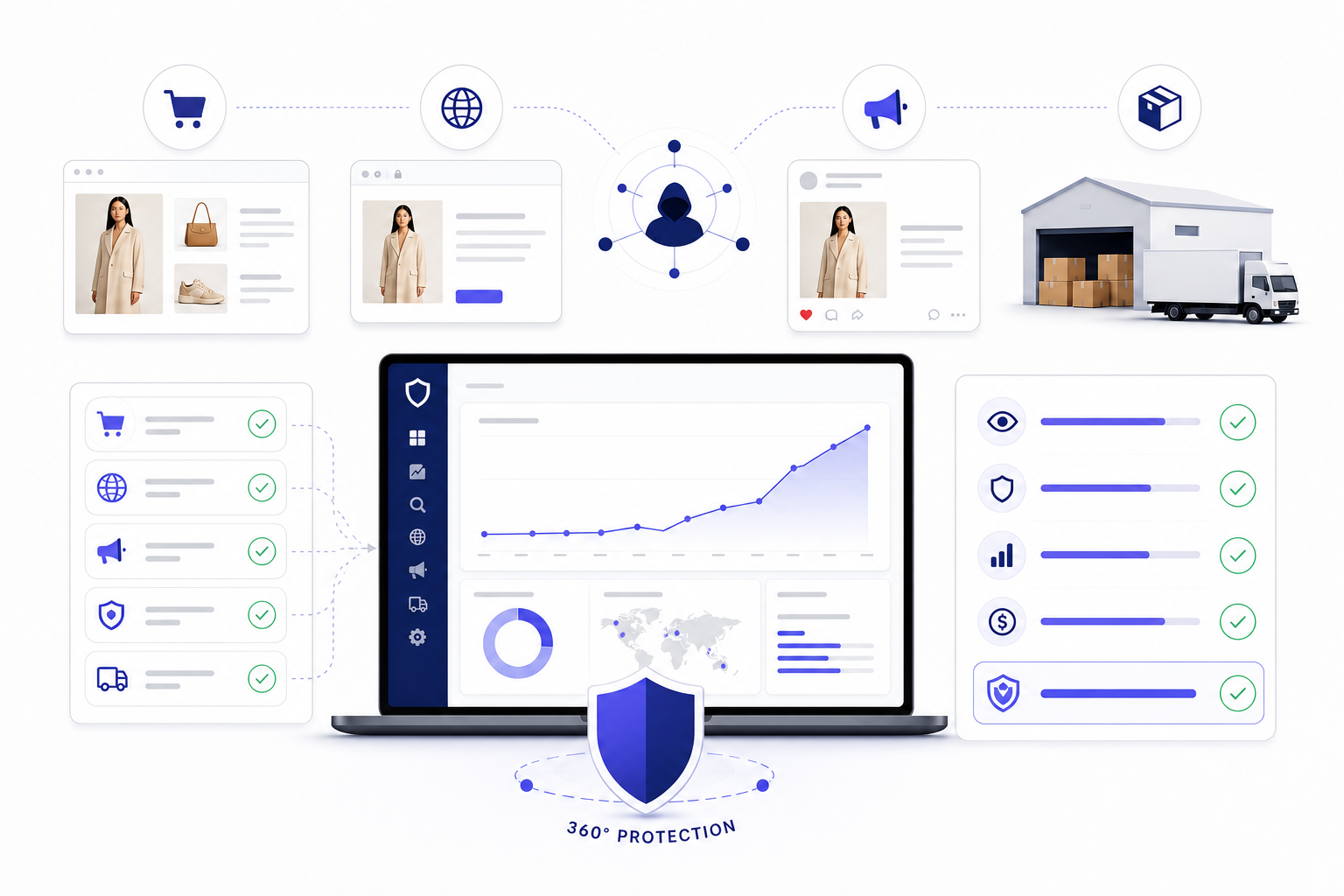
The fix is structural. One system runs anti-counterfeit, digital risk protection, anti-piracy, and gray market monitoring together, with trademark management and offline legal enforcement through MarqLaw on the same rails. All of it runs on a single data foundation, the Brand Ontology, which maps your sellers, SKUs, and IP rights so enforcement across every channel draws from the same source of truth.
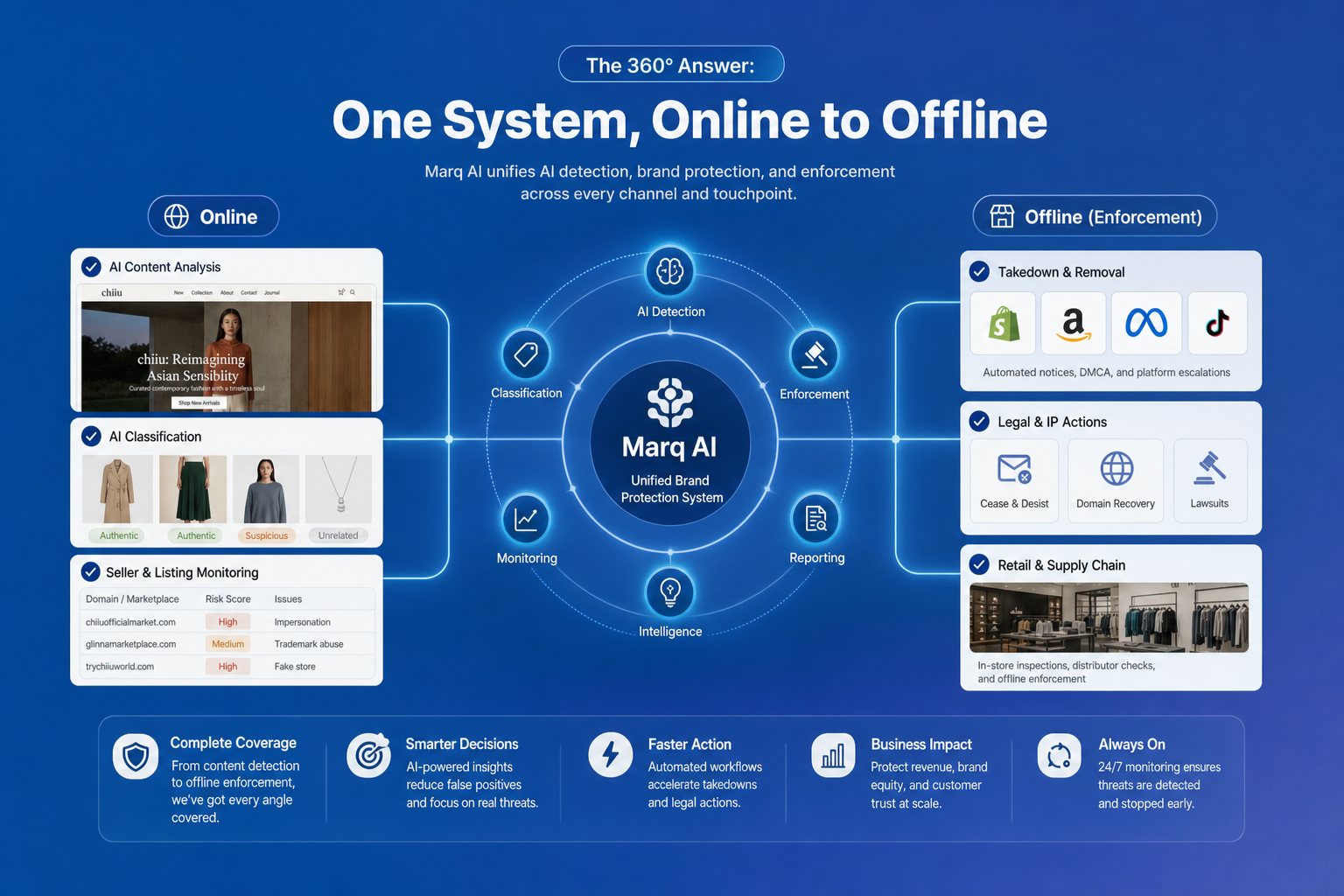
That shared map is what lets us trace a seller network back to its source and act offline: UDRP filings, civil litigation, criminal raids, and on-the-ground enforcement across Asia, where most counterfeits are made.
The results speak plainly. According to our 2025 internal data, we removed over 60 million infringements at a 99.1% verified takedown approval rate, hit takedown speeds up to 180x faster on newer channels, and helped a global CPG brand with $8B in annual revenue cut marketplace saturation by 20 percentage points in under eight months.
Reframe the KPI: From Activity to Outcomes
Takedown volume tells your board nothing it can act on. The metrics that hold up in a budget meeting measure the field a buyer actually sees: saturation rate, marketplace cleanliness, revenue recovered, and how fast a threat dies after detection. Understanding brand protection ROI means shifting from activity counts to outcomes your finance team can verify.
Saturation rate measures what share of active listings for your category or SKU belong to unauthorized sellers. If you pull down 10,000 listings but new ones fill the same search results page within days, your saturation rate holds flat and the buyer searching your brand name never noticed the difference. Marketplace cleanliness asks the same question from the shopper's side: when someone searches your brand, how many of the results are yours? Both numbers translate directly to revenue at risk and category control, which makes them far more defensible in a budget conversation than a removal count.
MarqVision reports a 20x improvement in saturation rate against legacy vendors, and customers typically recover 5 to 10 percent of annual revenue within twelve months. Those are figures your CFO and General Counsel can defend.
When Abuse Is Everywhere, You Need 360° Control
When abuse has spread across every channel you sell through, adding another point tool closes one gap while the operation continues running through other gaps. The real decision is whether to keep paying for partial coverage or move to protection that runs online and offline, end to end. Start by quantifying your true exposure with a Brand Exposure Report, then decide where to act.
Final Thoughts on Closing the Coverage Gaps
You already know the counterfeit seller, the phishing domain, and the fake ad trace back to one operation, but your vendors can't see past their own dashboards. The same network you paid to remove last quarter just opened three new storefronts this week. Request a Brand Exposure Report to quantify what's actually running under your brand across every channel, then build a case your finance team can defend.
FAQ
When brand abuse spans marketplaces, domains, and social ads simultaneously, should you expand your vendor roster or consolidate into one program?
Consolidate. Separate vendors each see one channel, report their own takedown volume, and none can trace the Temu seller, the lookalike domain, and the Instagram ad back to a single operator, so the network stays intact while your budget fragments. A unified program running anti-counterfeit, digital risk protection, and gray market monitoring on a shared data foundation lets enforcement follow the operator across channel hops instead of treating each hop as a new incident.
What is saturation rate, and why does it matter more than takedown count for measuring brand protection performance?
Saturation rate measures what share of active marketplace listings for your category or SKU belong to unauthorized sellers, what a buyer actually sees when they search your brand. Takedown count tells you how many listings were removed; saturation rate tells you whether the search results page got cleaner. If new listings fill the same slots within days of removal, your count climbs while saturation holds flat, and your finance team has no defensible figure to work with. Saturation rate and marketplace cleanliness convert directly to revenue at risk, which makes them the metrics your CFO and General Counsel can actually act on.
How does MarqVision's SKU-level detection catch counterfeit sellers that relisting under fresh accounts would otherwise evade?
MarqVision's Full-Stack Detection compares each listing against genuine product data at the individual SKU level (not just brand name or logo matching) and then clusters the sellers behind flagged listings using shared phone numbers, addresses, and listing patterns. When the same operator opens a new storefront after a takedown, the seller graph identifies them as a repeat offender rather than a new incident, so enforcement targets the network rather than the individual post.
Can digital-only enforcement stop a counterfeit operation, or does it always require offline action to shut the supply chain down?
Digital enforcement removes listings and domains, but the factory keeps shipping and the operator opens a fresh account unless the supply chain itself is disrupted. For operations with persistent relisting patterns, where the same seller clusters reappear within days of removal, offline action through UDRP filings, civil litigation, criminal raids, or on-the-ground enforcement in source markets is what closes the gap between listing removal and actual network shutdown.
How do I build a budget case for 360° brand protection when my current vendors already report high takedown volumes?
Reframe the KPI before presenting numbers: takedown volume measures activity, not outcomes, and boards cannot act on it. Pull your saturation rate, marketplace cleanliness score, and revenue recovered figures instead, as these translate directly to dollars your finance team can verify. A worked formula: Annual Revenue x Counterfeit Leakage Rate x Recovery Percentage gives a recoverable revenue figure that holds up in a CFO conversation. MarqVision's Brand Exposure Report quantifies your actual cross-channel exposure in dollars within three business days, giving you the baseline figure before you build the case.
Stay up to date on the latest IP Protection content from MarqVision.



4 Enforcements a Week to 400: Scale Brand Safety with Marq AI

Don’t Just Find Counterfeits. Dismantle the Entire Network.

.png)
Discover the latest trends and challenges in IP protection

Take Control of Your Trademarks with MARQ Folio
Renew and Manage Your Trademarks Easily With MARQ Folio

We’re waiting to hear from you

See the best brand protection solution in action

Don’t let piracy steal your growth

Talk to us about your brand protection problems