How AI has changed brand protection strategy
Legacy brand protection can't keep up with smarter bad actors. See how AI takes brand protection beyond counterfeit monitoring to a broader, more effective strategy.
 Irene Lee4 min read

On this page4
From simple counterfeit detection to tailored monitoring, automated processes and AI-driven analysis
Finding and removing thousands of counterfeit listings used to be considered enough to protect a brand. That’s no longer the case.
Bad actors keep getting smarter. They use new software, AI tools, upgraded tactics and hidden channels to slip past simple data detection and keep selling counterfeits. Traditional IP infringement detection struggles to stop these more complex schemes. Brands that don’t evolve their protection strategy risk far more serious IP infringement.
Detecting infringement at scale was once the core of brand protection. Now it matters more to anticipate bad actors’ tactics and stay ahead of them. In this post, we analyze how bad actors’ patterns have changed and show how advanced AI monitoring and seller network analysis address IP infringement, offering a strategic way to stay a step ahead of evolving tactics.
How bad actors have changed, and where traditional detection falls short

Removing counterfeit listings in bulk doesn’t, on its own, deliver real value to a business. Taking down thousands of listings can look like an impressive result at first, but if counterfeits of the same brand reappear and keep selling, the number means little. It’s just whack-a-mole against listings that keep coming back.
How bad actors use new technology to sell counterfeits
Bad actors are used to relisting counterfeits after they’re removed. With new photos and AI-written product copy, they keep listings alive longer and post them on several marketplaces at once. Traditional detection is losing its effect, and repeatedly removing listings doesn’t solve the problem.
Without a deep understanding of bad actors, their networks and their environment, or a faster and more efficient brand protection solution, brands will stay exposed to IP infringement.
Using AI to identify and stop fast-changing bad actors
An AI-based multi-modal decision-making framework analyzes every element of a potentially infringing listing, taking in text, images, logos, product pages and product names together. That raises detection accuracy while cutting the time and cost of enforcement, which strengthens brand protection.
With AI-based seller network analysis built in, brands can analyze bad actors’ behavior patterns and efficiently detect infringement across countries and platforms.
More efficient brand protection with advanced AI
Detecting infringement at scale increases the burden on brands to review every listing. The more listings are detected, the harder it can be to focus on the enforcement that matters.
Fully automated detection may look like the answer to that review burden, but it carries the risk of false positives. For example, wrongly flagging and taking action against an official seller who hasn’t infringed can do serious damage to a brand’s credibility.
Advanced AI is being adopted to overcome these limits. It makes brand protection more efficient and effective in three ways.
1. Prioritizing low-risk and high-risk infringement
: AI can sort out listings with a low likelihood of infringement and focus brand protection resources on high-risk listings. It assesses each listing’s risk based on past detection data and successful enforcement cases, and keeps learning over time, so it becomes more precise.
2. Predicting the financial losses caused by bad actors
: AI predicts the financial loss a particular bad actor could cause and analyzes potential outcomes, such as the chance of recovering losses through legal action. That helps companies make more efficient decisions and saves the time and money brand protection requires.
3. Intelligent assistant: AI-driven decision support
: A dashboard that visualizes AI-suggested decisions makes the analysis easy to review. It filters out detection errors and lets users assess high-risk infringement against the brand’s own criteria. AI quickly handles work that lawyers and IP protection experts used to spend hours reviewing, so decisions come faster. But because AI can still mistake an official seller for a bad actor, a final review by an expert remains necessary.
How bad actors sell counterfeits across multiple channels

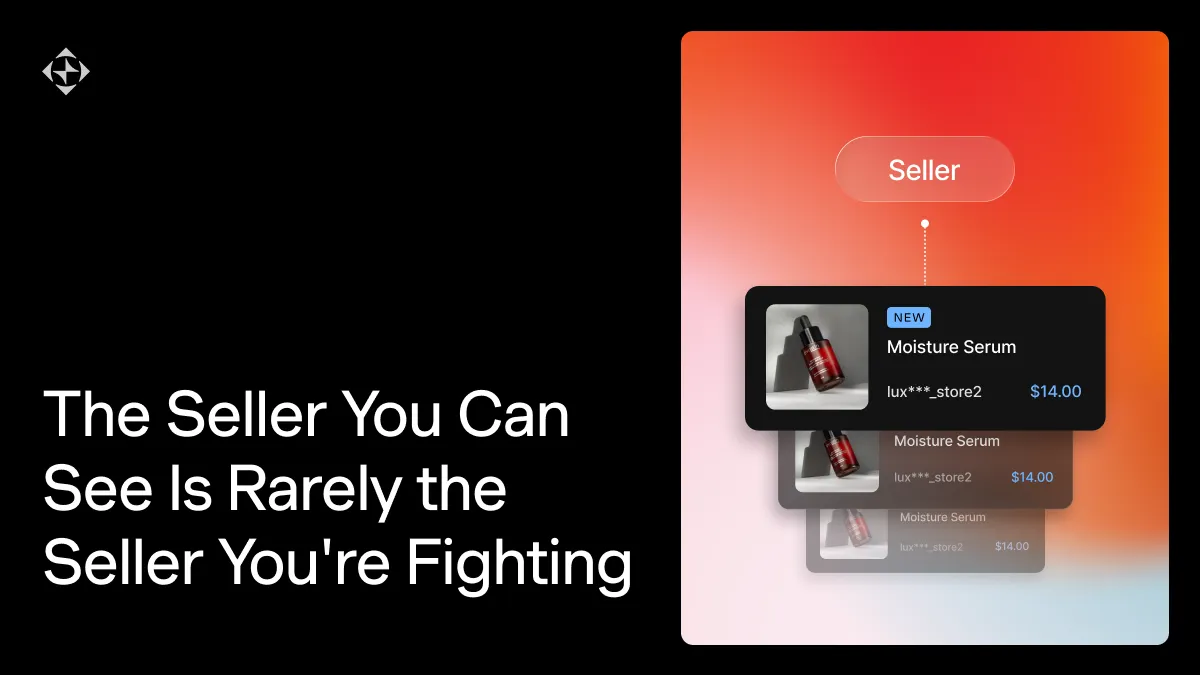
Bad actors hide behind anonymous accounts and sell fakes across platforms, accounts and countries, operating as if they were unconnected individual sellers. In particular, they use social channels like TikTok to advertise counterfeits and steer shoppers to other websites or apps to buy. This multi-channel approach makes listings hard to track and enforce against.
Traditional IP monitoring tends to focus on a single marketplace or platform, which limits how well it can see the overall strategy of bad actors operating across many channels. AI is essential to keep up with their increasingly sophisticated tactics. AI-based seller network analysis and predictive analysis can reveal links between platforms, and map networks among sellers that appear unrelated.
Trained AI models help group bad actors scattered across platforms and uncover hidden networks. That lets brands target not just individual listings but a bad actor’s entire network, removing counterfeit listings on multiple platforms at the same time.
This network-centered approach greatly improves detection. By identifying bad-actor networks and acting quickly, brands can move before consumers ever see the counterfeits, and hit counterfeit supply chains harder.
A new kind of brand protection solution
In recent years, counterfeit sellers have become more sophisticated and better at evading traditional detection. Large-scale detection and removal of counterfeit listings was once an effective strategy, but on its own it’s no longer enough. Bad actors use new channels to build their own networks and run complex operations.
Brands need a new solution that focuses on high-risk infringement and analyzes the seller networks behind it, to address the root cause. Using advanced AI to anticipate bad actors’ moves and respond a step ahead is essential. Removing listings isn’t enough. What matters is understanding the full landscape of infringement and responding quickly and accurately.
The success of brand protection will depend on how well brands use precise detection, automated processes and network analysis. With AI-based solutions, brands can stay strategically ahead of bad actors in an increasingly complex online environment and keep their products and value safe.
MarqVision was the first in the industry to adopt generative AI, which lets us monitor social channels and new marketplaces that were previously hard to cover, in real time. Advanced AI automates the drafting and sending of warning letters and reports for IP enforcement, and we provide a dashboard tailored to each brand. Explore the features that fit your brand and build a strategy for responding effectively to IP infringement.