From counterfeit detection to your brand's Saturation Rate: everything Marq AI shows you
Counterfeits keep coming back. How should you respond? The Marq AI counterfeit dashboard handles detection, enforcement and results analysis in one place.
 Irene Lee4 min read

On this page5
As global e-commerce grows rapidly, IP problems are becoming more complex. In this blog series, the product managers who build Marq AI explain the problems it solves and where it’s heading.
This post is based on an interview with Jay, who leads MarqVision’s counterfeit product.

In this interview
1. Why we built it
2. Key features
3. Challenges in the design process and how we solved them
4. Where we’re heading
Why we built the Marq AI counterfeit dashboard
As global e-commerce grows fast, counterfeiting has become far more complex and widespread than before. Problems used to center on China-based marketplaces. Now they’re spreading to markets worldwide, including the US, Europe and Southeast Asia. And as social media and live-stream shopping spread, counterfeit sales channels have moved beyond online marketplaces to a range of social platforms, making detection and enforcement even harder.
The biggest problem is that counterfeit listings reappear faster than they can be detected and removed. When a brand enforces manually in-house, removing a single listing takes more than 30 minutes, and another listing pops up right after. The cycle repeats.
The Marq AI Counterfeit feature was designed to overcome this structural limit. It doesn’t stop at detection: it’s built around automation and AI-driven analysis for fast enforcement, so brand teams can get out of repetitive work and focus on a more strategic response.
Key features of the Marq AI Counterfeit dashboard
Q: Was there a customer request that made you think, “We have to solve this,” or did you define the problem internally first?
One of the hardest things for brand managers enforcing against counterfeits was that it was hard to see results in numbers and use them strategically. Internally, too, we planned and kept refining features around one question: “How can we show brands real, ROI-based value?”
The result is the Counterfeit dashboard. The Marq AI counterfeit dashboard is designed to help brands quantify the threats they face and build an effective response strategy on that basis. The key point is features that let teams go beyond looking at data and connect it to strategic decisions.
Reports are also generated automatically from detected counterfeit listings and can be submitted straight to platforms, which has sped up response dramatically. Teams no longer have to check each listing and write reports by hand, so they can work far more efficiently, and brands can take down more threats, faster.
1) AI-based counterfeit detection
We used to judge whether something was counterfeit only from the product page information in a listing. Now AI also analyzes the text inside images, so it can judge far more precisely. That lets us catch details that are easy to miss.
2) Automated report drafting (FSD)
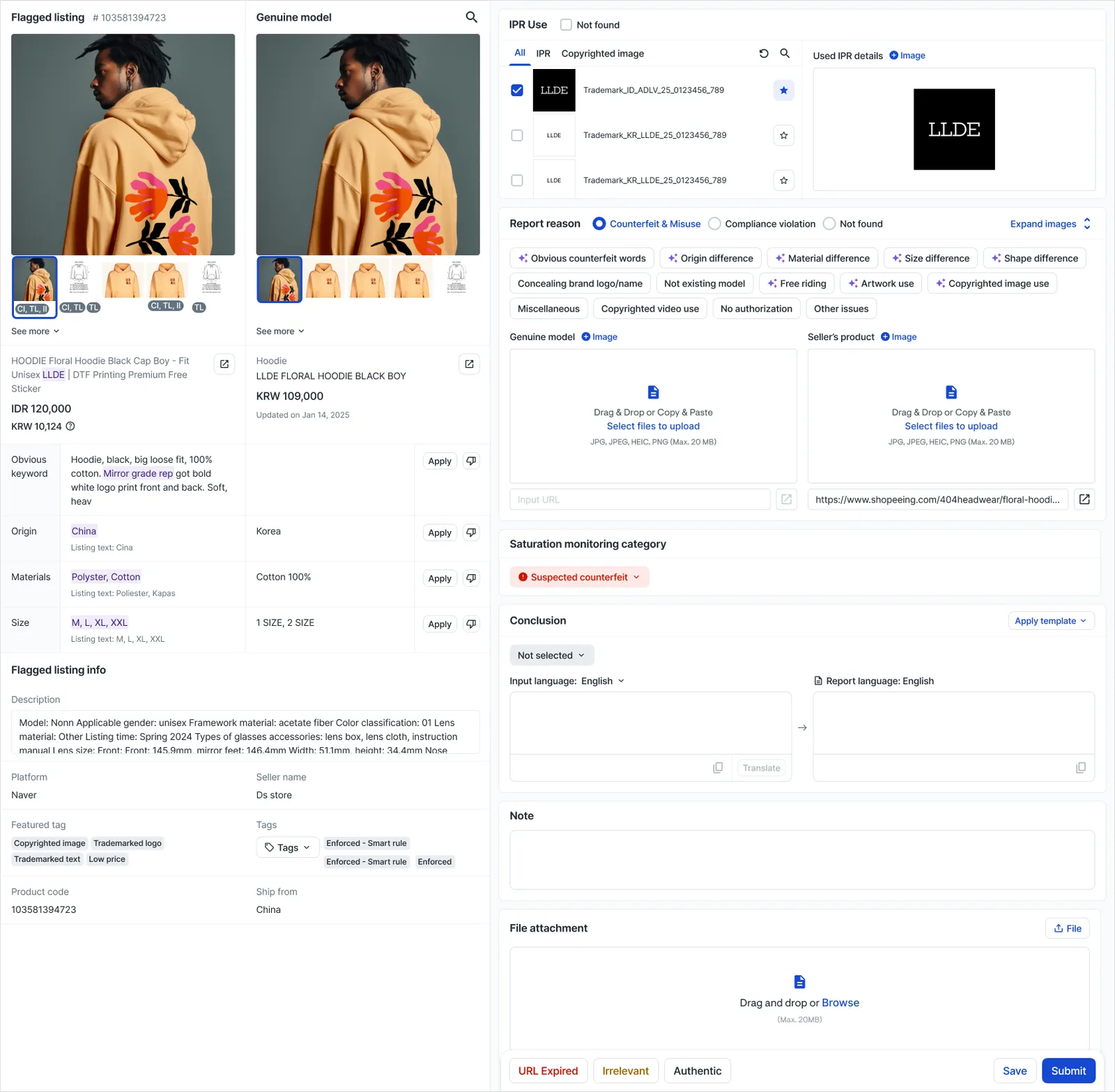
We recently enhanced automated reporting with LLMs. It compares genuine and fake products on details such as words that signal a counterfeit, place of manufacture, materials and size, and puts that analysis straight into the report, so response is faster and more efficient than when people write reports themselves.
3) Enforcement performance dashboard
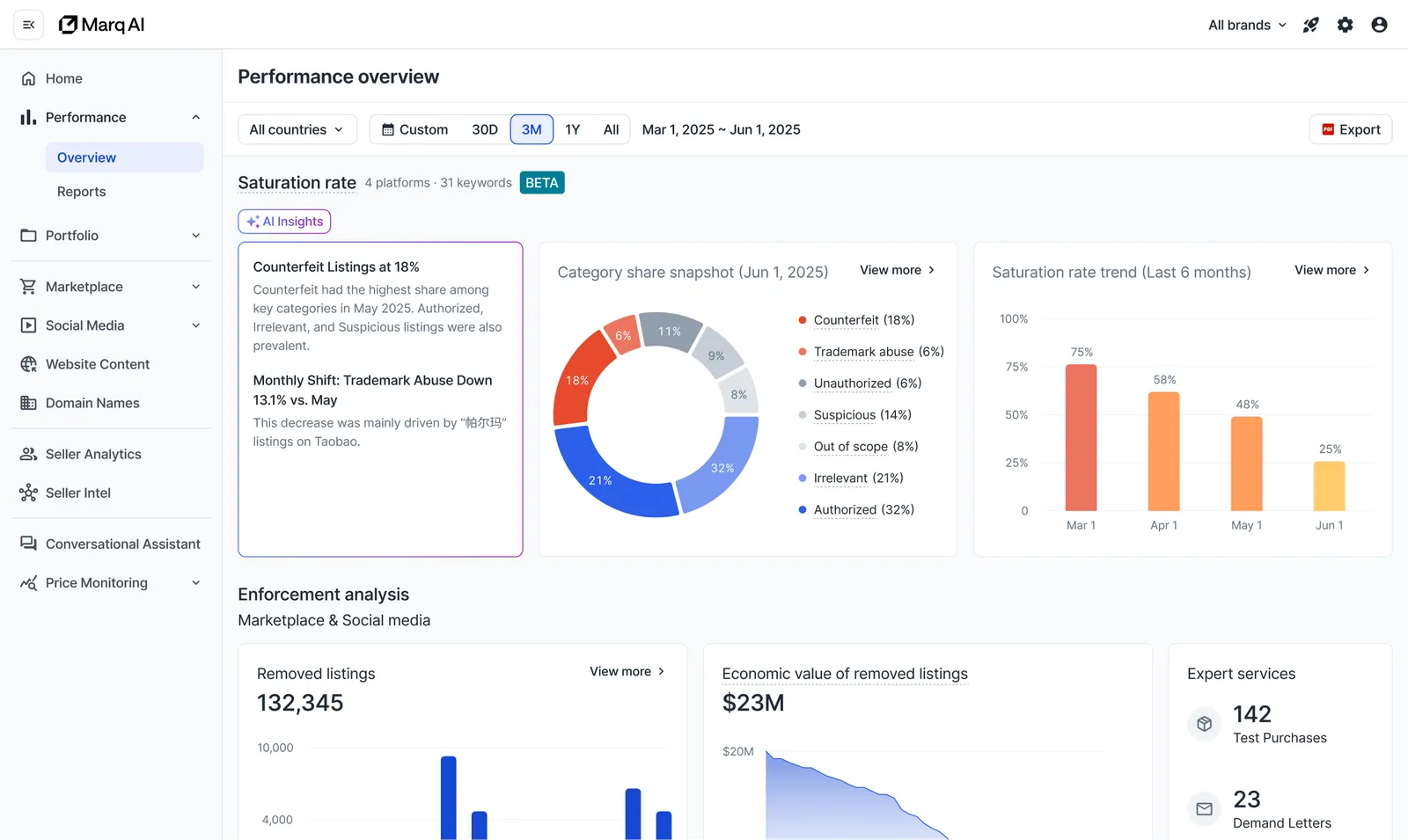
The dashboard shows, in real time, enforcement results, the number of listings removed, the estimated economic value and seller analysis at a glance.
Frequency by country and platform also makes clear where risk is actually concentrated. In one case, a brand manager expected China to be the worst, but the higher threat turned out to be on Southeast Asian platforms.
The recently introduced Saturation Rate, a market risk index, goes beyond counting removals. It visualizes, as a number and a trend, how risky an environment the brand is exposed to.
Brand managers used to have to piece together fragmented data to estimate their brand’s level of risk. Now, with the Marq AI Counterfeit dashboard, they can see the riskiest regions, channels and sellers at a glance.
Q: What changes will brand managers notice with these features?
First, because they can see at a glance where risk is concentrated, they can immediately set priorities for which listings or sellers to tackle first.
Second, because we provide quantified performance metrics, they can clearly explain how effective their brand protection strategy has been, and its ROI.
Above all, with repetitive, time-consuming report writing and enforcement automated, the burden on teams drops sharply. They can focus more on the strategic decisions that matter.
Challenges in the design process and how we solved them
Q: What was the hardest part of planning and building the dashboard and the monitoring and enforcement features?
We ran into two big challenges.
The first was that counterfeiting looks different in every industry. In fashion, sizing and printing problems are common; in jewelry, materials and plating; in beauty, ingredients and altered packaging. Even within the same industry, each brand’s problems differ a little. So we put a lot of work into a customized learning loop that reflects each customer’s data and feedback, so the AI can properly learn these differences.
The second was that bad actors and shopping patterns change very quickly. Global marketplaces such as AliExpress and Shopee used to be the main platforms, but counterfeit sales are now spreading through social media and live streaming. To keep up, we collect feedback from our operations team and customers and are expanding step by step, up to live-stream monitoring.
Q: So how are you tackling these problems?
Not everything is solved yet, but when we train our AI models we focus on consistently feeding in customers’ real data and feedback from the field. That’s how the models get more precise over time.
When we develop new features, we also keep a structure for actively collecting internal and external feedback. Internally, the operations team and IP experts are often the first to spot new tactics from bad actors and flag them. For example, the old approach was “post a photo and a price, and buy by DM.” Lately, tactics have evolved to skip DMs entirely and send buyers straight to an outside website link, or to sell through live streams that leave no trace. We share these trends quickly and build them into the product.
Customers give us a lot of feedback too. Questions like “We’re seeing signs of sales in live streams lately. Can you detect that?” or “Can you monitor this channel too?” have turned into real feature upgrades. In the end, our customers and we are building up data and experience together, making the response system stronger and stronger.

Where we’re heading
Q: Is there a feature you haven’t built yet but really want to add, or something you’d like to improve based on customer feedback?
The Marq AI Counterfeit feature is evolving beyond finding and removing fakes into a solution that supports customers’ business strategy. We want to focus on three directions.
The first is customized AI models. Every brand faces different types of IP threats. The problems a fashion brand faces are completely different from a beauty brand’s, and there are differences even within the same industry. So we’re modularizing AI models for each situation, based on customers’ data, to catch signs of infringement more precisely.
Next is detection that mimics consumer behavior. Until now, detection has meant mechanically searching for and flagging listings. Going forward, we’re designing an AI agent that follows a real shopper’s journey: which search terms they enter, which product descriptions they click, how they move through recommendation algorithms. The goal is detection that’s “close to reality.”
Finally, live streaming and customized data classification. This is what customers ask for most these days. Counterfeiting is now active not only on online marketplaces but on channels such as social media and live streams. So we’re extending monitoring to these channels. We’re also preparing to go beyond simply saying “this is fake / not fake,” breaking down and classifying data by each customer’s own criteria so they can use it directly for strategic decisions.
In the end, our goal is clear: to turn counterfeit enforcement from a cost into an investment. Not just enforcement, but a tool for building strategy on data and protecting brand value. That’s the picture Marq AI is working toward.

A word for brands struggling with counterfeits
Q: Is there anything you’d like to tell brands coming to the Counterfeit dashboard and features for the first time?
Anyone who has dealt with counterfeits knows that removing a few listings doesn’t solve it. They come back as soon as you remove them, and faster every time. So it’s becoming really important to stop working listing by listing and look at sellers and networks instead.
The Saturation Rate, performance metrics and seller-level insights in Marq AI are designed to help with exactly that. Instead of ending with a report that says “we removed this many,” you can see which seller groups are the biggest threat and which markets are riskiest right now. Then brand managers no longer have to respond blindly. They can enforce strategically, setting priorities and using resources efficiently.
There’s one thing we want to stress: counterfeit enforcement is an investment, not a cost. It can go beyond reducing fakes to become a long-term strategy for protecting brand value and improving ROI. As a partner leading that shift, Marq AI will keep building more precise IP protection solutions together with our customers.